
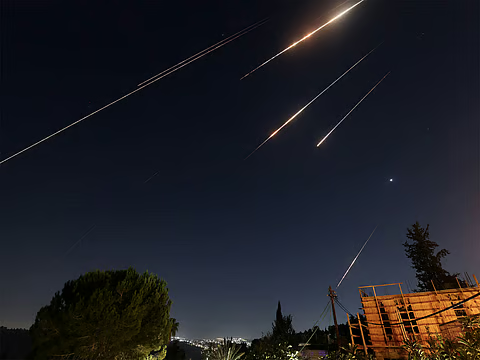

Saudi Arabia has warned Yemen’s Houthi rebels of a firm response after missile and drone attacks wounded 13 civilians in the kingdom’s south.
The latest strikes have further escalated fighting between the Houthis and Saudi-backed Yemeni government forces. The renewed conflict comes as wider regional tensions continue to disrupt key shipping routes and energy supplies.
The Houthis claimed they launched a large-scale attack on the King Khalid Air Base in Khamis Mushait using dozens of ballistic missiles and drones.
Houthi Attacks Target Southern Saudi Arabia
The Saudi-led coalition confirmed missile and drone attacks on Khamis Mushait, Abha and Taif.
Officials said the attacks wounded 13 people. Saudi Arabia then responded with more than 50 strikes, according to Houthi sources.
The coalition vowed to respond firmly to protect the kingdom.
It said it would take “all necessary operational measures to deter this… hostile and extremist approach”.
A resident of Khamis Mushait described hearing “intense blasts” that caused fires to burn for a long time.
“Honestly, we couldn’t sleep at all,” the resident said.
Saudi civil defence authorities also issued air-raid alerts across six regions early Tuesday before lifting them.
Houthis Vow to Escalate Fighting
Houthi officials said their attacks would continue as long as Saudi Arabia maintains military operations against them.
Houthi politburo member Hazem al-Assad said, “the Yemeni response will continue and escalate as long as they (Saudi Arabia) persist in their aggression against our people”.
The escalation follows renewed fighting in Yemen after the civil war reignited in July.
The Houthis have also targeted Saudi oil infrastructure. The attacks have added pressure to global energy markets as oil prices remain above $100 a barrel.
Meanwhile, a Houthi strike in western Yemen reportedly killed eight government soldiers on Monday.
Red Sea and Bab al-Mandab Tensions
The Houthis have expanded their control along Yemen’s Red Sea coast and the Bab al-Mandab Strait, a strategically important shipping route.
The group has also declared a maritime blockade against Saudi Arabia and targeted ships in the Red Sea.
The developments have become even more significant as the wider US-Iran conflict continues to disrupt shipping through the Strait of Hormuz.
At the same time, Gulf states and Iran postponed planned talks concerning the future of Hormuz.
Tehran accused Riyadh of using the Yemen conflict as a reason to delay the meeting.
Iran Denies Direct Control Over Houthis
Iran has long supported the Houthis through weapons and technology. However, analysts continue to debate the extent of Tehran’s role in the group’s latest offensive.
Iranian Foreign Ministry spokesman Esmaeil Baqaei rejected claims that Tehran controls Houthi decisions.
“Iran does not interfere in Yemeni affairs,” he said, describing the Houthis as “entirely independent actors who make their decisions based on their own interests”.
Meanwhile, the wider regional conflict remains at a stalemate.
US President Donald Trump said Monday that Washington remained open to talks with Iran.
“The failing Nation of Iran wants to make a deal, quickly and badly. I will determine whether or not the U.S.A. will choose to engage — The concept of which we are open to,” Trump said.
Iran’s top security chief Mohsen Rezaei rejected the possibility of immediate negotiations.
“There will be no negotiations until Iran’s conditions are met. That is all there is to it,” he said.
Yemen Fighting Forces Thousands From Homes
The latest escalation has added to Yemen’s already severe humanitarian crisis.
Yemeni government forces recently claimed they recaptured positions in Taiz province and killed at least 10 Houthi fighters.
Saudi Crown Prince Mohammed bin Salman also met US Central Command chief Admiral Brad Cooper in Jeddah to discuss regional developments.
The Houthis seized Yemen’s capital Sanaa in 2014, forcing the internationally recognised government to move to Aden.
Saudi Arabia later led a coalition intervention in support of the government. Years of fighting and airstrikes turned Yemen into one of the world’s worst humanitarian crises.
The UN’s migration agency said the renewed fighting has already forced 93,864 people to flee their homes, highlighting the growing human cost of the latest escalation.
For the latest updates, visit and follow The Truth International website (www.thetruthinternational.com) and subscribe to the YouTube Channel.

