
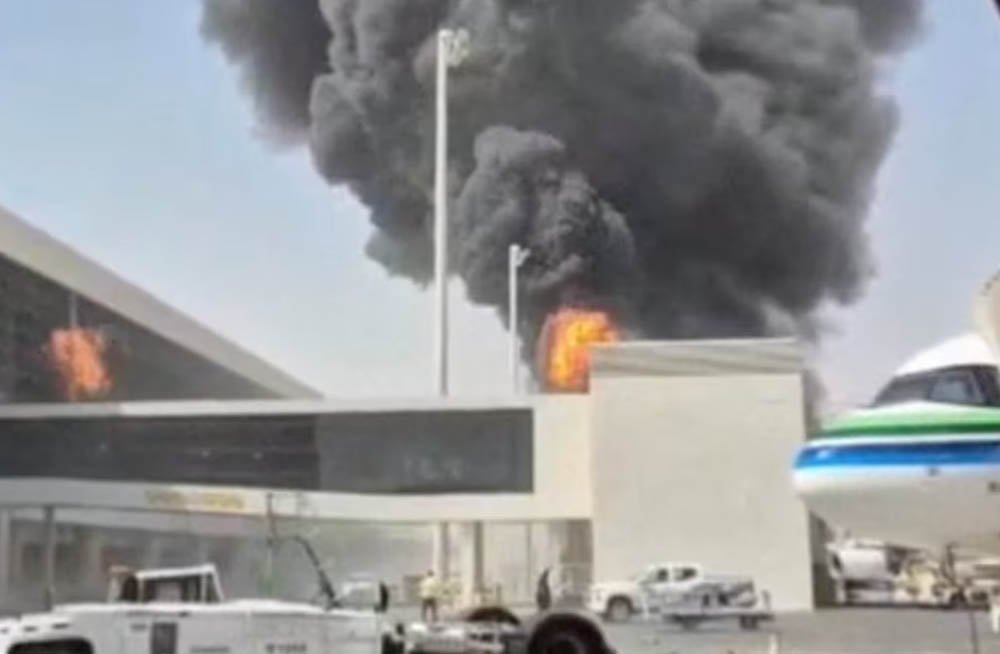

Saudi Arabia faced another security scare on Sunday after a fresh Houthi strike hit King Khalid International Airport in Riyadh. The incident followed a deadly attack a day earlier that killed at least a dozen people and disrupted airport operations.
The latest strike has intensified concerns over the security of Saudi Arabia’s critical infrastructure. Meanwhile, the Iran-backed Houthi group claimed responsibility for multiple attacks across the kingdom over the previous 24 hours.
The Saudi-led coalition fighting the Houthis reported that a projectile struck the airport and sparked a fire. It also said air defences intercepted a missile nearby. However, Saudi civil aviation authorities reported an unspecified number of injuries and began assessing the damage.
Residents and journalists in Riyadh reported hearing several explosions on Sunday. One resident of the Al-Aarid neighbourhood described the impact of the blasts.
“The birds went into a frenzy after the sound. The whole house shook,” the resident said.
Houthi Attacks Escalate as Riyadh Airport Faces Repeated Strikes
The latest incident follows a deadly attack on Saturday that killed at least 12 people, according to the initial report. The attack marked a major escalation in the conflict involving Saudi Arabia and Yemen’s Houthi movement.
The Houthis have increasingly targeted Riyadh’s airport and other important facilities in the world’s leading crude oil exporter. Three people also died in an attack on the airport on Thursday, according to the report.
Despite Saudi Arabia’s substantial military spending, the repeated incidents have raised questions about its ability to prevent every missile and drone attack.
Security analyst Thomas Juneau of the University of Ottawa explained the challenge facing Saudi defences.
“Saudi air defences have been able to intercept some Houthi missile and drone attacks, but Saudi Arabia is so large that it’s simply impossible for them to consistently defend themselves against Houthi attacks,” he said.
The anti-Houthi coalition condemned Saturday’s attack as a “full-fledged war crime” and vowed to “respond decisively”.
Meanwhile, Houthi media reported two Saudi strikes in Yemen’s Houthi-controlled Sanaa governorate on Sunday. The latest developments indicate a further escalation in the conflict, although details surrounding some military claims remain difficult to verify independently.
Airport Closure Disrupts Flights and Damages Infrastructure
The attacks forced authorities to suspend operations at King Khalid International Airport. According to aviation sources, the closure continued into Sunday as officials assessed the damage.
Flight-tracking service Flightradar24 reported that the shutdown had been extended until 2100 GMT. A second aviation source said operations would remain suspended “until further notice”.
The source also reported damage to radar and communications equipment. Authorities needed to assess the runways before determining when airport operations could resume.
The Saudi civil aviation authority confirmed injuries from the latest incident but did not immediately provide a specific number. Officials also began evaluating the extent of the damage.
Witnesses described scenes of panic following Saturday’s attack. A 32-year-old Riyadh resident recalled seeing injured passengers fleeing Terminal 3.
“People who were in Terminal 3 started running towards us,” the resident said.
“Some had lost a hand or an arm. People were running while carrying injured people, covered in blood.”
A medical source said health officials activated an unusual mass call-up of doctors to respond to the casualties.
Foreign Nationals Among Those Killed and Injured
The civil aviation authority identified victims from several nationalities following Saturday’s attack. Four Saudi citizens, two Bangladeshis, one American, one Egyptian, one Jordanian, one Syrian, one Palestinian and one Sudanese were among those killed.
Authorities reported 309 wounded. In addition, the Indian embassy in Saudi Arabia confirmed that an Indian citizen died on Sunday after sustaining injuries the previous day.
However, a Western diplomat based in Riyadh questioned whether the official injury figure captured every casualty. The diplomat suggested that people with minor injuries might not have been included.
The scale of the incident prompted several foreign missions to issue security warnings. The US, Canadian, German and Spanish embassies advised their citizens to avoid Riyadh airport.
Australia also urged its citizens to remain indoors and “shelter in place” on Sunday.
The Houthis further claimed that they had targeted Dammam airport. Its official website showed numerous delayed arrivals and departures on Sunday.
International Leaders Condemn the Attack
Saturday’s strike drew condemnation from the United Nations and leaders across the world. US President Donald Trump said he was considering joining Saudi strikes against the Houthis.
Israeli Prime Minister Benjamin Netanyahu also denounced the attack, describing it as a “horrific terrorist attack”. Saudi Arabia and Israel do not maintain diplomatic relations.
The attack occurred shortly before Saudi Arabia’s high-profile convention and entertainment season. October also marks the beginning of the busy Umrah season, when millions of Muslims travel to Mecca from around the world.
Consequently, prolonged disruption at Riyadh airport could create additional challenges for travellers if airport operations remain affected. However, the report did not establish how long the latest closure would last.
Why Are the Houthis Targeting Saudi Arabia’s Airports?
Saudi Arabia has led an international coalition supporting Yemen’s internationally recognised government militarily since 2015. The coalition has also sought to control Yemeni airspace and restrict access to Sanaa airport, which remains under Houthi control.
According to Juneau, the Houthis want to change the strategic balance by applying pressure on Saudi Arabia’s own transport infrastructure.
“They want to do to Saudi Arabia what Saudi Arabia does to them,” he said. “So if their airport in Sanaa has to be closed because of the Saudi air embargo, they want to do the same thing to Saudi Arabia.”
The Houthis described Saudi transport hubs as “a theatre of operations for our forces” and threatened to continue targeting them.
Their approach raises concerns about the vulnerability of civilian aviation facilities during the conflict. Repeated attacks could also disrupt travel and place additional pressure on regional security arrangements.
Fighting Continues Near a Key Shipping Route
Meanwhile, military sources reported that Saudi-backed Yemeni government forces were advancing against the Houthis near the Bab al-Mandab Strait. The strategic waterway serves as an important route for international shipping.
The Houthis, however, claimed to have repelled the government forces’ counter-offensive. Independent verification of both sides’ battlefield claims remained difficult because the situation was changing rapidly and journalists faced limited access.
The latest airport strike adds another dimension to the widening confrontation. As Saudi Arabia assesses the damage and reviews its security response, the repeated attacks highlight the continuing risks to civilian infrastructure and regional transport networks.
For the latest updates, visit and follow The Truth International website (www.thetruthinternational.com) and subscribe to the YouTube Channel.

