

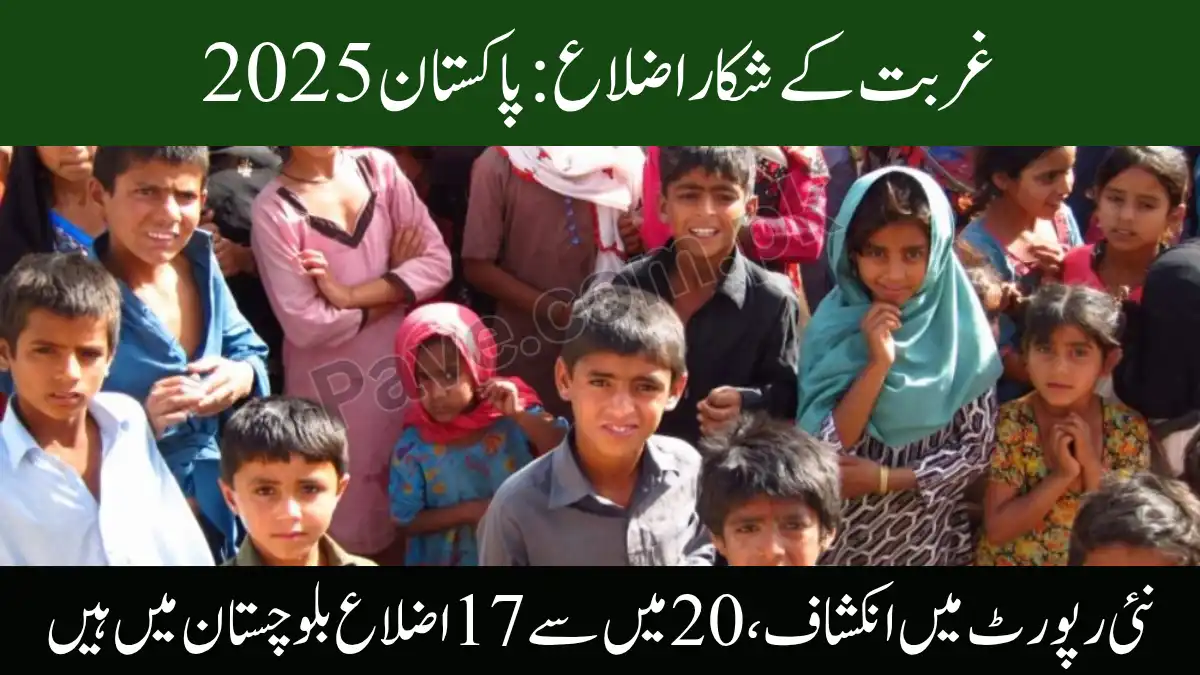

A new report by the Population Council reveals that 17 of Pakistan’s 20 most deprived districts are located in Balochistan, highlighting the province’s deep and persistent development challenges.
These districts face severe shortages of essential services, widespread poverty, and deteriorating infrastructure. Among the worst affected are Washuk, Khuzdar, Kohlu, Zhob, Dera Bugti, Mashkhel, Qila Saifullah, and Kalat, which consistently rank lowest in access to health, education, economic opportunities, and basic living conditions.
In Khyber Pakhtunkhwa, Kohistan and North Waziristan are identified as the weakest-performing districts, while Tharparkar remains the most deprived in Sindh. In contrast, 13 of the 20 most prosperous districts are in Punjab, with Balochistan absent from the list altogether, underscoring stark provincial inequalities.
More than 10 million people living in the 17 poorest districts lack basic facilities. Employment opportunities are extremely limited, with 15 of the 20 districts with the worst job prospects located in Balochistan.
Both Balochistan and KP report the highest rates of unemployment and unpaid household labour. Housing conditions are particularly alarming: 65 percent of households live in mud or temporary structures, and half lack toilets.
Access to clean drinking water is unreliable, with 40 percent of residents unable to obtain safe water. In Jhal Magsi alone, 97 percent of families live in mud or semi-constructed homes, and many households comprise only a single room.
Poor road networks, limited transportation, and weak telecommunications systems further isolate communities, making healthcare delivery challenging. In many remote areas, residents must travel over 30 kilometres to reach basic medical services.
Education access is similarly unequal; Karachi has the highest number of schools, while Balochistan has the fewest, and girls in rural districts face the greatest barriers to attending secondary schools.
The report warns that rapid population growth is worsening deprivation. Large family sizes strain already limited resources, reducing access to healthcare, education, and clean water, and pushing vulnerable districts further into poverty.
