

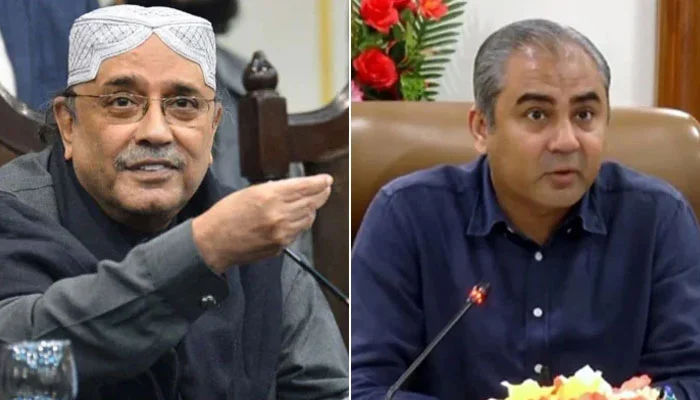

President Asif Ali Zardari has appointed Interior Minister Mohsin Naqvi to mediate between the Pakistan Muslim League–Nawaz (PML-N) and the Pakistan Peoples Party (PPP) in an effort to resolve growing tensions within the ruling coalition. The decision follows a series of verbal exchanges between leaders from both parties, particularly over issues related to governance and inter-provincial criticism.
According to official sources, Mohsin Naqvi will meet Prime Minister Shehbaz Sharif to discuss the situation and seek his support in de-escalating friction between the two allies. The meeting, scheduled for Wednesday, is aimed at preventing further strain on the coalition government, which has faced internal challenges in recent weeks.
Rising Strains Within the Coalition
The tension between PML-N and PPP deepened when PPP leader Raja Pervaiz Ashraf staged a walkout from the National Assembly session, announcing that his party would boycott proceedings until the Punjab government clarified its ministers’ remarks about Sindh.
These remarks, viewed as politically charged, were interpreted by the PPP as an attack on the Sindh government’s performance. The incident exposed widening cracks in the coalition that brought the PML-N back to power earlier this year.
Sensing the divide, Pakistan Tehreek-e-Insaf (PTI) leader Asad Qaiser offered the PPP his party’s support to bring a no-confidence motion against the federal government. “If the PPP is serious, they should move a no-confidence motion, and we will back it,” Qaiser said, adding that PTI was ready to “help topple the government” in Islamabad.
Palwasha Khan: ‘PPP Is Not Your Slave’
Amid the ongoing tensions, PPP leader Palwasha Khan strongly criticized the PML-N’s approach towards its coalition partner. Speaking at a press conference in Islamabad, she stated that the PPP’s cooperation should not be mistaken for subservience.
“The **People’s Party is not your [PML-N’s] slave. An alliance does not mean slavery,” she asserted. Khan reminded the PML-N that the federal government exists today due to the PPP’s parliamentary support.
She accused the Punjab government of targeting the Sindh administration to indirectly criticize the federal leadership, particularly Prime Minister Shehbaz Sharif. “The Punjab government does not like seeing Shehbaz Sharif on the prime minister’s seat,” she remarked.
Criticism Over Punjab–Sindh Rift
PPP leaders have been vocal about Punjab Chief Minister Maryam Nawaz’s remarks concerning flood relief efforts, the Benazir Income Support Programme (BISP), and water-sharing projects. The PPP contends that such comments undermine inter-provincial harmony and violate the spirit of cooperation essential to federal governance.
Palwasha Khan clarified that PPP’s criticism of Punjab’s leadership was not directed at the people of Punjab but at the provincial government’s policies. “Get used to being asked questions and take criticism positively,” she said. “We do not want to respond in the same tone you are using.”
She also emphasized that the PPP will continue to raise concerns about Punjab’s governance, insisting that the PML-N does not represent the entire province.
Zardari’s Role as Mediator
President Asif Ali Zardari, known for his behind-the-scenes political maneuvering, has stepped in to prevent the coalition from fracturing. His decision to involve Interior Minister Mohsin Naqvi reflects a broader effort to restore trust and communication between the two major coalition partners.
Naqvi, a former caretaker chief minister of Punjab, is considered a neutral figure who maintains working relationships with leaders from both parties. His mediation will focus on identifying points of agreement and reducing public confrontation that could damage the government’s image.
Coalition Stability at Stake
Political analysts suggest that maintaining coalition stability is critical for the government’s survival, especially amid pressing economic challenges and ongoing governance reforms. A public split between the PML-N and PPP could weaken the administration’s legislative agenda and embolden opposition forces.
Zardari’s decision to intervene underscores the urgency of preserving the alliance that secured parliamentary majority earlier this year. The coming days will be crucial in determining whether dialogue can ease tensions or if the coalition will continue to struggle with internal dissent.
As Pakistan’s political landscape remains volatile, the outcome of Naqvi’s mediation may define the future of the PML-N–PPP partnership and the government’s ability to sustain stability in the months ahead.
