

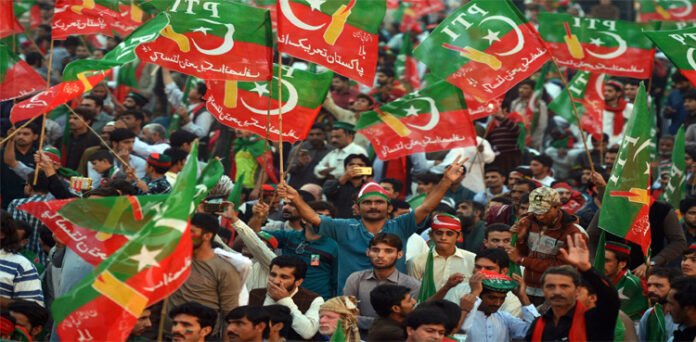

PTI Protests
ISLAMABAD: As Pakistan Tehreek-e-Insaf (PTI) sets the stage for a renewed anti-government movement expected to peak by August 5, a recent Gallup Pakistan survey offers a revealing look into public sentiment across Khyber Pakhtunkhwa (KP).
Conducted between February and March 2025 with a sample size of 3,000 respondents, the province-wide poll shows that while KP residents remain politically aware, the overwhelming majority prefer collaboration with the federal government over participating in protest campaigns.
According to the findings on Tuesday, 85% of KP respondents voiced strong support for the provincial government’s cooperation with federal authorities to foster development and improve governance. In stark contrast, only 10% opposed this cooperative stance, and 5% did not provide a response.
Significantly, this pro-cooperation sentiment cut across political lines, with 86% of PTI supporters, 93% of PML-N voters, 87% of JUI-F backers, and 86% of ANP affiliates endorsing federal collaboration.
Despite this, the survey uncovered a nuanced public view on political protests. While 53% of participants rejected the idea of attending future PTI-led protests, 40% expressed willingness to participate, and 7% remained undecided. Past protests also received mixed reviews—60% of respondents believed such demonstrations had distracted from effective governance, while 32% supported them and 8% offered no opinion.
Interestingly, 60% still viewed protests as a legitimate way to pressure the federal government for change, highlighting a populace that values activism as a secondary strategy rather than a first response.
Public perception of leadership also reflected divided opinions. Half of KP residents rated Punjab Chief Minister Maryam Nawaz’s performance as superior to KP Chief Minister Ali Amin Gandapur’s. Surprisingly, even among PTI voters, 37% said Maryam had outperformed Gandapur. When asked about replacing Gandapur, 47% were in favor, while 40% wanted him to remain in office and 13% remained neutral.
The survey also revealed critical views on the government’s performance in key areas. Around 53% of respondents expressed dissatisfaction with the lack of effective anti-corruption measures, while 49% were unhappy with unemployment levels. On the positive side, 47% approved of the government’s job-creation efforts.
In terms of public services, satisfaction rates were relatively higher for health facilities (64%), clean water access (64%), and educational services (62%). However, dissatisfaction remained notable at 34% for healthcare, 35% for water, and 36% for education.
When reviewing PTI’s 13-year tenure in KP, a majority reported visible improvements in infrastructure—59% in roads, 53% in public transport, and 50% in sanitation. Yet, there was growing frustration post-2024 elections, with 54% claiming no new developmental projects had been initiated.
Gaps in basic amenities were also highlighted. A staggering 81% of respondents were unhappy with the availability of public libraries, 77% with parks, 70% with community centers, and 66% with gas supplies. These deficiencies were particularly pronounced in southern districts such as Dera Ismail Khan, which continues to trail behind in facility access.
In summary, the Gallup survey paints a picture of a politically aware KP populace—one that prioritizes development and pragmatic governance over confrontation, yet remains ready to raise its voice when necessary. As the PTI prepares for its upcoming protest campaign, these insights may significantly shape the political narrative and strategies in KP moving forward.
