

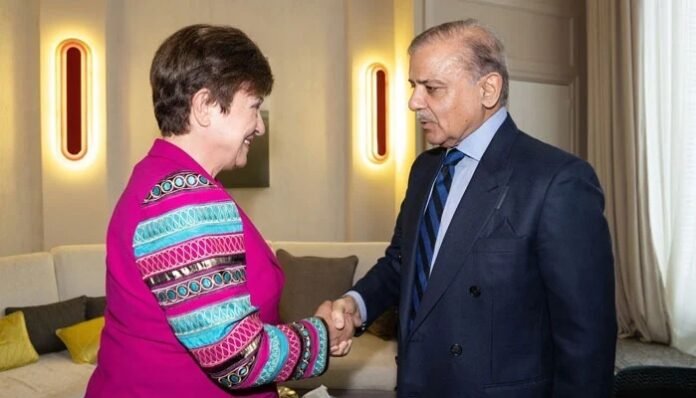

Prime Minister Shehbaz Sharif is set to meet International Monetary Fund (IMF) Managing Director Kristalina Georgieva in Dubai on Tuesday, just three weeks before the expected start of review talks for the $1 billion second tranche of Pakistan’s loan agreement.
Government and diplomatic sources informed that the meeting will take place on the sidelines of the World Government Summit in Dubai, with Pakistan requesting the session.
This marks the third meeting between PM Sharif and Georgieva in the last 10 months. The prime minister arrived in the UAE on Monday for a two-day official visit to attend the summit, which brings together global heads of state, policymakers, and private sector leaders to discuss governance, innovation, and international cooperation.
PM Sharif is accompanied by a high-level delegation, including Deputy Prime Minister Ishaq Dar and other key cabinet members. Finance Minister Muhammad Aurangzeb, who is currently in Lisbon, Portugal, has been asked to join the meeting upon his return.
While the specific purpose of the meeting remains unclear, it comes just three weeks before the scheduled first programme review of the $7 billion IMF deal. Neither the IMF nor Pakistan’s Ministry of Finance have commented on the upcoming meeting.
In September, PM Sharif and Georgieva met on the sidelines of the United Nations General Assembly in New York, where the IMF expressed support for Pakistan’s economic stabilization efforts and highlighted the importance of macroeconomic stability and sustainable growth.
The high-level meeting occurs amid domestic pressures on PM Sharif’s government. The real estate sector has lobbied for tax reductions, and the business community is urging the government to foster economic growth. However, the prime minister has postponed decisions on whether to cut income taxes for the real estate sector or abolish federal excise duties, instead forming a cabinet-led task force to recommend tax relaxations. Meanwhile, Pakistan’s salaried class continues to face hardships due to inflation, rising living costs, and heavy taxation, with no task force formed to address their concerns.
Additionally, teachers have protested the government’s decision to remove a 25% income tax rebate and recover arrears dating back to July 2022.
The IMF review talks are scheduled to begin from March 3 to 14 in Islamabad. Finance Minister Muhammad Aurangzeb confirmed that talks will start in the first week of March, with hopes for successful negotiations, especially after the introduction of Agriculture Income Tax legislation in Sindh and the resolution of gas pricing for power generation plants.
Pakistan has met key conditions related to maintaining a primary budget surplus, cash surplus, and increased provincial taxes. However, concerns remain over the performance of the Federal Board of Revenue (FBR) in the upcoming review talks. Other outstanding issues include amendments to the Pakistan Sovereign Wealth Fund Act, though officials are optimistic about a successful outcome.
In addition, an IMF Mission on Governance and Corruption Diagnosis Assessment is currently in Pakistan. It recently held meetings with the Financial Monitoring Unit and the Money-Laundering and Combating of Financing of Terrorism Authority, and is scheduled to meet with the Supreme Court and Judicial Commission of Pakistan later this week.
Following this assessment, a follow-up mission may visit in April to finalize recommendations. The IMF’s final report will be published in July, and any new recommendations could add additional conditions to the existing 40 requirements Pakistan must meet to secure the full $7 billion loan over the next three years.
