

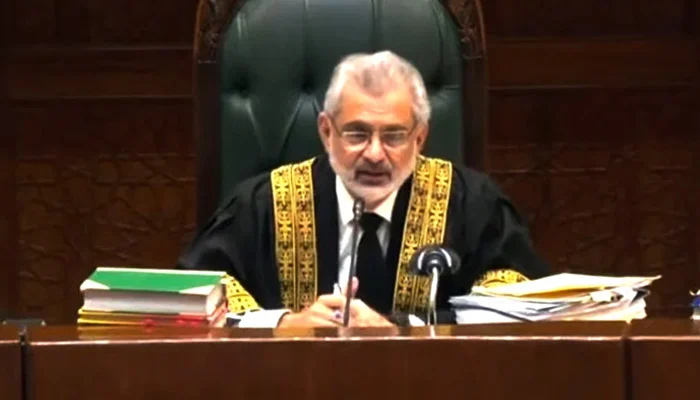

ISLAMABAD: The hearing of a series of petitions challenging the Supreme Court (Practice and Procedure) Act 2023 could not reach a conclusion on Monday. CJP Faez Isa, the presiding judge, announced that the remaining lawyers would have their turn for arguments tomorrow (Tuesday) at 11:30 am.
The law required committee of three senior judges of the court to form benches on constitutional matters of public importance.
CJP Isa headed the hearing, which began shortly after 9:30 am. The court live-streamed it on television. The bench consisted of Justice Sardar Tariq Masood, Justice Ijazul Ahsan, Justice Syed Mansoor Ali Shah, Justice Munib Akhtar, Justice Yahya Afridi, Justice Aminuddin Khan, Justice Sayyed Mazahar Ali Akbar Naqvi, Justice Jamal Khan Mandokhel, Justice Muhammad Ali Mazhar, Justice Ayesha A Malik, Justice Athar Minallah, Justice Syed Hasan Azhar Rizvi, Justice Shahid Waheed, and Justice Musarrat Hilali.
Tomorrow (Tuesday), lawyers representing the Jamaat-e-Islami and Muttahida Qaumi Movement-Pakistan will present their arguments.
Lawyer confronts CJP
On Monday, a full court bench of the SC took up the Practice and Procedure bill case, and during the hearing, a lawyer confronted Justice Qazi Faez Isa over his ‘attitude’ after the judge refused to hear him.
While Justice Isa was conversing with Attorney General Mansoor Awan, who was already on the rostrum, lawyer Imtiaz Siddiqui approached and stood next to him. The chief justice informed Siddiqui that he had already completed his arguments. However, Siddiqui persisted in trying to speak.
The chief justice, frustrated with the interruption, requested Siddiqui not to interrupt and attempted to address the attorney general once again. Despite this, Siddiqui cut across him, claiming it was ‘unfair’ and mentioned that the judge had previously promised to hear him after the attorney general.
Tense Exchange in Court Hearing
When the judge asserted that his arguments had already been heard, Siddiqui persisted, insisting that he was factually incorrect and urging him not to make false claims. He also cited another lawyer, Khawaja Tariq Rahim, who had refused to appear in court because the CJP had been ‘unkind’ to him, suggesting that the judge’s own attitude was not appropriate.
The chief justice responded by telling Siddiqui not to argue on behalf of someone who was not present in court. Siddiqui mentioned that Rahim was his colleague and had instructed him to bring this up in court.
However, the chief justice retrieved the written order from the last hearing, affirming that all judges had signed it. He read aloud the part that mentioned, “Mr. Imtiaz Rashid Siddiqui states that he does not want to add anything further and that his written submissions may be read.”
Following this, the chief justice instructed Siddiqui to sit down and began addressing lawyer Zayed Ibrahim. Siddiqui attempted to interrupt again, stating he wanted to ‘protest.’ The chief justice responded sternly, telling him to take his seat before he issued something, which prompted Siddiqui to finally move away.
