


Iran’s Nuclear Program
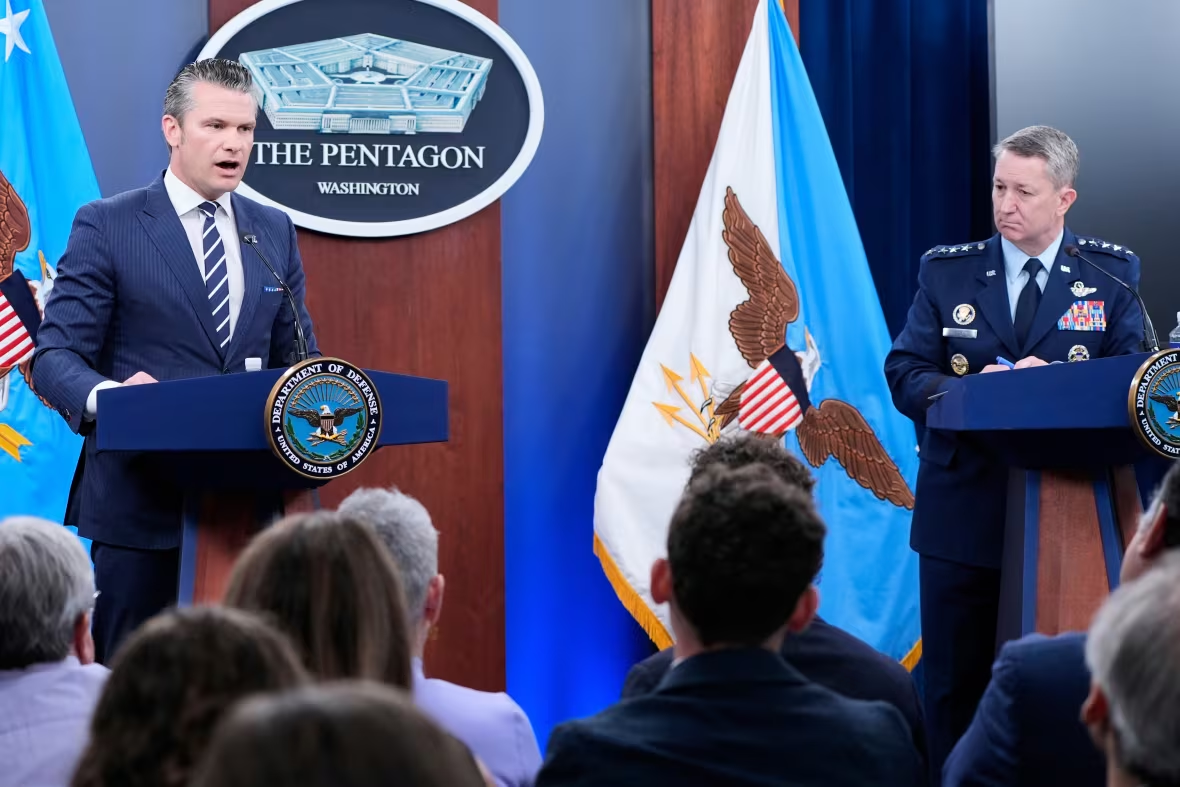
In a significant escalation of hostilities in the Middle East, US Defense Secretary Pete Hegseth announced on Sunday that American airstrikes had “devastated” Iran’s nuclear program, following coordinated attacks on three major Iranian nuclear sites: Fordow, Isfahan, and Natanz.
The precision strikes, carried out using B-2 Spirit stealth bombers, were ordered by President Donald Trump and mark one of the most aggressive US military actions against Iran in recent years.
Speaking at a press briefing at the Pentagon, Hegseth emphasized that the operation deliberately avoided targeting Iranian civilians or military personnel. “This mission was not about regime change. We specifically targeted Iran’s nuclear infrastructure—not its people or armed forces,” he said. Hegseth added that the United States remains open to peace, but Iran must now “find an off-ramp” to avoid further escalation.
President Trump, addressing the nation shortly after the strikes, reiterated his administration’s long-standing opposition to a nuclear-armed Iran. He warned Tehran against any retaliatory action, stating, “There are many targets left.” He added, “Iran must now choose peace—or face consequences far greater than today’s strike.”
The airstrikes followed a dramatic increase in regional tensions after Israel launched a large-scale bombing campaign on Iran. The Iranian government, which has consistently denied seeking nuclear weapons, responded angrily, accusing Washington of aligning with Israel to destroy its peaceful nuclear program.
Iranian Foreign Minister Abbas Araghchi accused the United States of deliberately sabotaging diplomatic talks, revealing that negotiations with European powers were underway in Geneva just days before the strikes. “The US didn’t just target our nuclear facilities—it blew up diplomacy,” Araghchi posted on social media. Speaking later in Istanbul, Araghchi said the US and Israel had “crossed a red line,” and that Iran would defend itself “by all means necessary.”
Iran’s President Masoud Pezeshkian condemned the strikes, calling the US the “main engine behind Israel’s aggression.” He reaffirmed Iran’s right to pursue a peaceful nuclear program, stating, “This right cannot be taken away—neither by threat nor war.”
In retaliation for the US attacks, Iran launched waves of ballistic missiles targeting multiple sites in Israel, including Ben Gurion Airport near Tel Aviv. Israeli authorities reported at least 23 injuries, while Iran claimed to have inflicted extensive damage.
Israel responded with fresh airstrikes on targets in western Iran, including Qom and other military bases. Four members of Iran’s Islamic Revolutionary Guard Corps were reportedly killed in the Israeli raids.
The United Nations’ International Atomic Energy Agency (IAEA) stated it had detected no rise in radiation levels at the bombed nuclear sites, and Iranian authorities confirmed no signs of contamination. The head of Iran’s Red Crescent also confirmed that no fatalities occurred in the US strikes on the nuclear facilities.
The international community reacted with growing alarm. Saudi Arabia confirmed no radioactive effects were found in the Gulf but expressed “deep concern” over the US action. The UAE, Qatar, and Oman—key mediators in the US-Iran nuclear talks—criticized the strikes and urged de-escalation.
The European Union called for restraint on all sides, but stressed that Iran must not be allowed to develop nuclear weapons. UK Prime Minister Keir Starmer also urged Tehran to return to the negotiating table.
Meanwhile, US Vice President JD Vance maintained that the United States was not at war with Iran, but with its nuclear ambitions. “The strikes were designed to delay, and possibly disable, Iran’s nuclear weapons capability,” he said.
Iran’s allies have also responded. The Houthi rebels in Yemen, aligned with Tehran, renewed threats to target American ships in the Red Sea if the US continues to engage militarily in the region.
As the situation evolves, Foreign Minister Araghchi announced that he would visit Moscow for urgent consultations with Russian President Vladimir Putin. Observers now warn that without swift international diplomatic intervention, the region may be on the brink of a broader conflict.
