
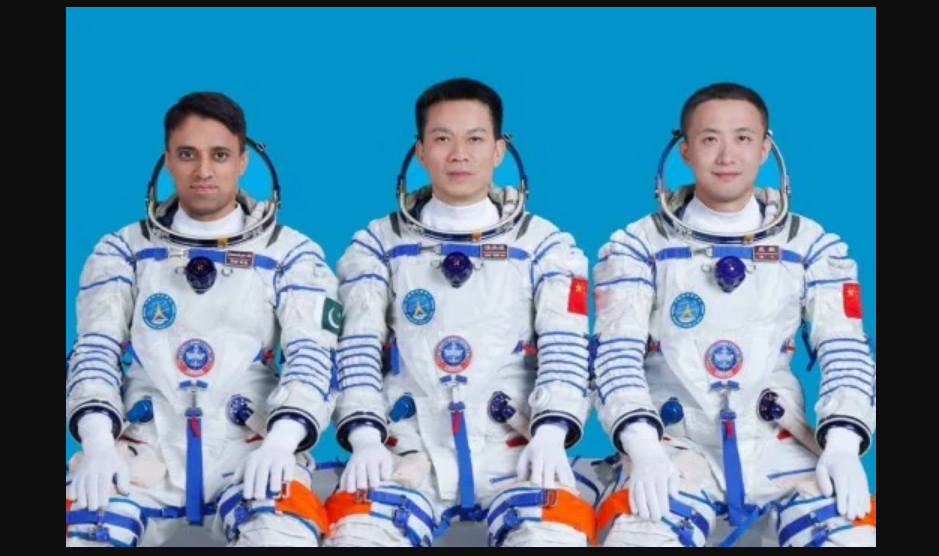

Pakistan is preparing for a major milestone in space exploration as astronaut Muhammad Zeeshan Ali joins China’s Shenzhou-24 crew. The mission will take him to China’s Tiangong space station alongside two Chinese astronauts.
China unveiled the three-member crew on Tuesday, November 24. The mission is scheduled to launch on Wednesday, November 25, at 8:18am. It will lift off from the Jiuquan Satellite Launch Centre in northwest China.
Zeeshan, a former pilot in Pakistan’s armed forces, will join Chinese astronauts Tang Hongbo and Wu Yi. Their mission will mark the first joint spaceflight involving Chinese and foreign astronauts under China’s crewed space programme.
According to China Manned Space Agency (CMSA) spokesperson Zhang Jingbo, the Pakistani astronaut will spend approximately one week aboard Tiangong. During this period, he will conduct scientific experiments alongside the Chinese crew.
Pakistani Astronaut Set for Historic Tiangong Mission
Zeeshan’s selection represents an important development in Pakistan-China space cooperation. He will serve as a payload specialist, supporting scientific research and experiments during his stay.
The mission will also demonstrate China’s expanding international participation in human spaceflight. Moreover, it marks a significant step in the two countries’ longstanding diplomatic relationship.
CMSA confirmed that Zeeshan will return to Earth aboard the Shenzhou-23 spacecraft. The spacecraft docked with Tiangong in May and currently carries astronauts from an earlier mission.
He will return alongside two members of the Shenzhou-23 crew, Zhang Zhiyuan and Lai Ka-ying. Lai became the first astronaut from Hong Kong to participate in China’s crewed space programme.
Meanwhile, the mission will involve approximately 90 experiments. These activities will cover space science research, technological testing and other scientific objectives.
What Will Zeeshan Do During His Week in Space?
During his stay, Zeeshan will work as a payload specialist and participate in scientific experiments. His responsibilities will involve supporting research activities alongside the Chinese astronauts.
The crew will also conduct an orbital rotation with astronauts from the previous Shenzhou-23 mission. Additionally, they will perform routine operations and maintenance aboard the Tiangong space station.
Their work will include continuing scientific research and conducting experiments involving space payloads. These activities will contribute to China’s ongoing efforts to expand its capabilities in space.
The mission also provides an opportunity for Pakistan to participate directly in China’s human spaceflight activities. Consequently, Zeeshan’s role carries significance beyond his individual journey.
Pakistani Leaders Welcome Zeeshan’s Space Mission
Pakistan’s political leadership has welcomed the astronaut’s selection for the historic mission. Planning Minister Ahsan Iqbal congratulated Zeeshan and highlighted the strength of Pakistan-China relations.
He described the joint mission as a reflection of “the trust and iron brotherhood between Pakistan and China”.
Information Minister Attaullah Tarar also expressed pride over the development. In a post on X, he described a Pakistani astronaut travelling into space as a source of joy and national pride.
Earlier, in April 2026, Pakistan selected Muhammad Zeeshan Ali and Khurram Daud for astronaut training in China. Their selection marked an important stage in Pakistan’s participation in the programme.
Another Chinese Astronaut Begins a Year-Long Space Mission
While the Shenzhou-24 crew prepares for its mission, another Chinese astronaut will undertake an extended stay aboard Tiangong.
Zhu Yangzhu, the third member of the Shenzhou-23 crew, will remain aboard the station for another six months. He will join the two Chinese astronauts from the incoming Shenzhou-24 mission.
His extended stay will help China complete its first-ever year-long human presence in orbit. The mission will also provide important information about the human body’s ability to adapt to prolonged space environments.
Furthermore, the research will help scientists understand the challenges associated with long-duration spaceflight. China hopes to use these findings for future crewed lunar missions and possible Mars exploration.
China Advances Plans for Its First Crewed Moon Landing
China continues to develop its long-term lunar exploration programme alongside its space station activities. Beijing aims to land Chinese astronauts on the Moon before 2030.
The planned lunar mission will involve a crew of three astronauts. According to programme deputy chief designer Wang Xiang, two members will be expected to land on the lunar surface.
China has already achieved several important developments in its lunar exploration programme. Zhang Jingbo said the programme had made progress during Tuesday’s briefing.
The next phase will include additional launch-site rehearsals and technology verification activities. These preparations will involve the Long March-10A rocket and the Mengzhou crewed spacecraft.
The rehearsals will test launch procedures and interactions between different spacecraft systems. Meanwhile, China plans a technology verification flight for the Long March-10 rocket.
The Lanyue lunar lander also remains on track for its maiden flight. These developments form part of China’s preparations for future crewed lunar exploration.
“The Chinese people are making steady and far-reaching strides in exploring the Earth,” Zhang said.
Hong Kong Astronaut Completes Important Tasks Aboard Tiangong
China’s space agency also highlighted the contribution of Hong Kong astronaut Lai Ka-ying during the Shenzhou-23 mission.
Lai served as a payload specialist and completed several scientific and technical assignments aboard the space station. Zhang praised her performance and said she had successfully fulfilled her responsibilities.
Her work included space science research, technological experiments and popular science lectures. She also supported her fellow astronauts during challenging activities outside the spacecraft.
During extravehicular operations, Lai controlled the robotic arm from inside the station. This allowed her to assist two fellow crew members during their spacewalk activities.
Her support helped them complete solar wing repairs and install space debris protection devices. Zhang also praised her professional approach and commitment to scientific work.
“Lai Ka-ying approached every task with a rigorous, conscientious scientific attitude and a pragmatic, truth-seeking work style,” Zhang said.
He added that her participation had helped younger generations appreciate China’s scientific and technological capabilities.
“Her experience has enabled the younger generation – especially youth in Hong Kong and Macau – to personally feel the strength of the motherland’s scientific and technological prowess.”
Pakistan-China Space Cooperation Reaches New Milestone
Zhang described Pakistan’s participation in the Shenzhou-24 mission as a landmark achievement for both countries. The development also coincides with the 75th anniversary of Pakistan-China diplomatic relations.
The partnership reflects growing cooperation in scientific research and space exploration. Moreover, China’s space agency expressed interest in expanding international participation in future missions.
“Our lunar programme is steadily advancing too,” Zhang said. “We look forward to working with more countries and regions to explore the vast universe, use other space peacefully and advance together for the common good of all humanity.”
Zeeshan’s upcoming journey therefore represents an important moment for Pakistan’s involvement in human spaceflight. His participation will give the country a direct role in scientific activities aboard China’s space station while strengthening bilateral cooperation.
For the latest updates, visit and follow The Truth International website (www.thetruthinternational.com) and subscribe to the YouTube Channel.

