
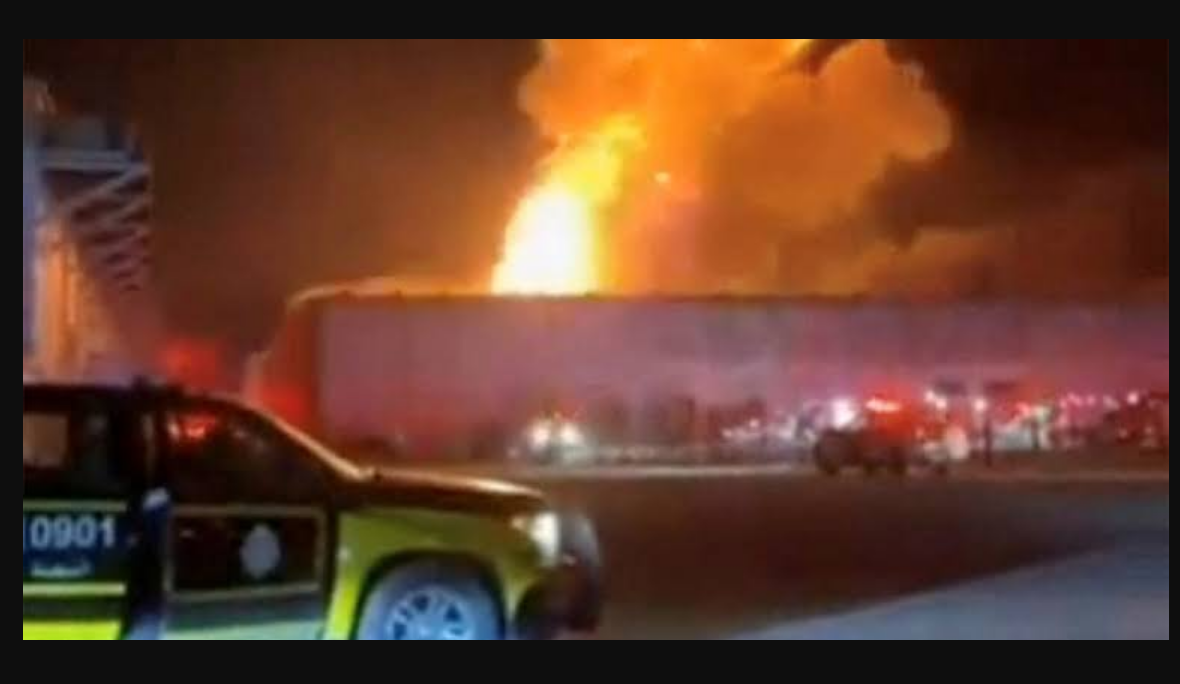

A Pakistani resident was critically injured, while a Bahraini citizen also sustained injuries during Iran’s latest attacks on Bahrain.
A Pakistani national remains in critical condition after Iranian attacks injured two people in Bahrain, authorities confirmed on Sunday. The second victim, a Bahraini citizen with disabilities, sustained injuries but remains stable. Both individuals are receiving medical treatment at a hospital.
The latest incident marks another escalation in attacks against the Gulf kingdom. Bahrain has faced several strikes this week, ending a weeks-long lull in the conflict. The wider confrontation began in late February following US-Israeli strikes against Iran.
Iranian Attacks Target Civilian Facility in Bahrain
Bahrain’s Interior Ministry initially reported a strike against a civilian industrial facility late Saturday night. However, officials did not immediately identify the exact location.
According to the ministry, the attack triggered a fire and caused material damage. Nevertheless, its initial statement reported no injuries.
Authorities subsequently issued another alert warning residents about a potential threat. However, officials declared an all-clear shortly after midnight local time.
On Sunday, the ministry confirmed that two people had sustained injuries during the previous night’s attacks.
“As a result of the heinous Iranian attacks on Bahrain yesterday, a Bahraini citizen with disabilities sustained injuries and is in stable condition, while a Pakistani resident was also injured and is in critical condition.
“Both are receiving treatment in the hospital,” it added.
Meanwhile, residents reported seeing smoke rising over Sitra Island, located along Bahrain’s eastern coast. The island hosts several industrial facilities, including a refinery operated by state-owned oil company Bapco.
IRGC Claims Strikes on US Military Positions
Iran’s Islamic Revolutionary Guards Corps (IRGC) also claimed responsibility for targeting American military positions in Bahrain.
According to the organisation, its forces launched missile and drone strikes against the Al-Riffa and Awali bases.
“During the operation, US military positions at the Al-Riffa and Awali bases in Bahrain were targeted with missile and drone strikes”.
The IRGC further claimed that two American military radars had been hit.
“Two radars belonging to the US Army’s Patriot air defence systems… were struck,” it said.
Additionally, the organisation warned that any violation of Iranian airspace would trigger a strong response. It described its anticipated response as “harsh and decisive”.
Tanker Attacks Raise Fresh Concerns Over Strait of Hormuz
The latest attacks in Bahrain came as two tankers were struck in the Strait of Hormuz. The strategic waterway has become a major flashpoint in the ongoing conflict.
Iran continues attempting to blockade the shipping route, while the United States maintains a counter-blockade of Iranian ports. Meanwhile, American forces have been escorting vessels through the strategically important strait.
Before the war, the waterway carried approximately one-fifth of the world’s oil supplies. Consequently, disruptions have raised concerns about international energy transportation.
The British maritime agency UKMTO reported that an unidentified projectile struck a tanker while it was travelling through the strait on Saturday.
“There are no reported casualties at this time,” it said.
The agency also reported that another tanker sustained damage to its engine room.
Meanwhile, Tehran has repeatedly reported fires aboard vessels in the waterway in recent weeks. Iranian authorities have frequently claimed that mines caused these incidents.
Iran Holds Talks With Qatar Amid Regional Tensions
Despite the continuing confrontation, diplomatic efforts are also underway to prevent further escalation.
Iranian Deputy Foreign Minister Kazem Gharibabadi confirmed that a Qatari delegation had visited Tehran on Friday evening. The delegation reportedly held discussions with Iranian officials for approximately two hours.
However, Gharibabadi did not disclose further details about the discussions.
Iranian Foreign Minister Abbas Araghchi also called for ongoing regional negotiations to continue.
“The ongoing talks in the region must be given a chance, and the blockade must be lifted rationally.”
However, he maintained that Tehran would not discuss reopening the Strait of Hormuz unless its demands were addressed.
“Our position is clear: as long as Iran’s demands are not met, the discussion on the Strait of Hormuz and its opening is pointless,” he said, according to state television.
Iran’s demands include ending the war across all fronts, unfreezing Iranian assets and lifting oil sanctions. Tehran also wants Washington to end its counter-blockade of Iranian ports.
Iran Calls US Economic Blockade an Act of War
The diplomatic tensions have intensified following Washington’s economic pressure campaign against Tehran.
In August, the United States announced what it described as an “economic asphyxiation” campaign. The initiative aimed to restrict Iran’s trade and financial activities.
Gharibabadi criticised the measures on Saturday, warning that Tehran would respond to the restrictions.
“We consider the economic blockade an act of war and we will take all necessary measures to lift it”.
“We have made this known to the other parties, including the mediators”, he added, saying “the United States was aware of this.”
Meanwhile, Araghchi reiterated that Iran would not surrender its stockpiles of enriched uranium. The nuclear programme remains one of the biggest disagreements between Tehran and Washington.
Western countries accuse Iran of pursuing nuclear weapons capabilities. However, Tehran maintains that its nuclear programme serves entirely civilian purposes.
“I believe a solution can be found, but we have clear red lines: the material will not be taken out of the country,” Araghchi said.
Iran Announces Rolling Power Cuts Amid Energy Problems
Meanwhile, Iranian President Masoud Pezeshkian warned that attacks against the country’s energy infrastructure had worsened existing energy challenges.
He said the damage caused by US and Israeli strikes had intensified the situation. Therefore, Iran should prepare for additional difficulties during the coming winter.
Mohammad Allahdad, head of Iran’s national electricity company, also announced planned electricity restrictions.
Speaking on state television, he confirmed that authorities would introduce rolling power cuts beginning Sunday.
“Given the country’s fuel supply conditions, the electricity sector will be forced to impose distribution restrictions,” he said.
The latest developments highlight the widening consequences of the conflict. Moreover, the injuries reported in Bahrain demonstrate the growing risks facing civilians and foreign residents across the Gulf region.
For the latest updates, visit and follow The Truth International website (www.thetruthinternational.com) and subscribe to the YouTube Channel.

