

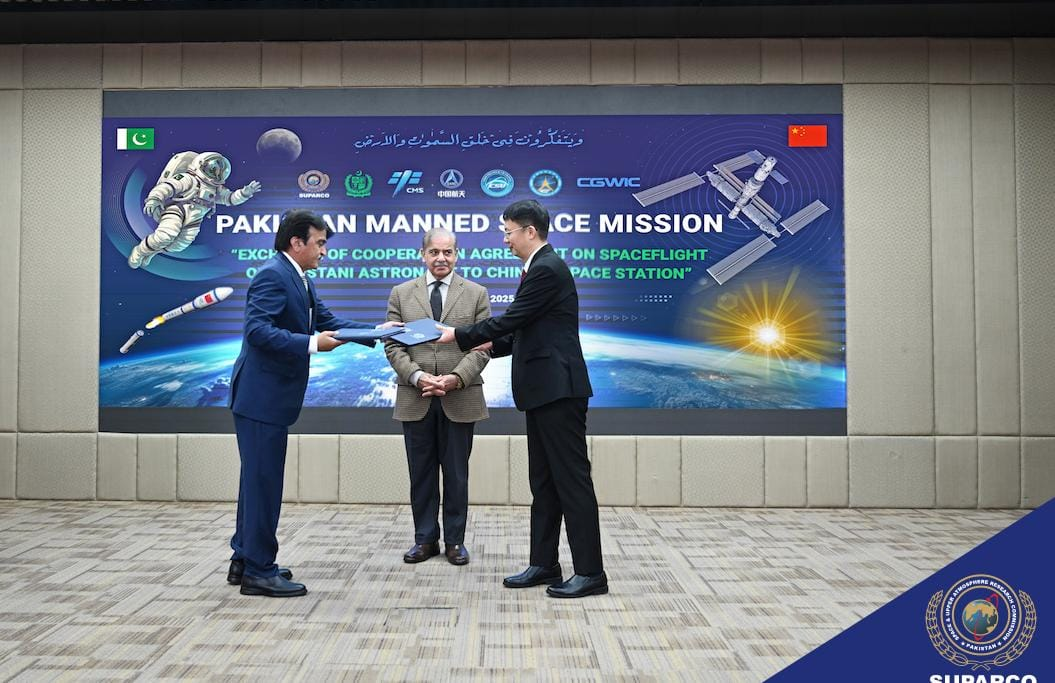

ISLAMABAD: The Pakistan Space & Upper Atmosphere Research Commission (SUPARCO) has signed a groundbreaking cooperation agreement with China’s Manned Space Agency (CMSA), paving the way for Pakistan’s first astronauts to embark on a mission to Tiangong, the Chinese Space Station (CSS).
Under the agreement, two Pakistani astronauts will undergo training at China’s Astronaut Center. One astronaut will be selected to specialize as a scientific payload specialist, preparing for critical research aboard the CSS.
The selection process for Pakistan’s first astronaut will be completed by 2026, with the chosen astronaut set to participate in a future CSS mission. The mission will involve conducting advanced scientific experiments in fields such as biological and medical sciences, aerospace, applied physics, fluid mechanics, space radiation, ecology, material sciences, microgravity studies, and astronomy.
According to an official statement, the China Space Station is equipped with cutting-edge experimental racks and external adaptors, enabling research in multiple disciplines. The findings from these experiments are expected to contribute to advancements in medical research, environmental monitoring, and space technology, with practical applications for life on Earth.
At the signing ceremony, Prime Minister Shehbaz Sharif hailed the agreement as a defining moment for Pakistan’s space exploration aspirations. He emphasized that this marks a significant step toward the nation’s goals in human spaceflight and highlights Pakistan’s progress in space science and technology, including achievements in satellite launches and global scientific contributions.
Dr. Lin Xiqiang, Director General of CMSA, expressed excitement about the collaboration, reinforcing China’s commitment to international space cooperation. He noted that Pakistan’s participation in the CSS program underscores the strong ties between the two nations and supports the broader vision of peaceful space exploration for humanity’s benefit.
SUPARCO Chairman Mohammad Yousuf Khan called the agreement a milestone in Pakistan’s space journey, encouraging the nation’s youth, professionals, and academics to actively engage in the astronaut program. He urged them to contribute through research, innovation, and skill development.
This mission is expected to elevate Pakistan’s position in the global space community, promoting advancements in scientific research, technological innovation, and space exploration. The research conducted aboard the CSS will not only enhance space science but also reinforce Pakistan’s role in international space exploration efforts.
