
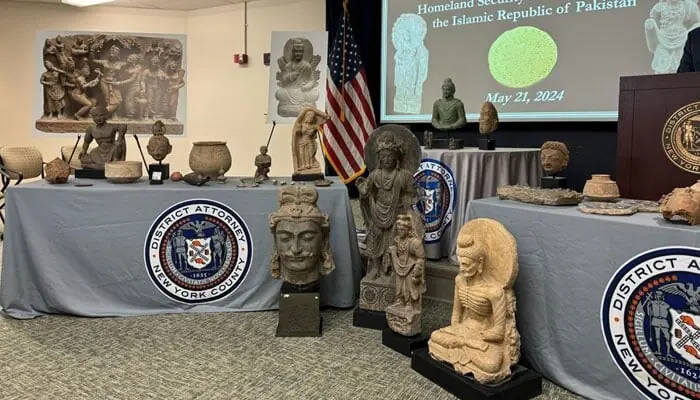

Most returned artefacts belong to Gandhara civilisation; new museum planned
ISLAMABAD: Pakistan has recovered 513 smuggled archaeological artefacts from the United States under bilateral cooperation, with officials telling a Senate committee that most of the returned objects belong to the ancient Gandhara civilisation.
During a meeting of the Senate Standing Committee on National Heritage and Culture, officials said US authorities had seized the artefacts after they were illegally smuggled out of Pakistan over several decades.
They described the recovered collection as an invaluable part of Pakistan’s cultural heritage and confirmed that the artefacts are now in government custody.
Officials also informed the committee that plans are underway to establish a new museum to preserve and display the recovered items. They said land acquisition is being coordinated with the Capital Development Authority, while authorities are exploring public-private partnership options for the project.
Senators demand detailed investigation
Committee members sought comprehensive information on the smuggling network, including those allegedly involved, the number of missing artefacts and the value of the recovered collection.
The committee directed the Ministry of National Heritage and Culture to submit a detailed report covering the investigation, recovery process and the status of ongoing inquiries.
Lawmakers also discussed reports concerning the alleged demolition of a historic Mughal-era arch near Rohara Village. The committee instructed the ministry to investigate the matter and present its findings at the next meeting.
Officials address Unesco conservation concerns
The committee also reviewed conservation work at the Taxila World Heritage Site following concerns previously raised by UNESCO over restoration projects at Mohra Moradu and Sirkap.
Officials said the concerns related to construction materials, restoration methods and the height of rebuilt structures. They added that the Punjab government had provided the requested information and that no further objections had since been communicated.
According to officials, the conservation programme follows internationally recognised guidelines developed with recommendations from UNESCO, ICOMOS and the Urban Unit.
Pakistan currently has six UNESCO World Heritage Sites and has submitted nomination dossiers for 24 additional sites. The committee also recommended a visit to Taxila to review the conservation work and reaffirmed its commitment to protecting the country’s cultural heritage while strengthening measures against the illegal trafficking of antiquities.

