

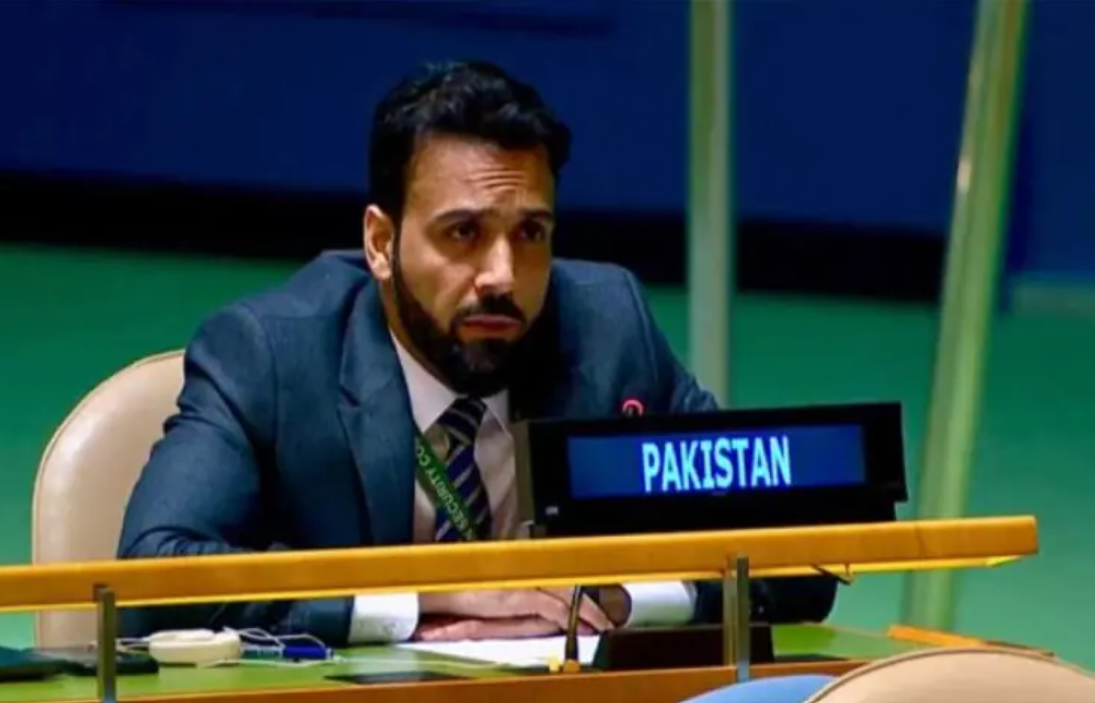

The diplomatic clash between Pakistan and India at the United Nations intensified when India referred to Pakistan as “Terroristan.” Pakistan strongly rejected the remark, condemning it as shameful, undignified, and an attempt to malign an entire sovereign nation. The exchange highlighted deep-seated tensions between the two South Asian rivals during the General Assembly session.
Pakistani diplomat Muhammad Rashid, exercising the right of reply, called India’s remark an insult not only to Pakistan but also to its people. He stressed that resorting to such language diminishes India’s credibility before the international community. According to him, a serious platform like the United Nations should not be misused for cheap mockery and political point-scoring. Instead, the world expects mature dialogue and constructive debate.
Rashid further said that India’s rhetoric was an attempt to deflect attention from its own track record of sponsoring terrorism beyond its borders. He cited credible reports pointing to Indian intelligence networks that allegedly fund, train, and direct groups to destabilize neighboring countries. Such actions, he noted, not only undermine regional peace but also reveal India’s duplicity in its counterterrorism claims.
The Pakistani diplomat argued that destabilizing South Asia and violating international law has long been a habit of India. He underlined that India’s claims of fighting terrorism are contradicted by its support for sabotage, subversion, and targeted killings through covert networks. Such practices, he added, seriously endanger peace and security in the region.
He also reminded the Assembly of Pakistan’s sacrifices in the global fight against terrorism. Over 90,000 lives have been lost by Pakistan in its decades-long struggle, yet its contribution has been acknowledged by the international community. This, he argued, makes the Indian claim of calling Pakistan an “epicenter of terrorism” baseless and malicious.
The Pakistani envoy also took issue with Indian Foreign Minister S. Jaishankar’s earlier statement labeling Pakistan as a hub of global terrorism. He described those accusations as false and politically motivated. He argued that India itself behaves like a regional bully, holding South Asia hostage to its aggressive ambitions and extremist ideology.
Highlighting Indian actions in Kashmir, he said that extrajudicial killings, arbitrary detentions, staged encounters, and collective punishment are evidence of state terrorism under the pretext of counterterrorism. He recalled the case of Kulbhushan Jadhav, an Indian naval officer arrested in Pakistan, as proof of India’s direct involvement in clandestine cross-border terrorism.
Rashid also dismissed what he termed Jaishankar’s “bizarre” claims about the Pahalgam incident. He stressed that Pakistan had condemned the attack, offered an independent investigation, and joined international calls for justice. However, India rejected the offer and instead used the incident to justify aggression against Pakistan in May. According to him, that aggression resulted in the loss of 54 innocent lives, including women and children.
Pakistan, he said, responded with a carefully calibrated defense under Article 51 of the UN Charter, targeting only military objectives. The counteraction led to the downing of Indian aircraft and other military losses. Rashid emphasized that Pakistan acted responsibly, ensuring that its response was lawful and proportional.
Concluding his speech, the Pakistani diplomat reaffirmed his country’s commitment to peace and stability in South Asia. He argued that nearly two billion people in the region deserve development and security, not endless hostility. True progress, he said, requires dialogue, mutual respect, and sincerity. Pakistan has upheld these principles, he asserted, while India must decide if it truly seeks peace or prefers confrontation.
The fiery exchange between the two neighbors underscored their longstanding dispute, with both sides using the global platform to push their narratives. However, Pakistan insisted that India’s undignified rhetoric could not overshadow its own violations of human rights and international law.
