
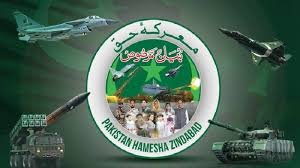

Pakistan’s military has stressed that there is no space for war between two nuclear neighbours. The statement came during events marking the first anniversary of Marka-e-Haq. Military officials also reaffirmed Pakistan’s commitment to peace, regional stability, and strong national defence.
The message was delivered during a joint press conference by Inter-Services Public Relations Director General Lieutenant General Ahmed Sharif Chaudhry, Rear Admiral Shifaat Ali Khan, and Air Vice Marshal Tariq Ghazi.
Officials reviewed the events of the 2025 Pakistan-India conflict and highlighted what they called the “strategic consequences” of the confrontation.
Pakistan Highlights Strategic Lessons From 2025 Conflict
Lieutenant General Ahmed Sharif Chaudhry said Pakistan successfully defended itself against a much larger military force. He stated that the conflict proved Pakistan’s preparedness across land, sea, air, cyber, and information domains.
The military spokesperson said India failed to convince the international community that Pakistan was responsible for terrorism. He claimed global opinion shifted after the conflict and that Pakistan was increasingly viewed as a victim of cross-border terrorism instead.
He also criticised India for accusing Pakistan without presenting evidence related to the Pahalgam incident in Indian Illegally Occupied Jammu and Kashmir.
According to Chaudhry, several questions raised by Pakistan still remain unanswered after one year. He questioned how an FIR was registered within minutes of the incident and asked why no clear evidence had been presented publicly.
The military spokesperson further claimed that the conflict strengthened Pakistan’s role as a “net security stabiliser” in South Asia. He said Pakistan handled the crisis with maturity and restraint despite rising tensions.
Chaudhry warned that political influence over military leadership in India was becoming dangerous. He criticised Indian politicians and military officials for what he described as aggressive rhetoric and politicised narratives.
Pakistan Warns Against War Between Nuclear Neighbours
The ISPR chief said the conflict reaffirmed the importance of nuclear deterrence in the region. He strongly warned against the idea of conventional war between Pakistan and India.
According to him, any large-scale military confrontation between two nuclear powers would be reckless and disastrous. He said Pakistan remained fully prepared to defend itself but preferred peace and stability.
Chaudhry also claimed the conflict exposed weaknesses in Indian media reporting and information warfare. He accused Indian media outlets of spreading misinformation during the conflict.
He said modern warfare now extends beyond traditional battlefields. According to him, future conflicts involve cyber operations, information campaigns, surveillance systems, drones, and coordinated multi-domain strategies.
The military spokesperson added that Pakistan’s armed forces had successfully adapted to these modern warfare requirements. He said the country remains fully prepared for future security challenges.
Chaudhry also praised the unity between Pakistan’s people, government, and armed forces during the conflict. He described this national unity as one of the most important outcomes of Marka-e-Haq.
Pakistan Reaffirms Saudi Arabia Defence Partnership
During the press conference, Lieutenant General Chaudhry also discussed Pakistan’s defence relationship with Saudi Arabia.
He described ties between Islamabad and Riyadh as deep, longstanding, and multidimensional. He said any threat to Saudi Arabia would also be considered a threat to Pakistan.
Pakistan and Saudi Arabia signed a Strategic Mutual Defence Agreement in 2025. The agreement states that aggression against one country would be treated as aggression against both.
Last month, Pakistan reportedly sent fighter jets and military personnel to Saudi Arabia under the defence cooperation framework.
Pakistan Navy and Air Force Recall Operational Success
Rear Admiral Shifaat Ali Khan described Marka-e-Haq as a historic conflict. He said the Pakistan Navy successfully protected ports, maritime trade routes, and naval installations during the confrontation.
He claimed India attempted to increase naval pressure in the Arabian Sea but failed to disrupt Pakistan’s maritime operations.
Air Vice Marshal Tariq Ghazi also shared operational details about the Pakistan Air Force response. He said the PAF maintained constant surveillance and combat readiness throughout the conflict.
According to Ghazi, Pakistan’s air defence system successfully tracked Indian deployments and neutralised multiple threats.
He claimed the Pakistan Air Force achieved an “8-0” result against the Indian Air Force during aerial engagements. He stated that several Indian fighter jets, including Rafale, Su-30, MiG-29, and Mirage 2000 aircraft, were downed or heavily damaged.

