

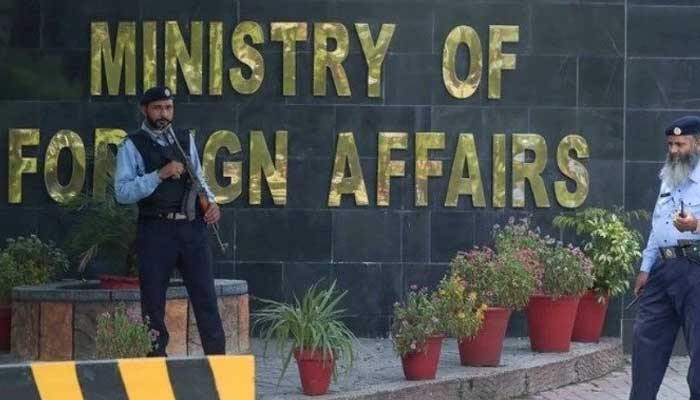

Pakistan’s Foreign Office has firmly rejected the narrative presented by Indian leaders regarding the Pahalgam terrorist attack, accusing New Delhi of distorting facts to justify aggression. In a strongly worded statement, spokesperson Shafqat Ali Khan criticized Indian parliamentarians for portraying themselves as judge, jury, and executioner in the absence of an independent investigation.
During a Lok Sabha session, Indian Home Minister Amit Shah claimed that authorities recovered Pakistani voter ID cards and locally produced chocolates from the three individuals killed in a Kashmir gunfight, information India asserts connects the men to the April 22 Pahalgam attack on tourists. Prime Minister Narendra Modi also denied claims that international pressure, including from former U.S. President Donald Trump, influenced a pause in India’s military operations.
In response, Pakistan’s Foreign Office described these allegations as false and unfounded. “The account given by the Indian Home Minister is replete with fabrications,” the spokesperson asserted, questioning the timing of the announcements as Indian lawmakers debated military action.
Further, Pakistan maintains there is no credible evidence of its involvement in the attack and reiterated its appeal for a transparent, third-party investigation, a proposal that has received international support but was rejected by India.
Shafqat emphasized that India’s military objectives failed to materialize. “India did not achieve any of its strategic goals,” he said. In contrast, Pakistan proudly declared its “resounding success” in neutralizing Indian fighter jets and military assets during the conflict, asserting these accomplishments are beyond dispute.
The Foreign Office also rejected India’s suggestion of Pakistani “nuclear blackmail,” branding it a misleading narrative aimed at masking New Delhi’s own escalation. Pakistan reaffirmed its commitment to conventional deterrence, emphasizing restraint in the face of provocations.
Shafqat called on Indian leaders to acknowledge casualties suffered by their own forces and to admit that third-party diplomacy played a significant role in brokering the ceasefire. “India refused Pakistan’s offer for an independent probe,” he noted, adding that Indian claims of unilateral gains hold little credibility in the absence of transparent investigation.
Regarding the broader implications of the conflict, the spokesperson reaffirmed Pakistan’s overarching principle: bilateral relations are grounded in respect for sovereignty, territorial integrity, and the United Nations Charter. He made clear that any attempt by India to establish a new status quo without mutual consent is categorically unacceptable.
The Foreign Office also highlighted India’s reported suspension of the Indus Waters Treaty, describing it as a violation of international agreements and warning that such actions may undermine regional stability, unless New Delhi promptly honors its commitments.
Pakistan concluded by affirming its pursuit of peace and diplomacy. “We remain committed to dialogue and regional stability while resolutely countering any future aggression,” said Shafqat. The message: Pakistan will stand firm in defending its territorial rights and international norms.
