

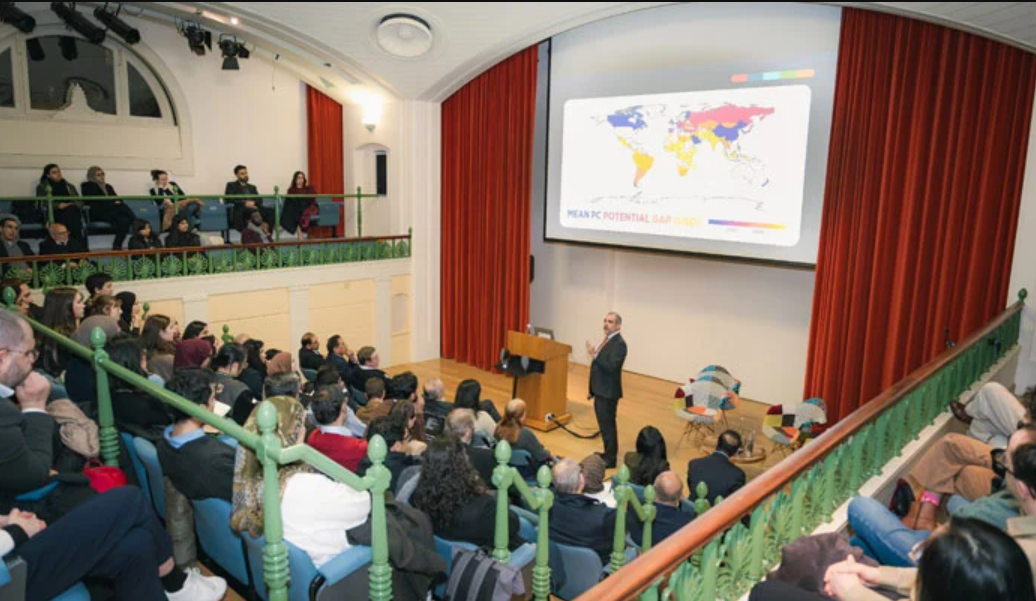

A leading development economist unveiled an ambitious plan for a long-term Human Potential Fund for Pakistan during a major lecture at Oxford University. The initiative aims to identify and develop talent at scale and seeks to redefine how development is understood in a rapidly changing world.
The announcement came during the Fourth Annual Iqbal Lecture hosted by the Oxford Pakistan Programme (OPP). The event gathered a large audience of students, scholars, and supporters, with additional participants joining from universities across Pakistan through live broadcast.
Professor Khwaja Calls for a Shift From Poverty to Potential
The keynote speaker, Professor Asim Ijaz Khwaja, delivered a thought-provoking address titled Reimagining Development: From Poverty to Human Potential. He argued that traditional development approaches, shaped decades ago, can no longer address current challenges. Moreover, he highlighted that modern pressures, including political instability, shrinking global aid, and rapid technological change, demand a renewed framework.
He stated that the world often treats poverty as the core issue, while the true challenge lies in wasted human capability. He stressed that individuals possess talent that remains unused due to weak institutions, education challenges, limited opportunities, and labour market barriers.
Inspired by Allama Iqbal’s concept of khudi, he urged policymakers to place people, rather than problems, at the centre of national development strategies. During his address, he announced his plan to advance the Human Potential Fund for Pakistan to help the country uncover and grow its talent on a transformative scale.
Panel Explores Institutional Barriers and Paths to Reform
After the lecture, a panel discussion brought together global experts from development and economic policy. They examined how institutions, governance structures, and state capacity influence the realisation of human potential. Through their discussion, they highlighted the need for systems that empower individuals while also supporting broad reform.
Audience questions focused on major issues, including implementation hurdles, extreme poverty, environmental risks, and data reliability. In response, Professor Khwaja emphasised that sustainable progress requires strong systems and empowered citizens. He noted that development strengthens when people believe their actions can influence outcomes.
Growing Significance of the Annual Iqbal Lecture
During the closing remarks, representatives from the Dadabhoy Foundation expressed pride in the rapid growth of the lecture series. They noted that within four years, the event has become a regular part of Oxford’s academic schedule. They also highlighted the importance of bringing Iqbal’s intellectual legacy into global conversations about development and human capability.
