

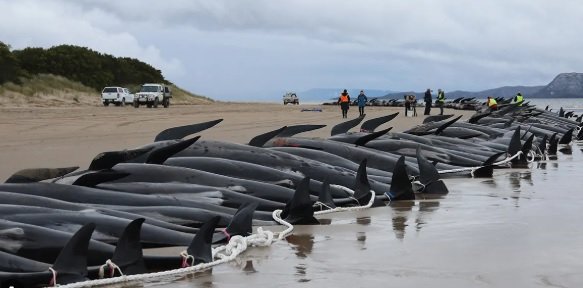

More than 150 false killer whales have been stranded on a remote beach in Tasmania, prompting a race against time as rescue teams work to save those still alive, Australian environment officials reported on Wednesday.
The Department of Natural Resources and Environment Tasmania confirmed that marine experts are at the site of the mass stranding near Arthur River on Tasmania’s northwest coast, approximately 400km (250 miles) from the state capital, Hobart.
“They’ve been stranded now for, we estimate, 24 to 48 hours,” said Brendon Clark, a liaison officer with Tasmania Parks and Wildlife Service, during a news conference.
Out of the 157 stranded whales, only about 90 are still alive, Clark said, adding that authorities are assessing whether it will be possible to re-float them. However, challenging surf conditions and the remoteness of the beach are complicating the rescue efforts.
“To try to re-float the animals directly back into that surf would be challenging and would also present enormous safety risks for our staff and personnel,” Clark explained. He noted that rough ocean conditions, the inaccessibility of the area, and the difficulty of transporting specialist equipment to the site are further hindering the operation.
“Our experts on-site are working tirelessly to determine the best methodology for responding to this very difficult and distressing incident in a humane and effective manner,” he added.
Local Discovery
The stranded whales were discovered around midnight on Tuesday by a local resident’s son, according to the Associated Press.
“The water was surging right up, and they were thrashing. They’re just dying—they’ve sunk down in the sand,” said Jocelyn Flint, a local resident. “There are little babies. Up one end, there’s a lot of big ones. It’s sad,” she added.
A Race Against Time
Images released by the Department of Natural Resources and Environment Tasmania show volunteers and experts assessing the scene, with some inspecting the stranded whales up close. As rescue teams battle the clock and the elements, the focus remains on providing a humane response and saving as many animals as possible.
