

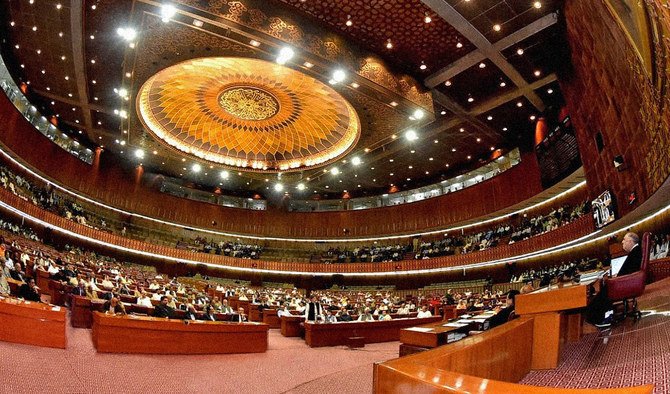

ISLAMABAD: On Tuesday, National Assembly Speaker Ayaz Sadiq announced that he had officially written to both the government and opposition, requesting nominations for the parliamentary committee responsible for appointing the Chief Election Commissioner (CEC) and members of the Election Commission of Pakistan (ECP).
Sadiq made this statement during the house proceedings in response to various points raised by Leader of the Opposition, Omar Ayub Khan. He explained that the parliamentary committee would be formed once the nominations were received.
In response to Ayub’s earlier remarks, the NA speaker reminded the house that it had been decided, in principle, that no points of order would be permitted during the question hour. “We are adhering to this decision strictly and will continue to do so,” he emphasized.
Earlier, the opposition leader raised a point of order, questioning the performance of the Special Investment Facilitation Council (SIFC). He requested information on the salaries, qualifications, and output of the individuals working with the SIFC, as well as details of investments brought to Pakistan by the council. Ayub also criticized the incumbent government for rendering the National Assembly ineffective, noting that his questions about the SIFC had not been answered.
Ayub further accused the government of extending the tenure of CEC Sikandar Sultan Raja, who he claimed should have been charged under Article 6 for violating the Constitution due to his failure to conduct timely general elections and the controversial elections held after significant delays. He also mentioned that two ECP members had completed their constitutional terms.
The opposition leader reminded the speaker that he had written a letter requesting the formation of a parliamentary committee for the appointment of a new CEC and ECP members, asserting that the country’s progress hinges on an independent Election Commission and the use of electronic voting machines (EVMs). He alleged that former army chief General Qamar Bajwa had intervened to prevent the use of EVMs in the Feb 8 elections, claiming that their use would have hindered the installation of the ‘Form 47’ government. He further accused influential external forces of altering the agenda of the parliamentary human rights committee, with National Assembly staff reportedly under pressure.
Ayub also criticized intelligence agencies for allegedly interfering in judicial affairs, citing letters written by judges of the Islamabad High Court regarding such interference. He expressed strong dissatisfaction with the repeated denial of his opportunities to speak in the house, calling it a breach of parliamentary tradition.
He condemned the ongoing political victimization, citing a raid by Punjab police on the house of PTI MNA Aneeqa Bhatti, the arrest of her brother, and the continued surveillance of her family’s land. He also alleged that PTI MNAs, including Ahmad Chatta, Mobin Jutt, and Osama Mela, had been subjected to police raids that led to household damage. “Yet the same police cannot confront the dacoits of slum areas,” he remarked.
The opposition leader also accused former Prime Minister Imran Khan and his wife, Bushra Bibi, of being convicted in bogus Toshakhana cases. Ayub stated that under the current circumstances, dialogue with the government was impossible. He also mentioned that the IMF delegation in Pakistan was questioning the rule of law in the country. Additionally, he refuted the government’s claims of reduced inflation, stating that the ruling class would soon face public backlash for worsening the people’s conditions.
Salary Increase
In a separate development, the National Assembly passed the Members of Parliament Salaries and Allowances (Amendment) Bill 2025 on Tuesday, following a majority vote. This legislation comes shortly after an increase in the salaries of National Assembly members, which were raised from Rs218,000 to Rs519,000.
The bill, which had already been approved by the Senate, was amended to grant the finance committees of both houses of parliament the authority to determine the salaries of lawmakers. The bill, presented by Romina Khurshid Alam, was passed without opposition from Minister for Law Azam Nazeer Tarar. The bill now returns to the Senate for final approval.
Despite political differences, members from both the treasury and opposition benches had shown uncommon unity on the issue of salary increases and other benefits during a recent meeting of the NA’s Finance Committee.
