
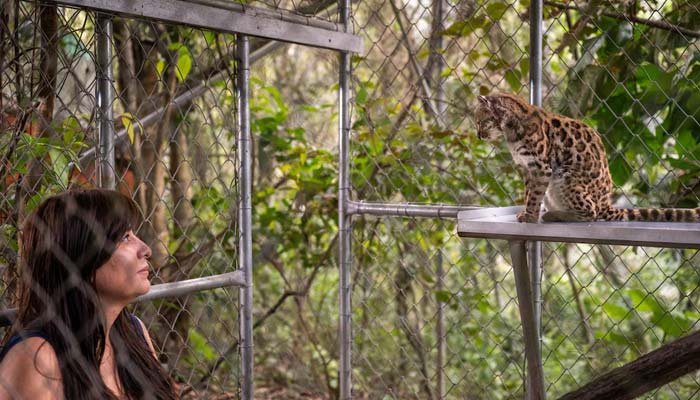

Scientists have identified a previously unknown wild cat species in Bolivia’s cloud forests.
The discovery marks the first formal description of a new living cat species in more than a century.
Researchers named the animal Leopardus tilcayo, using the name Tilcayo given to it by local communities.
Tiny Cat Found in Bolivia’s Cloud Forests
The newly identified cat lives in Bolivia’s Yungas forest.
The region is known for steep mountains, dense vegetation, high humidity and frequent cloud cover.
The cat belongs to the tiger cat group found across South America.
It measures about 46 centimetres in length.
It weighs around 1.4 kilograms, making it smaller than an average domestic cat.
Its light-brown fur features irregular rosette patterns across its body.
Researchers said little is currently known about its behaviour and lifestyle.
Camera-trap footage suggests the animal may be active mainly at night.
Small rodents found in scat samples also suggest they could be part of its diet.
DNA Confirms New Species
Researchers used genetic analysis to determine that the Bolivian tiger cat is genetically distinct.
The team studied DNA from 38 cats across several South American countries.
The research included eight museum specimens.
The analysis showed that tiger cats previously treated as a single group actually contain five genetically distinct species.
Scientists estimate that the lineage leading to Leopardus tilcayo separated from other tiger cats around 1.4 million years ago.
Researchers said the genetic differences indicate a long period of evolutionary separation.
Scientists Were Surprised by the Discovery
The cat attracted scientific attention because its physical characteristics did not match descriptions commonly based on Brazilian tiger cats.
Researchers initially questioned which tiger cat species was actually present in Bolivia.
Further genetic testing revealed that the animal represented a separate species.
Scientists said they had not previously proposed the Bolivian tiger cat as a separate species or subspecies.
Only two live individuals have been examined so far.
Researchers also have a limited number of camera-trap records.
One of the studied cats is a 10-year-old male.
It currently lives at the Senda Verde Wildlife Sanctuary after previously being kept by a local family.
Another Tiger Cat Subspecies Identified
The research team also identified a new tiger cat subspecies in Peru’s Yungas region.
It was named Leopardus tigrinus antisuyo.
The name refers to Antisuyu, a region of the former Inca Empire that included the animal’s habitat.
Scientists said the findings could change how tiger cat populations are assessed.
Conservation Concerns Grow
The International Union for Conservation of Nature currently classifies tiger cats as two vulnerable species with declining populations.
Researchers have submitted their findings to the IUCN.
A future assessment will examine the five genetic lineages separately.
That could provide a clearer picture of the conservation risks facing each population.
Researchers warned that Leopardus tilcayo could potentially face a higher conservation threat when assessed independently.
The Yungas ecosystem is already under pressure.
Deforestation, agriculture, human-caused fires and mining are threatening the region’s forests.
Scientists say protecting native forests and maintaining connections between habitats are important for the newly identified species.
Researchers also stressed that many species around the world may remain undiscovered.
Some could disappear before scientists even identify them.

