

Mohsin Naqvi’s call for new administrative units and DG ISPR’s emphasis on good governance have revived a sensitive question: can Pakistan continue managing expanding populations through the same provincial structure?
Pakistan’s debate over new provinces rarely remains a discussion about public administration.
Within hours, it becomes a dispute over identity, territory, political influence and control over resources. Supporters describe smaller provinces as a route towards efficient government. Opponents view them as attempts to divide historic regions, weaken provincial autonomy or alter established political power.
This pattern is particularly visible in Sindh.
Any proposal involving Sindh immediately raises concerns about the province’s unity, Karachi’s status, the division of resources and the relationship between urban and rural populations. These concerns are real and cannot be dismissed.
Yet the intensity of the political response often prevents a more basic question from receiving attention: is Sindh’s present administrative structure delivering effective government to its people?
That question has returned to the national agenda after Interior Minister Mohsin Naqvi declared on July 30 that Pakistan’s governance system had “collapsed.” He called for the creation of smaller administrative units, whether described as provinces or by another name, to take government closer to citizens.
A day later, Director General Inter-Services Public Relations Lieutenant General Ahmed Sharif Chaudhry said good governance was essential for Pakistan’s security and stability. He noted that Pakistan had a population of roughly 240 million to 250 million people but continued to operate through four provinces. He said the effectiveness of that arrangement deserved a serious political debate, conducted constitutionally and according to public consent.
These statements have not settled the argument. They have reignited it.
For Sindh, the renewed debate offers an opportunity to move beyond slogans and examine whether provincial restructuring, regional administration or genuine local-government empowerment could improve service delivery.
The Debate TTI Raised Before It Became National
The Truth International examined this issue last year through a series of province-specific articles.
Each article considered whether Pakistan’s administrative divisions could provide a foundation for smaller and more responsive governing units. The Sindh analysis focused on the difference between dividing a province for political control and reorganising administration for better governance.
That distinction remains critical.
The objective should not be to create new ethnic territories, manufacture political offices or place one community against another. The objective should be to reduce the distance between citizens and the institutions responsible for policing, hospitals, schools, irrigation, transport, sanitation and disaster response.
Naqvi’s remarks and the DG ISPR briefing have now brought that argument into the centre of national politics.
However, the renewed attention also creates a risk. If the debate is conducted through provocative slogans, secret proposals or imposed formulas, it will deepen provincial mistrust. If it is treated as a transparent question of public administration, it could begin a much-needed examination of how Pakistan is governed.
Sindh Is No Longer the Province It Once Was
Sindh’s administrative structure must now serve nearly 55.7 million people across approximately 140,914 square kilometres.
The province is also more urbanised than the national average. According to the 2023 census, almost 54 percent of its population lives in urban areas.
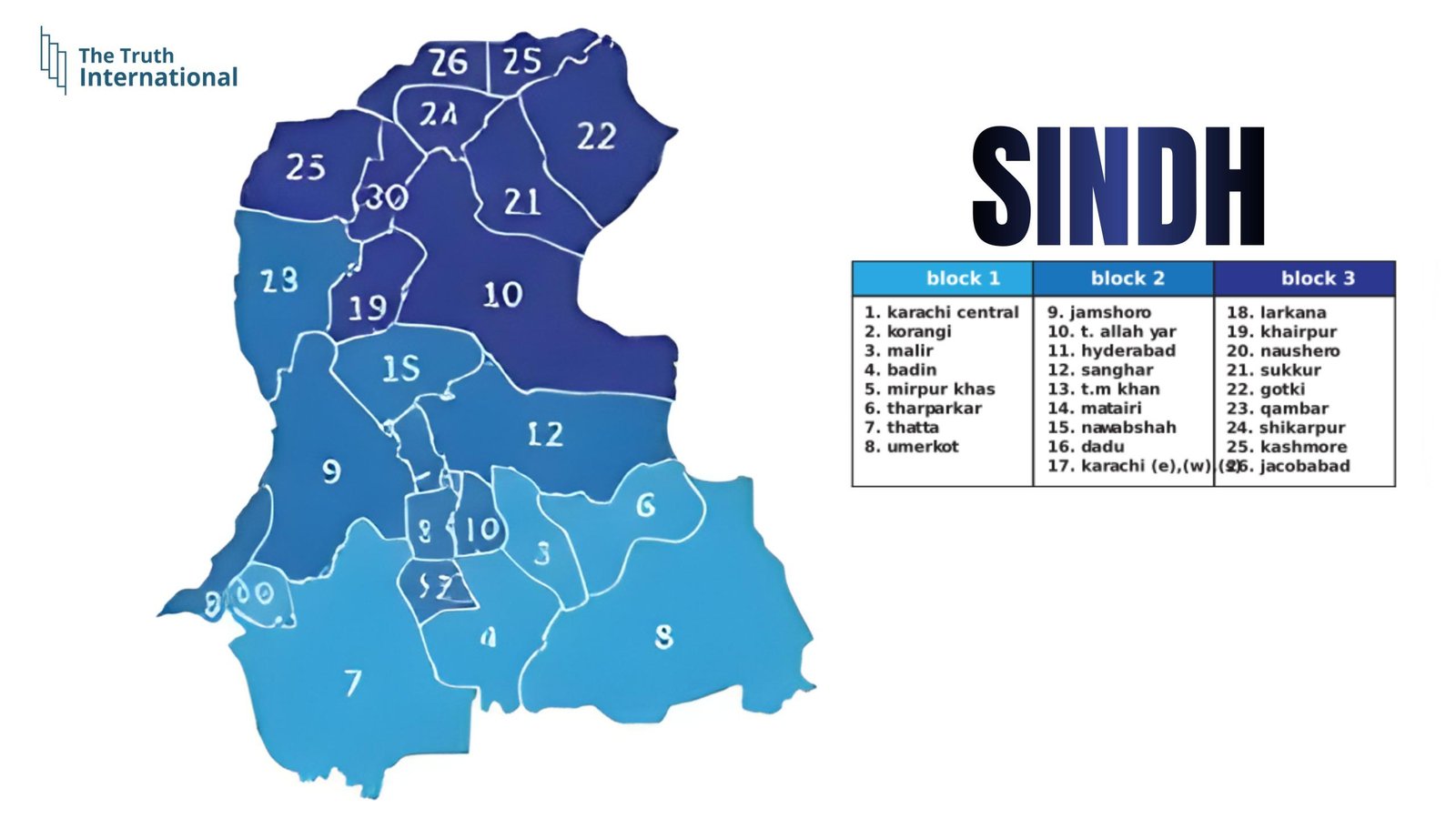
Karachi Division alone has more than 20.35 million residents and accounts for approximately 36.6 percent of Sindh’s population. The province also contains five other divisions: Hyderabad, Sukkur, Larkana, Mirpurkhas and Shaheed Benazirabad. These regions differ substantially in population density, economic activity, infrastructure, climate exposure and public-service requirements.
Karachi is a global-scale metropolitan centre. It requires mass transit, complex policing, port management, waste disposal, housing regulation and municipal planning.
Hyderabad functions as a major urban, educational and commercial centre for lower Sindh.
Sukkur is strategically linked to irrigation, agriculture, transport and northern Sindh.
Larkana has different political, agricultural and public-health requirements.
Mirpurkhas and surrounding districts face rural poverty, water insecurity and climate vulnerability.
Shaheed Benazirabad serves another large agricultural region with its own infrastructure and development challenges.
These areas do not merely differ in culture or political preferences. They require different forms of administration.
A single provincial government in Karachi must therefore manage one of the world’s largest cities while also addressing coastal erosion in Thatta and Sujawal, drought in Tharparkar, irrigation problems in the central districts, public safety in northern Sindh and healthcare shortages across remote settlements.
The question is not whether Sindh is historically or culturally one province.
The question is whether one centralised provincial administration can respond effectively to the full range of challenges experienced by almost 56 million people.
Karachi’s Scale Distorts the Provincial System
Karachi dominates discussions about Sindh because of its population, economic contribution and political importance.
This dominance creates problems for both Karachi and the rest of the province.
Karachi residents frequently argue that the city generates significant public revenue but does not receive authority or resources proportionate to its size. Municipal institutions remain divided across multiple agencies. Land, transport, water, policing and waste management are controlled by different levels of government.
Residents outside Karachi often raise the opposite concern. They believe provincial attention, investment and institutional capacity are concentrated in the capital while smaller cities and rural districts remain dependent on distant departments.
The result is a system in which neither side feels adequately served.
Karachi believes it lacks control over its own affairs. Rural and secondary urban areas believe Karachi absorbs provincial attention and resources.
This conflict cannot be resolved merely by changing a map. It requires clarity over functions, finances and accountability.
A new province without fiscal authority could remain ineffective. An empowered city government without coordination with surrounding districts could create additional fragmentation. A regional administration without elected representation could become another layer of bureaucracy.
Administrative restructuring must therefore begin by identifying which decisions should be made at the federal, provincial, regional, district and municipal levels.
Climate Change Has Made Centralisation More Dangerous
Sindh’s governance debate is no longer limited to development budgets or political representation.
It is increasingly a climate-survival issue.
The 2022 floods affected 33 million people across Pakistan and caused more than $30 billion in damage and economic losses. Sindh was among the worst-affected regions, with large areas remaining submerged long after the initial rainfall ended.
The disaster demonstrated that emergency response depends on more than federal announcements or provincial funding.
It requires functioning institutions close to affected communities.
Local administrations must identify vulnerable settlements before flooding. Regional authorities must coordinate evacuations, shelters, healthcare, food distribution and road access. Irrigation and disaster-management bodies must exchange information quickly. Reconstruction must reflect the different needs of coastal, riverine, agricultural and urban areas.
When all major decisions move through one provincial centre, delays become more likely.
The needs of a flooded village in Dadu are different from those of an inundated urban neighbourhood in Karachi. Coastal communities in Thatta face different risks from agricultural districts along the Indus. Drought conditions in Tharparkar require a different institutional response from river flooding in Sukkur or Larkana.
Smaller and properly empowered administrative regions could potentially respond faster because decision-makers would be closer to the affected districts.
But proximity alone is not enough.
Those institutions would need trained staff, independent budgets, reliable data, emergency authority and clear responsibility. Otherwise, restructuring would simply create smaller versions of the same weak system.
Governance and Security Are Becoming Inseparable
The DG ISPR’s intervention has added a national-security dimension to the discussion.
His argument was not simply that Pakistan should create more provinces. His broader point was that weak governance undermines security and stability.
This principle applies beyond areas directly affected by militancy.
When citizens cannot access justice, policing, employment, education or essential services, their trust in institutions declines. Criminal networks exploit administrative gaps. Land disputes remain unresolved. Smuggling and informal economies grow. Political resentment intensifies.
Sindh has experienced several forms of this problem.
Karachi has faced organised crime, land disputes, extortion and politically influenced policing. Northern Sindh has struggled with criminal groups operating in difficult riverine terrain. Rural communities frequently complain about weak policing and unequal access to justice.
Security operations may temporarily suppress criminal activity. They cannot replace effective civilian administration.
Police stations require professional oversight. Courts need accessibility. District governments need authority. Land records must be reliable. Municipal services must function. Young people need legitimate economic opportunities.
Good governance does not eliminate every security threat. However, persistent governance failure allows insecurity to return.
This is why the new-provinces debate cannot be separated from institutional reform.
Why Sindh’s Political Resistance Cannot Be Ignored
The Pakistan Peoples Party has reacted cautiously and, in some cases, directly rejected the idea of dividing Sindh.
PPP Vice President Sherry Rehman said no formal proposal had been presented to the party and advised the government not to expand the controversy without political consensus. Sindh Chief Minister Murad Ali Shah rejected the renewed proposal, describing the issue as an old debate that the people of Sindh had consistently opposed. The PPP has indicated that its Central Executive Committee will consider the broader question of new administrative units.
This opposition reflects more than party politics.
Sindh’s history has created a deep sensitivity towards any suggestion of territorial division. Many Sindhis fear that administrative reform could be used to separate Karachi from the province, weaken Sindh’s control over its resources or undermine its historic identity.
These fears must be addressed directly.
No sustainable administrative reform can be imposed on Sindh without public support. A proposal prepared by unelected experts, federal officials or institutions outside the province would lack legitimacy and could produce greater instability.
The DG ISPR himself emphasised that any change should follow the Constitution and reflect the public will.
Therefore, the burden lies on supporters of restructuring to explain precisely what they propose.
Are they suggesting new constitutional provinces?
Are they proposing autonomous regional governments?
Would existing divisions become administrative units?
Would Karachi receive metropolitan authority?
How would revenue be distributed?
What would happen to water, irrigation, policing and public employment?
Would citizens directly elect regional governments?
Without answers, the phrase “new administrative units” remains too vague to build public confidence.
The Constitutional Barrier Is Significant
Creating a new province is not an ordinary administrative decision.
Legal experts differ over the precise constitutional route, but there is broad agreement that altering provincial boundaries would require a constitutional amendment. Under Article 239, the process would require two-thirds majorities in both houses of Parliament and approval by a two-thirds majority in the assembly of the province whose boundaries would be changed.
Some constitutional lawyers argue that Pakistan’s Constitution does not contain an explicit mechanism for creating entirely new provinces and may first require a clearer enabling amendment. Others believe the existing amendment procedure is sufficient if the affected provincial assembly and Parliament approve the change.
This makes Sindh’s consent essential.
The federal government cannot realistically create new provinces in Sindh while bypassing the Sindh Assembly.
That requirement is not merely a legal obstacle. It is a constitutional protection intended to prevent the federation from unilaterally altering provincial territory.
Any serious proposal must therefore emerge through provincial consultation rather than federal pressure.
Could Stronger Local Government Achieve the Same Goal?
Opponents of new provinces present an important alternative.
They argue that Pakistan does not necessarily require additional provincial legislatures, governors, chief ministers, secretariats and bureaucracies. It requires powerful local governments.
Article 140A of the Constitution obliges provinces to establish local-government systems and devolve political, administrative and financial authority to elected local representatives. In practice, however, local governments often remain dependent on provincial administrations for finances, appointments and essential functions.
This raises a legitimate question.
Before dividing Sindh into new provinces, should the existing provincial government first empower Karachi, Hyderabad, Sukkur, Larkana, Mirpurkhas, Shaheed Benazirabad and their districts through meaningful local devolution?
A genuine local-government system could transfer authority over water, sanitation, local roads, land-use planning, primary healthcare, schools and municipal policing to elected institutions.
This approach would be less constitutionally difficult than creating new provinces.
However, local government alone may not resolve every issue.
Major policing, irrigation, disaster management, higher education, regional transport and health networks often extend beyond individual districts or municipalities. These responsibilities may require an intermediate regional tier between local councils and the provincial government.
Sindh could therefore examine a regional governance model based on its existing divisions.
Each division could receive an elected regional council, defined administrative powers and a guaranteed budget. The provincial government would retain province-wide responsibilities, while regional institutions would coordinate services across districts.
Such a model could test decentralisation without immediately redrawing Sindh’s constitutional boundaries.
New Provinces Are Not a Substitute for Reform
Creating more provinces will not automatically produce good governance.
A smaller province can still be corrupt, inefficient, financially dependent and politically captured.
If appointments remain politicised, budgets remain opaque and citizens cannot hold officials accountable, changing administrative boundaries will produce limited results.
New units could also increase expenditure.
Each province would require a legislature, cabinet, secretariat, public service structure and institutional network. Without careful planning, the reform could create more offices while leaving citizens with the same weak services.
Therefore, any proposal must include measurable governance objectives.
Would emergency response times improve?
Would schools and hospitals receive funds faster?
Would police become more accountable?
Would regional development gaps narrow?
Would citizens gain direct control over local spending?
Would administrative costs fall or rise?
The success of reform should be judged through such outcomes, not by the number of provinces created.
A National Commission Could Move the Debate Forward
Pakistan needs a structured process rather than another cycle of speeches and political reactions.
A national commission on administrative and local-government reform could examine population, geography, climate exposure, public finances, service delivery and regional inequality.
Its membership should include representatives from all provinces, local governments, political parties, universities, civil society, constitutional experts and public-administration specialists.
Sindh should conduct its own provincial consultation before accepting or rejecting any model.
Public hearings could be held in Karachi, Hyderabad, Sukkur, Larkana, Mirpurkhas and Shaheed Benazirabad. Citizens should be asked which services fail, where decisions are delayed and which functions should be transferred closer to communities.
The process should compare several options rather than presenting division as the only solution.
These could include stronger local governments, elected regional councils, metropolitan authorities, division-based federating units or a combination of models.
No boundary should be changed until the financial, administrative and constitutional consequences are publicly available.
The Real Choice Is Between Reform and Continued Failure
The renewed debate should not be reduced to a choice between dividing Sindh and preserving Sindh.
Sindh’s territorial unity and the quality of its governance are related but separate questions.
A province can remain united while transferring substantial authority to regions and municipalities. It can also be formally divided while power remains concentrated in new capitals.
The central issue is where decisions are made, who controls public money and how citizens hold institutions accountable.
Naqvi’s language may have been blunt, but his description of a system unable to solve recurring problems has resonated because those failures are visible.
The DG ISPR’s remarks added another reality: when governance repeatedly fails, the consequences extend beyond poor services. They affect social stability and national security.
Sindh cannot avoid this conversation by treating every reform proposal as an attack on its identity.
At the same time, the federal government cannot expect Sindh to accept vague plans developed without democratic consent.
The way forward lies between these positions.
Pakistan needs a transparent, constitutional and evidence-based examination of its administrative structure. Sindh needs a serious discussion about whether power should remain concentrated in the provincial capital or move towards its divisions, districts and cities.
The question is not merely whether Pakistan should create more provinces.
The more important question is whether the state is prepared to transfer real power, real finances and real accountability closer to its people.
Without that commitment, new provinces will become new bureaucracies.
With it, administrative reform could become the beginning of a more responsive federation.

