
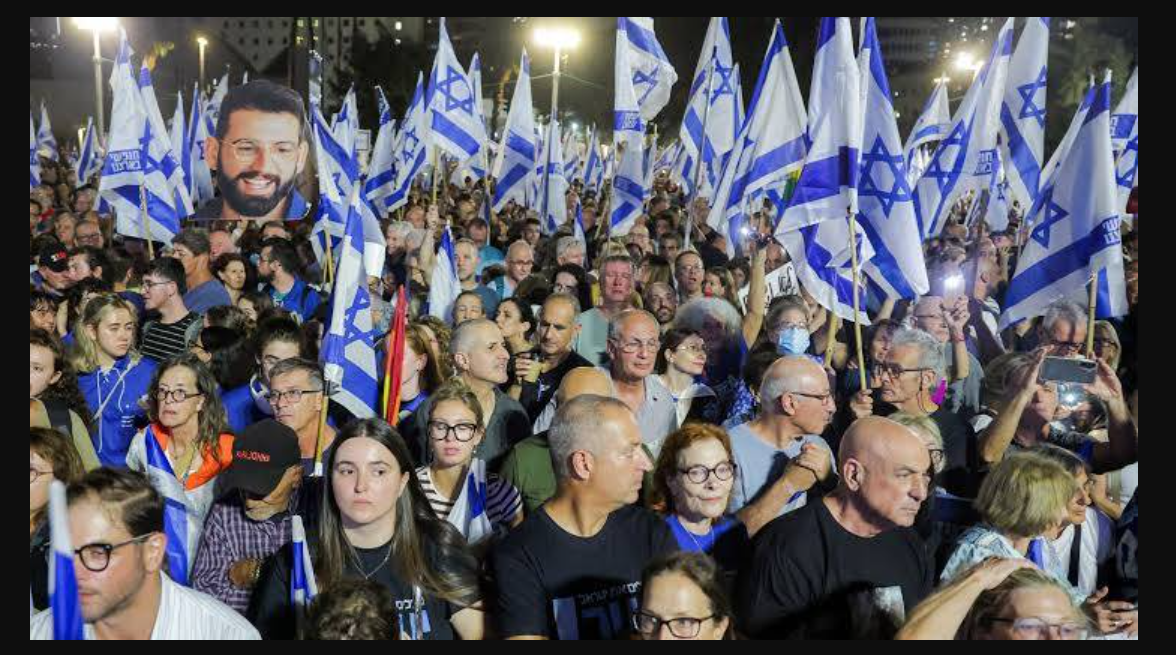

Thousands of protesters gathered in Tel Aviv on Saturday, demanding accountability from Israeli Prime Minister Benjamin Netanyahu ahead of a closely watched general election. The demonstration came three days before voters were due to decide the country’s political direction.
The rally focused on security failures surrounding the Hamas-led attack on October 7, 2023, which triggered the Gaza war. Protesters also called for an independent state commission to investigate why authorities failed to prevent the attack.
Families Demand Answers Over October 7 Attack
The October Council organised the demonstration, bringing together families of victims and hostages taken by Palestinian militants during the October 7 attack. The group has campaigned for accountability and a full investigation into the security failures.
Ahead of the rally, the council announced its intention to mark three years of campaigning for answers.
“Three days before the election, we will hold the culminating event marking three years of struggle to uncover the truth, demand accountability, and establish a state commission of inquiry,” the October Council wrote on X.
According to Israeli media, leaders from the four main opposition parties attended the gathering. Former military chief Gadi Eisenkot, whose political bloc was competing closely with Netanyahu’s, received a warm welcome from demonstrators.
Protesters marched from Rabin Square towards Hostages Square, a central location for previous demonstrations demanding the release of captives held in Gaza.
Hadas Feuershtein, 68, criticised the government’s record before the rally began.
“Whoever has been leading us for the past four years (since Netanyahu’s government took office in late 2022) has done such a terrible job,” she said.
“Israel has never been in a situation as it is now,” she added.
Election Polls Show No Clear Majority
The latest polls published before election-related restrictions on polling coverage took effect showed neither major bloc securing a parliamentary majority.
A poll published by public broadcaster KAN projected 52 seats for Eisenkot’s bloc and 50 for Netanyahu’s bloc in the 120-seat Knesset. The remaining seats were projected to go to unaffiliated parties, including Arab parties.
Meanwhile, opposition figures Gadi Eisenkot and Naftali Bennett were expected to hold separate final campaign meetings with voters in Tel Aviv on Sunday evening.
The October Council had also warned law enforcement about possible provocations from pro-government groups. Separately, police said they arrested a suspect over an alleged assault on a public figure’s security team in Tel Aviv.
Israeli media identified the target as former prime minister and opposition leader Naftali Bennett.
Dispute Over Independent Investigation
Netanyahu’s government has refused to establish an independent commission of inquiry into the October 7 security failures. Instead, it has proposed a political commission with members appointed equally by governing coalition and opposition lawmakers.
However, opposition leaders have rejected that arrangement, arguing that politicians should not control an investigation into their own government’s conduct. They have also pledged to boycott a commission appointed by political representatives.
Netanyahu’s Digital Economy Proposal Draws Criticism
The election campaign has also focused on Israel’s international standing and economic future after years of conflict involving Gaza, Lebanon and Iran. Rising violence in the occupied West Bank has added to international criticism of Israeli government policies.
Britain and several other countries imposed sanctions targeting goods from Israeli settlements in the West Bank. The measures followed settler attacks against Palestinians and settlement construction approved by Netanyahu’s right-wing government.
Against this backdrop, Netanyahu suggested on Friday that Israel might need to develop an alternative digital economy. He also warned that multibillion-dollar weapons packages from Washington “won’t keep coming”.
Opposition leaders criticised the proposal. Eisenkot sarcastically called the suggested parallel digital currency “bbCoin”, referring to Netanyahu’s common nickname, Bibi.
“Netanyahu says that if he is elected again, Israel will disconnect from the global economy. No online shopping, no investments in high-tech, no security. We must not let bbCoin destroy Israel,” Eisenkot wrote on X.
Former prime minister and opposition leader Yair Lapid also warned of potential economic consequences if Netanyahu won another term.
“If he wins the elections, that’s what will happen: there will be sanctions, there will be no security agreement with the United States… and there will be no Israeli economy,” Lapid said in an interview with Israel’s Channel 12.
First-time voter Naama Bitterman, 18, said she expected the anti-Netanyahu bloc to win and improve Israel’s international image.
“I think that if we win — and we are going to win — we can change how other people in the entire world see us,” she said.
With voting approaching, the demonstrations highlighted public anger over the October 7 security failures, disagreements over accountability and concerns about Israel’s international and economic future.
For the latest updates, visit and follow The Truth International website (www.thetruthinternational.com) and subscribe to the YouTube Channel.

