
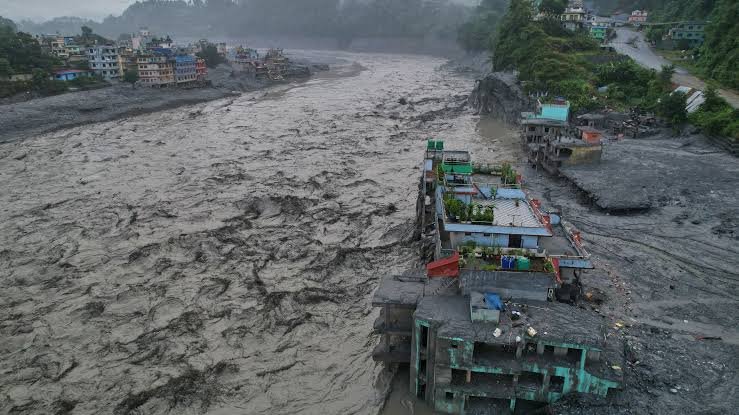

One month after a devastating flood tore through Nepal, the Himalayan nation is still counting its losses.
Thousands remain missing, while rescue teams continue searching through vast areas of mud and debris.
The disaster struck on August 26 after a massive collapse of rock and ice near Langtang Lirung on the China-Nepal border. The resulting torrent swept through valleys, destroying infrastructure, homes and major development projects.
‘Bullet Train’ of Rock, Ice and Water
The disaster began at around 8:37am on August 26.
A huge section of rock and ice broke away from the northern face of Langtang Lirung at an altitude of about 5,200 metres.
The collapsed mass was more than one kilometre wide and extended roughly 700 metres vertically.
It plunged nearly 800 metres onto a debris-covered glacier before surging down the valley.
The force of the collapse briefly blocked the Lhende River. Water and debris then broke through and rushed downstream.
Geologist Sudan Bikash Maharjan of the International Centre for Integrated Mountain Development said the debris travelled around 20 kilometres.
At Rasuwagadhi, it descended about 1,700 metres in only seven minutes.
The extreme speed and force turned the flood into a destructive wall of rock, ice, mud and water.
Death Toll Rises as Thousands Remain Missing
Nepal’s disaster authorities say 1,451 bodies have been recovered from the rubble and mud.
More than 5,700 people remain missing.
Many of those missing were workers at hydropower projects that were swept away by the flood.
Foreign nationals, including tourists and pilgrims, were also caught in the disaster.
Identifying victims has become a major challenge.
Authorities have collected DNA samples from recovered bodies. However, only around 100 victims have been identified so far.
With morgues overwhelmed, some victims have been buried in mass graves after their DNA information was recorded.
The disaster also caused severe destruction on the Chinese side of the border.
Chinese state media reported 43 deaths and 519 people missing after the flood destroyed a border area.
Rescue Teams Continue Search Operations
Hundreds of rescuers have spent weeks searching through thick mud and collapsed structures.
Helicopters have been used to reach isolated areas and transport emergency supplies.
Rescue teams have also searched tunnels and damaged infrastructure for survivors.
In one dramatic rescue, three workers were found alive inside tunnels under construction.
Two were Nepali nationals and one was Chinese.
One survivor, 30-year-old Sanjay Sah, said he remained trapped for 10 days in darkness.
He survived by drinking muddy water and relying on his faith.
Despite such rare rescues, teams continue to recover bodies from large areas covered by sticky grey mud.
More Than 80,000 People Need Assistance
The disaster has affected more than 80,000 people across Nepal.
Thousands of survivors have lost homes, possessions and sources of income.
Many are now living in temporary shelters and remain dependent on emergency assistance.
The United Nations has launched an appeal for nearly $50 million in emergency aid.
Several communities close to the disaster zone remain cut off.
The Nepali government and international agencies are using helicopters and cargo drones to deliver food, medical supplies and other essential items.
Several countries have also announced financial assistance. However, the support pledged so far remains far below the estimated scale of the disaster.
Nepal Faces Billions in Reconstruction Costs
The economic impact is expected to continue long after rescue operations end.
Nepal estimates that rebuilding damaged infrastructure could cost around $4.78 billion.
About $57 million is required for immediate reconstruction and recovery during the next six months.
The energy sector has suffered particularly heavy damage.
Nepal’s electricity generation capacity has fallen by around 10 percent, with hydropower accounting for much of the country’s energy infrastructure.
The energy sector alone represents about half of the total infrastructure damage caused by the disaster.
The economic burden comes as Nepal already faces limited financial resources.
The World Bank estimates that around 82 percent of Nepal’s workforce is employed informally.
Nepal’s GDP per capita stood at about $1,447 in 2024, highlighting the challenge of financing recovery on such a large scale.
Climate Change Raises Fresh Concerns
Scientists have linked the disaster to several long-term environmental changes in the Himalayan region.
Experts from the World Weather Attribution group described the event as a “compound crisis” involving glacier retreat, permafrost thaw, long-term warming and geological instability.
Climate scientist Friederike Otto said climate change was one of the factors driving the increasing risks in the region.
The disaster has renewed concerns about the vulnerability of Himalayan communities to climate-related hazards.
Nepal’s leaders are calling for greater international support to help mountain communities adapt to a rapidly changing environment.
Prime Minister Balendra Shah has urged the international community to recognise the growing risks and accelerate action on climate change.
One month after the disaster, Nepal is facing a difficult combination of missing people, destroyed infrastructure, humanitarian needs and billions of dollars in reconstruction costs.

