

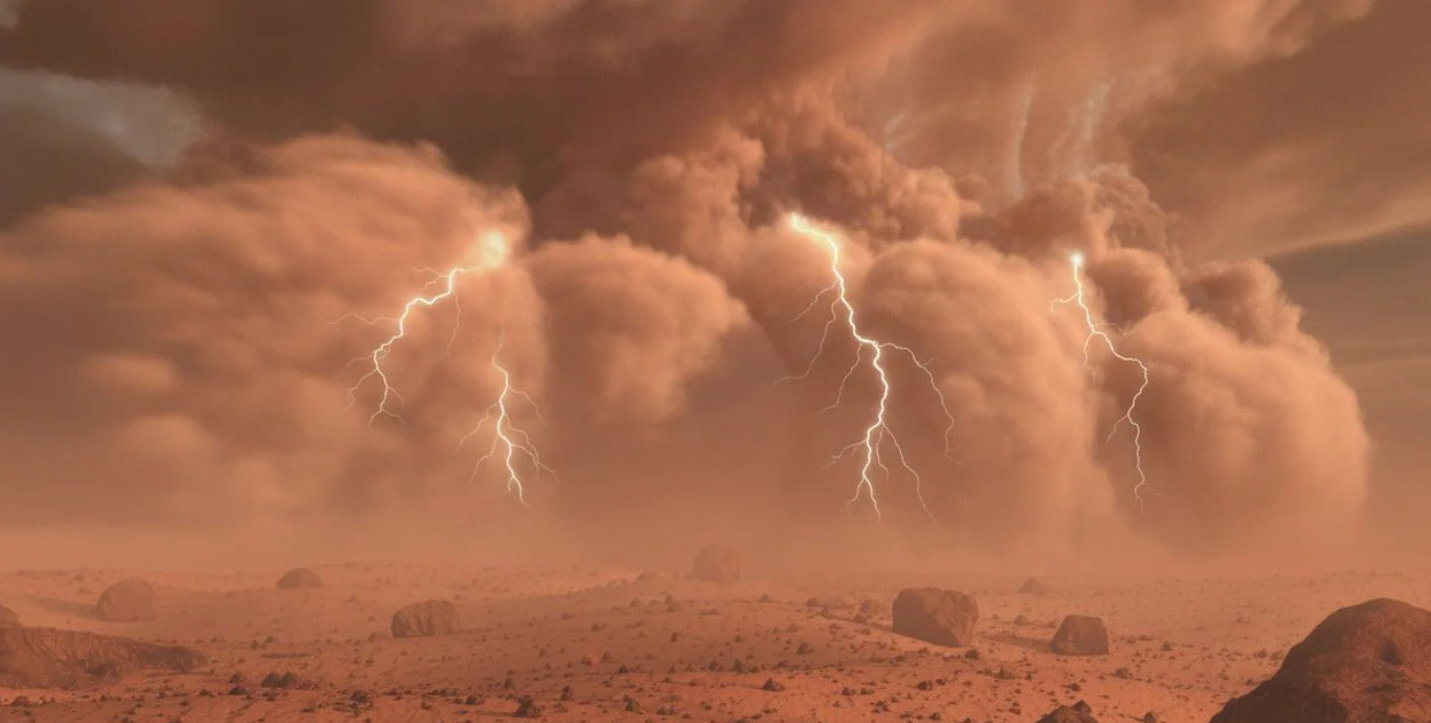

For the first time, NASA’s Perseverance rover has recorded lightning on Mars, detecting faint electrical “zaps” produced by the planet’s dust storms. Scientists had long speculated that electrical discharges might occur in the Martian atmosphere, but confirming them proved challenging—until the rover’s microphone inadvertently captured these events.
Tiny Electrical Discharges Detected Across the Planet
Unlike Earth’s dramatic, kilometre-long lightning bolts, these Martian discharges are extremely small. Researchers describe them as similar to static shocks experienced when touching a car door on a dry day. Although low in energy, these zaps appear to occur constantly across the planet’s surface.
The process begins when microscopic dust particles rub against each other, becoming electrically charged. This energy is released in tiny arcs, only a few millimetres to centimetres long, producing an audible shock. Mars’ thin atmosphere and unique surface composition allow even minimal charge buildup to trigger these discharges.
Historical Context of Dust-Induced Lightning on Mars
The concept of Martian dust lightning has existed since the early days of planetary exploration. Laboratory experiments replicated these phenomena, and in 2016, the European Space Agency’s Schiaparelli lander carried instruments to detect electrical discharges. However, the lander crashed during landing, leaving the theory unconfirmed—until Perseverance recorded the signals via its SuperCam microphone.
Scientific Implications for Martian Climate and Chemistry
Researchers believe these discharges may provide new insights into Martian climate dynamics. Dust drives the planet’s weather similarly to how water influences Earth’s weather cycle. Seasonal dust storms could trigger more frequent electrical events, potentially influencing atmospheric processes.
Additionally, these electrical discharges might contribute to breaking down organic molecules on the Martian surface. They may also explain the rapid disappearance of methane, a longstanding mystery for scientists studying the planet.
Impact on Future Mars Missions
The discovery carries practical implications for future exploration. Robotic instruments and materials may need enhanced protection against electrical discharges. Similarly, human missions will need to consider potential risks to spacesuits and equipment exposed to prolonged lightning activity.
Scientists caution that, over time, these small shocks could affect astronaut safety and mission equipment, emphasizing the importance of studying Martian electrical activity further.
NASA’s accidental detection of Martian lightning marks a milestone in planetary science. By revealing persistent electrical discharges linked to dust storms, the finding enhances understanding of Mars’ weather, climate, and potential hazards for exploration. Future missions may benefit from this knowledge, ensuring better preparation for both robotic and human explorers on the Red Planet.
