



ISLAMABAD: Justice Jamal Khan Mandokhel said National Assembly’s Deputy Speaker Qasim Suri announced the April 3 ruling which dismissed the no-confidence motion against Prime Minister Imran Khan, but the ruling carried signature of Speaker Asad Qaiser.
Justice Mandokhel stated this today as Qasim Suri and Asad Qaiser’s lawyer, Naeem Bukhari, presented his arguments in the suo motu case concerning the legality of the deputy speaker’s ruling.
Responding to the judge’s statement, Bukhari replied that perhaps the documents given to him might not be “original”.
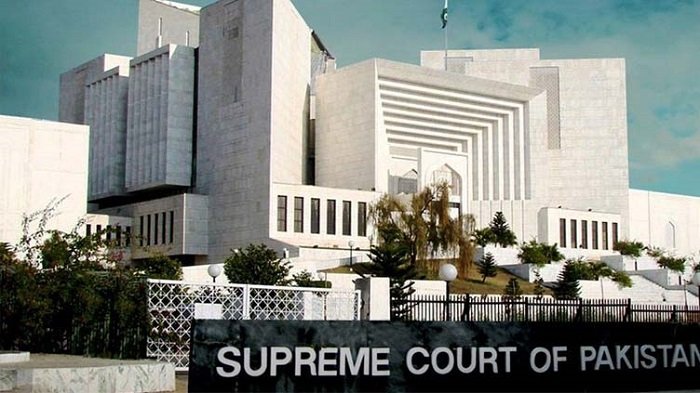
A five-member bench, headed by Chief Justice of Pakistan (CJP) Umar Ata Bandial and comprising Justice Ijazul Ahsan, Justice Justice Mazhar Alam Miankhel, Justice Munib Akhtar and Justice Jamal Khan Mandokhel took up the case around 9:30am.
Bukhari began his arguments by stating that he would focus on whether a point of order could be discussed at any time. He argued that the apex court had refrained from interfering in parliamentary proceedings in the past and asked whether the court would have taken notice if the speaker had dismissed Fawad Chaudhry’s point of order.
“When assemblies were dissolved in the past, the election process was not stopped even though it was declared unconstitutional,” he said, asserting that the speaker could reject the no-trust move on a point of order. “This has never happened before but the speaker has the power [to do so].”
He said that the former minister had requested a point of order as soon as the session had began. “The point of order couldn’t have been taken up had voting on the no-confidence motion started,” he said.
Justice Mandokhel asked which law stated that the speaker had the power to dismiss the no-confidence motion. “We want to understand the definition of a point of order,” he said.
“The question is whether a new point of order can be taken up once the no-confidence motion is introduced,” the CJP said. Justice Akhtar also asked if the point of order was included in the day’s agenda.
However, Bukhari replied that a point of order could be raised at any time.
“Voting on the no-confidence motion is a constitutional requirement,” Justice Mandokhail pointed out. Can the rules be used to invalidate the constitutional right to vote, he wondered.
