

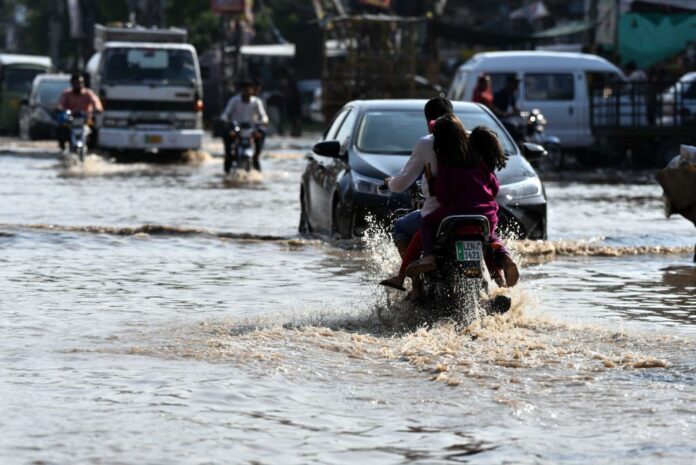

ISLAMABAD: Monsoon death toll in Pakistan has increased to 221 as more people lost their lives in the torrential rains in the past 24 hours. The death toll has risen as fresh cloudbursts triggered flash floods, landslides, and lightning strikes across various regions, particularly in the country’s mountainous areas, the National Disaster Management Authority (NDMA) reported on Tuesday.
In the last 24 hours alone, rain-related incidents claimed the lives of five people — including two men and three children — while ten others sustained injuries, the NDMA said. Rescue and relief operations are ongoing as weather conditions remain volatile.
As Pakistan reels from a relentless monsoon season, the number of injured in rain-related accidents has climbed to 592, including 77 men, 40 women, and 104 children, according to the National Disaster Management Authority (NDMA). The ongoing extreme weather has devastated communities across the country, with Punjab emerging as the worst-hit province, reporting 135 deaths and 470 injuries.
In other provinces, Khyber Pakhtunkhwa has reported 40 deaths and 69 injuries; Sindh has seen 22 fatalities and 40 people wounded. Balochistan has confirmed 16 deaths, while Azad Kashmir recorded one fatality and six injuries. Gilgit-Baltistan reported three non-fatal casualties, and Islamabad witnessed one death.
The primary causes of these casualties include structural collapses, drowning, landslides, flash floods, lightning strikes, and electrocution.
The NDMA reported that 25 homes collapsed within the last 24 hours, while five cattle perished. Since the onset of the monsoon, 804 homes have been either damaged or destroyed, and at least 200 livestock animals have been lost.
Province-Wise Property Damage Overview:
- Punjab: 168 homes partially damaged
- Khyber Pakhtunkhwa: 142 homes partially damaged, 78 completely collapsed
- Sindh: 54 partially and 33 fully collapsed homes
- Balochistan: 56 homes partially damaged, 8 destroyed
- Gilgit-Baltistan: 71 partially damaged, 66 completely razed
- Azad Kashmir: 75 partially damaged, 17 destroyed
- Islamabad: 35 partially damaged homes, one fully collapsed
A flood emergency has also been declared in Babusar, where torrential rains have triggered flash floods and landslides across a 7–8 km radius near Babusar Top. At least 14 to 15 routes have been blocked, although authorities confirmed that stranded tourists have been safely relocated to Chilas.
Rescue and relief operations remain underway. However, the NDMA has urged citizens—particularly those living in low-lying or flood-prone areas—to exercise extreme caution as more heavy rainfall is expected.
More Rain Forecast as PMD Issues Fresh Warnings
The Pakistan Meteorological Department (PMD) has forecast widespread rain, wind, and thundershowers across Kashmir, Khyber Pakhtunkhwa, Islamabad, Punjab, and Gilgit-Baltistan on Tuesday. While some parts of the country will continue to experience hot and humid conditions, others may witness heavy to very heavy rainfall.
The PMD has specifically warned of flash flooding on July 22 in local streams and nullahs, especially in northern and hilly areas such as Chitral, Swat, Dir, Shangla, Mansehra, Kohistan, Abbottabad, Murree, and Galliyat, as well as in Dera Ghazi Khan and northeastern Punjab.
Urban flooding is also a concern for major cities including Islamabad, Rawalpindi, Gujranwala, Lahore, Sialkot, Sargodha, Faisalabad, Okara, Nowshera, and Peshawar. Landslides and mudslides pose additional risks in elevated terrain across Khyber Pakhtunkhwa, Gilgit-Baltistan, Kashmir, Murree, and Galliyat.
While monsoon rains are vital for agriculture and water reservoirs, experts warn their impact has worsened in recent years due to rapid urbanization, inadequate drainage infrastructure, and the increasing frequency of extreme weather events linked to climate change.
