

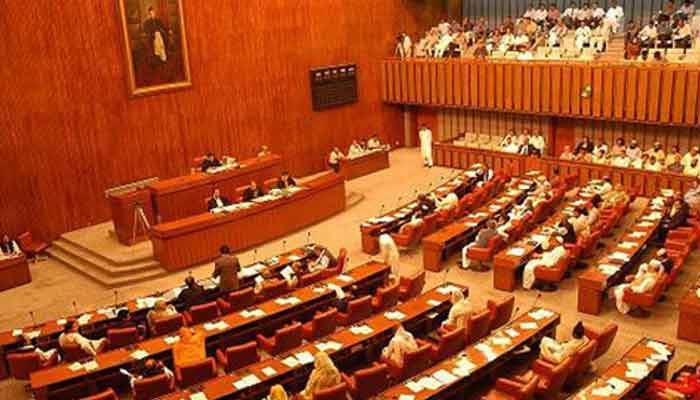

ISLAMABAD: The federal government has presented the finance supplementary bill (mini-budget) in the Senate amid opposition’s protest as Chairman Senate Sadiq Sanjrani referred the bill to the house committee with the directive to finalise recommendations within three days.
When Finance Minister Shaukat Tarin presented mini-budget in the upper house, the opposition members stood up and raised anti-government slogans as soon as the chairman gave floor to Finance Minister.
The government had already introduced in the National Assembly on December 30, with another controversial State Bank of Pakistan (Amendment) Bill, 2021 aimed at granting autonomy to the central bank.
In their fiery speeches, opposition leaders criticised the government for presenting the mini-budget on the dictation of the International Monetary Fund (IMF) and they termed it a total surrender of the country’s economic sovereignty.
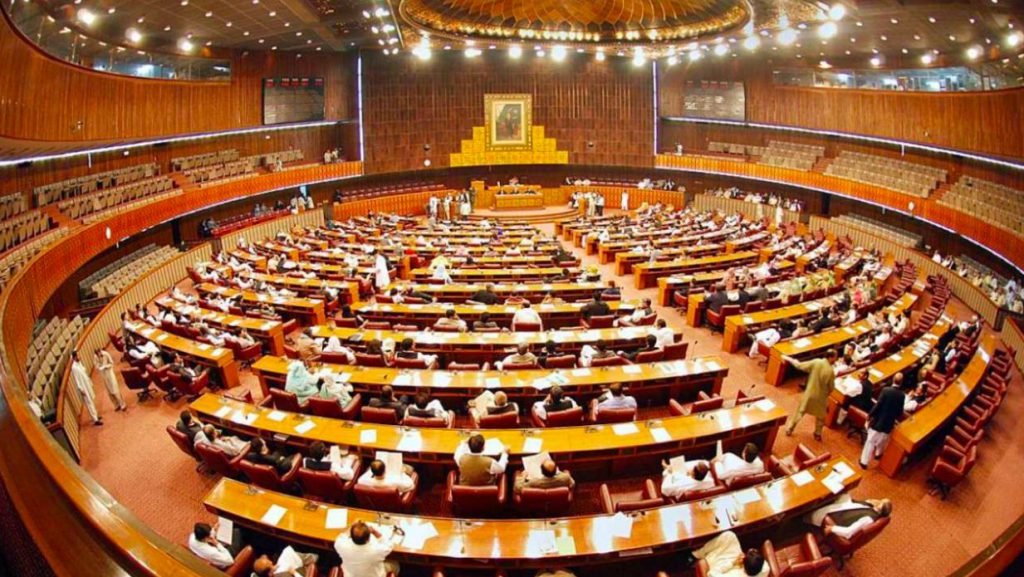
The approval of the finance (supplementary) bill seeking to amend certain laws related to taxes and duties as well as the SBP bill is necessary to ensure that sixth review of Pakistan’s $6 billion Extended Fund Facility gets cleared by the IMF’s Executive Board which is scheduled to meet on January 12 to decide about the disbursement of about $1 billion tranche.

The government laid the bill in the Senate under Article 73 of the Constitution which deals with the “procedure with respect to money bills”, which are only required to be passed by the National Assembly, the lower house of parliament.
Article 73(1) states that “Notwithstanding anything contained in Article 70, a money bill shall originate in the National Assembly: provided that simultaneously when a money bill, including the finance bill containing the annual budget statement, is presented in the National Assembly, a copy thereof shall be transmitted to the Senate which may, within fourteen days, make recommendations thereon to the National Assembly”.
These recommendations, however, are not binding for the National Assembly and it can approve a money bill, even without considering them.
Although the Constitution provides 14 days to the Senate for preparing recommendations, the chairman’s directive that the committee complete its task within three days clearly shows that the government wants to complete the process as early as possible and it may make an attempt to get the money bill passed from the National Assembly before Jan 12.
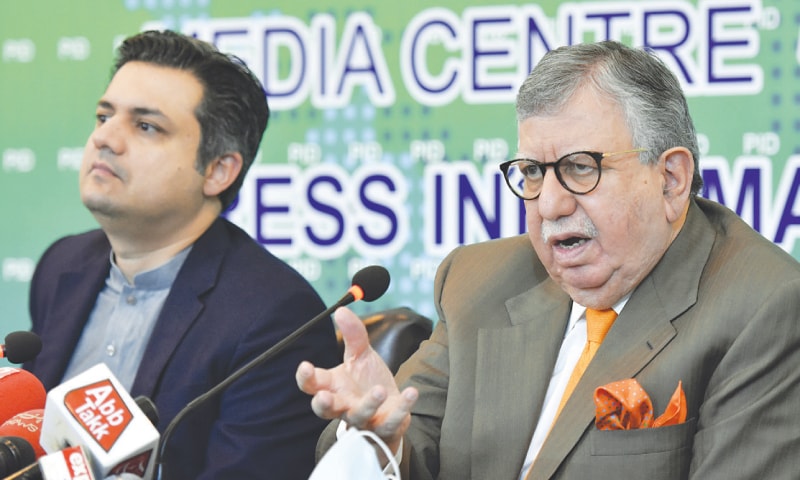
Talking to reporters on Monday, Mr Tarin had stated that the Senate could finalise its recommendations in four days and then the bill could be passed by the National Assembly. He, however, had said that there was no problem for the IMF, if the approval of the bill was delayed for a few days.

The government succeeded in presenting the money bill in the Senate despite having a thin attendance on the treasury benches.
During the question hour, the opposition pointed out lack of quorum after staging a walkout from the house to register its protest over some remarks of Minister of State for Parliamentary Affairs Ali Mohammad Khan while responding to a question regarding the foreign visits of Prime Minister Imran Khan and the government failed to ensure the presence of the required 26 members (one-fourth of the total 100-member house) despite the chairman provided them ample time to do so by ordering the ringing of the bells twice. However, the opposition members returned to the house after some time, thus facilitating the government to complete the quorum and present the bill.
Speaking on a point of order, Raza Rabbani of the Pakistan Peoples Party (PPP) regretted that the government had brought the two legislations as per IMF conditions. Amid slogans of “shame, shame” from the opposition members, he said the finance minister had himself admitted in his recent statement that the government had increased the oil prices on the IMF’s directive.
He praised the finance minister for showing “candidness” by publicly acknowledging that the talks with the IMF remained tough due to the US pressure on the donor agency.
“The nation wants to know what pressure the US wants to exert on Pakistan through the IMF which has forced the government to mortgage Pakistan,” he said.
Mr Rabbani asked the minister to inform the nation through this house as to what type of pressure the US was putting on Pakistan.
Chairman Senate Sadiq Sanjrani rescued Finance Minister Tarin when he said the finance minister would respond to the point when he will be winding up the debate.
