

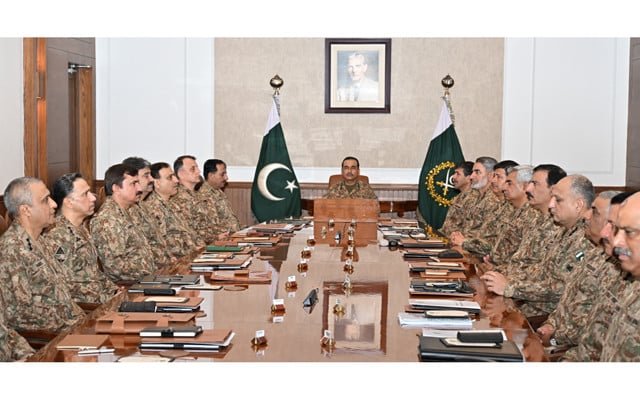

Military Leadership
The National Security Committee (NSC) meeting, chaired by Speaker Ayaz Sadiq, is currently underway at Parliament House, focusing on the country’s security challenges. This in-camera session includes a comprehensive briefing from military leadership, providing parliamentarians with updates on the evolving security situation.
High-Level Attendance at NSC Meeting
The meeting is being attended by key government and military figures, including Prime Minister Muhammad Shehbaz Sharif, federal ministers, Advisor to the Prime Minister Rana Sanaullah, and Amir Muqam. Military leadership is also present, with Chief of Army Staff (COAS) General Syed Asim Munir, Director General of Inter-Services Intelligence (DG ISI), and Director General of Military Operations (DGMO) briefing the attendees.
Other notable figures include Prime Minister Azad Jammu and Kashmir Anwarul Haq and Chief Minister Gilgit-Baltistan, along with provincial leaders such as Governor Khyber Pakhtunkhwa Faisal Karim Kundi, Chief Minister KP Sardar Ali Amin Gandapur, Chief Minister Balochistan Mir Sarfaraz Bugti, Governor Punjab Sardar Saleem Haider, and Chief Minister Punjab Maryam Nawaz Sharif. Senior politicians like Maulana Fazlur Rehman, Kamran Murtaza, Maulana Atta-ur-Rehman, and Senator Kamil Ali Agha are also present.
Speaker Expresses Disappointment Over Opposition’s Absence
In his opening remarks, Speaker Ayaz Sadiq emphasized the need for national unity in addressing security threats. Expressing disappointment over the opposition’s absence, he stated, “The country is facing serious challenges that require a united response. It would have been better if all parties had attended this critical discussion.”
Prime Minister Shehbaz Sharif Praises Security Forces
Prime Minister Shehbaz Sharif highlighted the security concerns, particularly in Balochistan and Khyber Pakhtunkhwa (KP). He reaffirmed the nation’s collective stance against terrorism and acknowledged the sacrifices made by security forces.
“Our security forces have made immense sacrifices to protect the country. We will continue to fight terrorism at all costs. It would have been better if opposition leaders had joined this crucial meeting,” the premier remarked.
Military Briefing Reveals Foreign Involvement in Terrorism
During the session, military officials provided an in-depth briefing on the rising terrorist activities, particularly in KP and Balochistan. Key revelations from the briefing include:
- Foreign Involvement: The Indian intelligence agency RAW and Afghan elements are allegedly supporting terrorist groups such as Fatna-ul-Kharij to destabilize the region.
- Cross-Border Threats: Intelligence reports suggest that Afghan soil has been repeatedly used to plan attacks against Pakistan.
- Major Terrorist Attacks: Incidents like the Jafar Express attack and the assault on Bannu’s Counter-Terrorism Department (CTD) center were reportedly coordinated from Afghanistan, involving several Afghan nationals.
- Foreign Weapons Supply: Militant groups are using foreign-manufactured weapons, indicating external support.
- Pre-Ramadan Surge: There was a significant rise in terrorist activities ahead of Ramadan, suggesting coordinated efforts to create instability.
The security briefing included visual presentations showcasing key intelligence findings, evidence, and analysis of recent attacks.
Fazlur Rehman Criticizes PTI’s Boycott
During the meeting, Maulana Fazlur Rehman expressed his disappointment over PTI’s absence, stating that had they consulted him, he would have advised them to attend. He reiterated his commitment to national security and policy continuity, warning against Pakistan’s involvement in foreign conflicts.
Criticizing past decisions, he said joining the U.S.-led war after 9/11 was a mistake that brought major losses to Pakistan. He also stressed that Pakistan should avoid becoming a part of any external war, particularly in Afghanistan.
Bilawal Bhutto Calls for Diplomatic Action Against Terrorism
PPP Chairman Bilawal Bhutto Zardari stressed that Afghanistan has become a hub for terrorist activities. He warned that if terrorism is not controlled, its effects could spill over into neighboring countries.
He called for a stronger diplomatic stance against terrorism, urging Pakistan to expose the Afghan government’s role in harboring terrorist elements. He also emphasized the need for global powers to remain engaged with regional security challenges.
Mohsin Naqvi’s Absence and Political Developments
Federal Interior Minister Mohsin Naqvi was absent from the NSC meeting, reportedly due to his stay in Dubai for medical reasons after attending the closing ceremony of the ICC Champions Trophy.
Meanwhile, former Prime Minister Nawaz Sharif was not invited to the meeting, while former Balochistan Chief Minister Sardar Akhtar Mengal did not attend despite being invited. PTI members of parliament also remained absent.
PTI’s Conditional Participation
Although Khyber Pakhtunkhwa Chief Minister Ali Amin Gandapur was permitted to attend, PTI made its broader participation conditional on securing a meeting with its founding chairman, Imran Khan.
PTI leader Sheikh Waqas Akram stated that the party had decided not to participate unless they were granted access to Khan. “PTI will attend only if a meeting with the founding chairman is arranged,” he asserted.
Khawaja Asif Criticizes PTI for Skipping the Meeting
Defense Minister Khawaja Asif criticized PTI’s decision to boycott the meeting, stating that their priority is Imran Khan rather than national security.
“At a time when the country is grappling with terrorism, PTI is prioritizing political gains over national security. This is nothing short of anti-patriotism,” he remarked.
Planned Operation Against Terror Groups
Government sources indicate that authorities are considering launching a large-scale operation against banned militant outfits, including the Balochistan Liberation Army (BLA), which has been responsible for recent attacks in Balochistan.
Additionally, the government is planning to convene a Multi-Party Conference (MPC) to discuss security challenges, with hopes that all political stakeholders will participate.
As Pakistan faces rising security threats, the NSC meeting underscores the critical need for political unity, intelligence coordination, and strengthened diplomatic efforts to counter terrorism effectively.
