

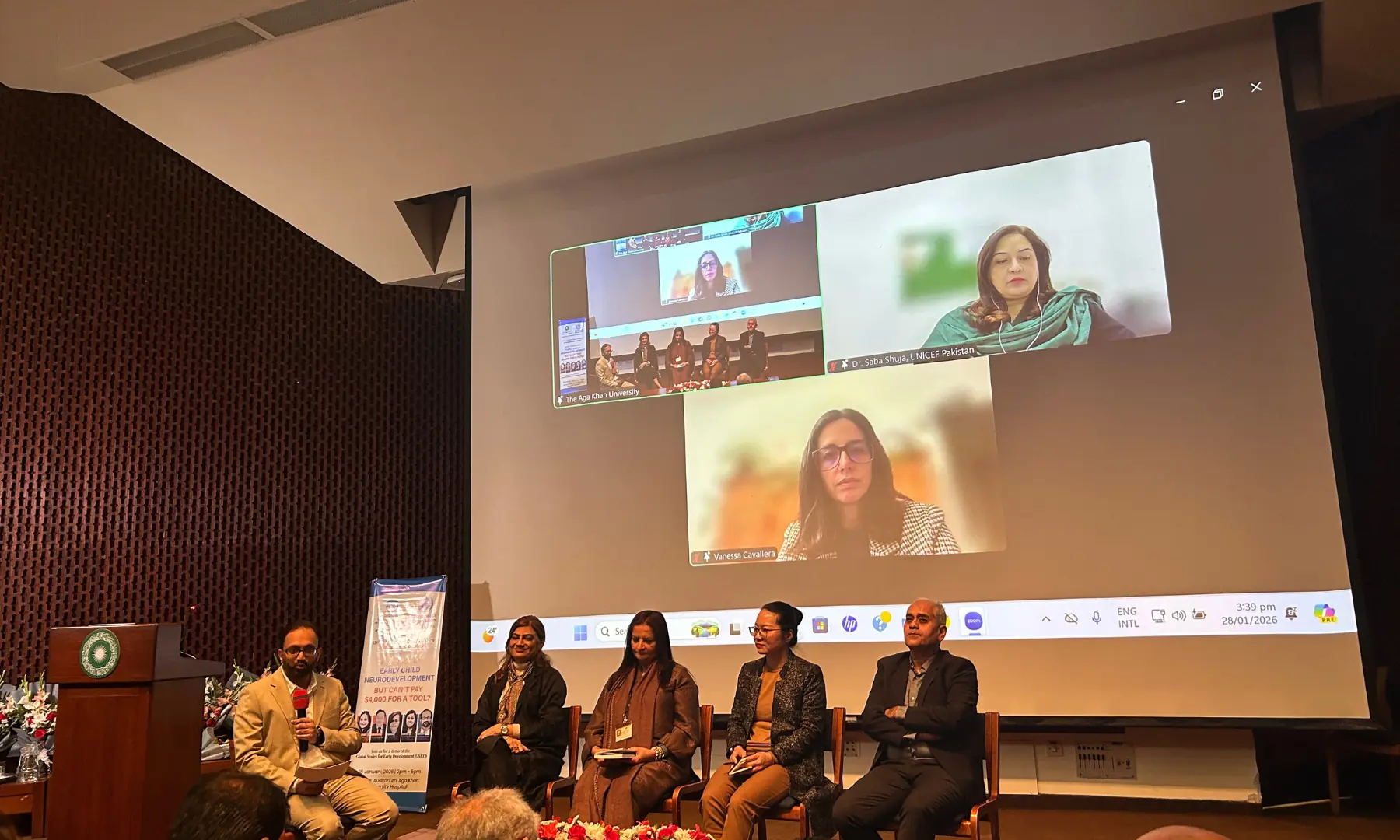

Health experts and policymakers on Wednesday stressed that measuring early child development is critical for ensuring lifelong health, learning, and well-being, as researchers demonstrated a World Health Organisation (WHO)-developed digital assessment tool at Aga Khan University (AKU), Karachi.
The tool, known as the Global Scales for Early Development (GSED), is designed to assess cognitive, socio-emotional, language, and motor development in children from birth to 36 months. Developed by WHO, the GSED has been adapted into local languages, including Urdu and Sindhi, and integrated into provincial systems to address concerns over the cost, complexity, and inaccessibility of existing assessment methods.
Speaking at the event, experts noted that the absence of reliable and comparable data has long hindered governments’ ability to prioritise early childhood development and track progress on Sustainable Development Goal indicator 4.2.1, which measures whether children are developmentally on track.
“What we do not measure, we struggle to prioritise and often fail to act on,” said Dr Imran Nisar, associate professor of paediatrics and child health, highlighting the importance of structured measurement tools such as GSED.
According to WHO estimates shared at the seminar, more than 250 million children globally are at risk of not reaching their developmental potential. In Pakistan alone, around 54 per cent, approximately 33 million children, are affected, said WHO Representative Ellen Thom, who described early childhood development as essential not only for survival but also for lifelong health and productivity.
Dr Salim Virani, vice provost for global research at AKU, emphasised that early childhood should be seen as a foundation for future outcomes. He urged policymakers to integrate child development measurement into existing public health and nutrition surveys, noting that early interventions generate long-term social and economic returns.
WHO’s Dr Vanessa Cavallera said the GSED was developed using data from over 70,000 children across 31 countries and is suitable for population-level evaluations, particularly in low- and middle-income countries.
Sindh Parliamentary Secretary for Health Nida Khuhro, in a recorded message, said standardised and locally adapted data ensures informed policy planning and investment, ensuring no child remains invisible in development efforts.
