
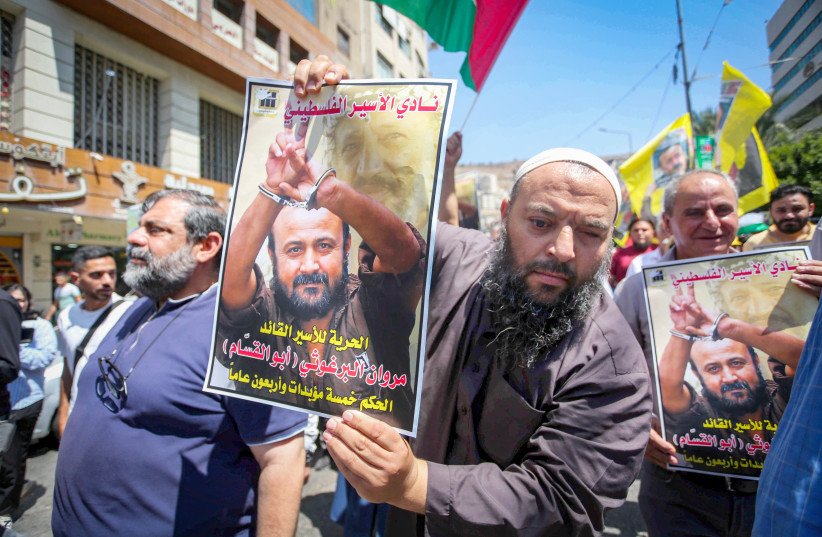

Marwan Barghouti continues to command substantial Palestinian support despite spending nearly 24 years in Israeli prison, with an analyst attributing his popularity partly to the symbolic image that has developed around the senior Fatah figure.
Barghouti is serving five life sentences after an Israeli court convicted him of murder and membership in a terrorist organisation. Nevertheless, recent polling by the Ramallah-based Palestinian Center for Policy and Survey Research places him well ahead of other potential presidential candidates.
Its latest survey showed Barghouti receiving 54% support, compared with 14% for Palestinian Authority President Mahmoud Abbas. A poll conducted 10 months earlier put Barghouti at 49%.
Analyst Says Barghouti Has Become Powerful Political Symbol
Dr Michael Milshtein of Tel Aviv University’s Moshe Dayan Center said Barghouti’s prolonged absence may have strengthened his political image.
According to Milshtein, Barghouti represents several causes important to Palestinians, including prisoners and resistance, while supporters also perceive him as less associated with corruption than other senior Palestinian Authority figures.
Meanwhile, dissatisfaction with existing Palestinian leadership has further strengthened his position. Abbas remains president despite his elected term expiring in 2009, while the Palestinian Authority continues to face economic and governance difficulties.
Support for Barghouti Extends Beyond Fatah
Barghouti has also developed support beyond his own Fatah movement.
During hostage-ceasefire negotiations in 2024 and 2025, reports indicated that Hamas sought his release as part of a potential agreement.
Moreover, Barghouti co-authored the 2006 National Conciliation Document of the Prisoners with representatives from Hamas, Palestinian Islamic Jihad and the PFLP.
Milshtein suggested Hamas could view Barghouti as a figure capable of supporting Palestinian political reconciliation and projecting national unity.
However, he said a Barghouti presidency from an Israeli prison would create major complications for both Israel and the Palestinian Authority.
His enduring popularity therefore reflects not only his political history but also dissatisfaction with current alternatives and the powerful symbolism surrounding his imprisonment.

