

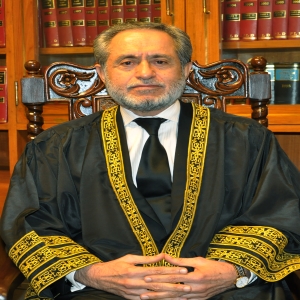

Supreme Court Justice Jamal Khan Mandokhail stated on Monday that comprehending the intent behind the Army Act could help address a significant portion of the military trial issue.
His remarks were made during a hearing conducted by a seven-member Supreme Court bench, led by Justice Amin-ud-Din Khan, with Justices Mandokhail, Muhammad Ali Mazhar, Naeem Afghan, and Musarrat Hilali also in attendance. The bench was reviewing intra-court appeals concerning the trial of civilians in military courts.
Previously, the Supreme Court had conditionally permitted military courts to announce verdicts for 85 individuals accused of participating in the May 9, 2023, unrest. The court had ruled that the decisions of military courts would remain subject to a final verdict by the apex court on related pending cases.
Subsequently, military courts sentenced 85 Pakistan Tehreek-e-Insaf (PTI) activists to terms ranging from two to ten years of rigorous imprisonment for their involvement in attacks on military facilities and monuments. In January, the military accepted mercy petitions for 19 of the 67 convicts sentenced in connection with the May 9 events, citing humanitarian considerations.
On October 23, 2023, a five-member bench of the Supreme Court unanimously ruled that the military trials of civilians were unconstitutional after admitting petitions challenging such proceedings.
During Monday’s hearing, Uzair Bhandari, representing PTI founder Imran Khan, argued that even if the Army Act were nullified, the anti-terrorism laws would remain applicable. He emphasized that since multiple legal forums exist, the focus should be on ensuring the accused’s fundamental rights. He also asserted that Article 245 of the Constitution does not confer judicial powers upon the military.
Justice Mandokhail questioned whether a court martial qualified as a judicial proceeding. Bhandari acknowledged that it was a judicial authority but clarified that its jurisdiction was limited to military personnel, not civilians.
Justice Amin-ud-Din observed that certain categories of civilians fall under the Army Act and inquired how the distinction would be determined. Justice Mandokhail pointed out that the Constitution grants the military two types of powers—one for national defense and another for assisting the civil government.
Justice Amin-ud-Din also questioned whether, in the event of an attack on military headquarters, authorities would need to wait for an Article 245 notification before responding. In response, Bhandari stated that when faced with an immediate threat, all institutions, including the police and military, act accordingly. He referenced the Supreme Court’s ruling in the Liaquat Hussain case, which stated that if the military apprehends an attacker, they must transfer them to civilian authorities, although they can provide assistance in handling the detainee.
Justice Naeem Afghan raised another question: If a military officer and a civilian jointly violate the Official Secrets Act, where would their trial be held? Bhandari replied that such cases should be heard in an anti-terrorism court.
Justice Mandokhail reiterated that understanding the rationale behind the Army Act would resolve much of the ongoing debate, as the Constitution explicitly defines it as legislation pertaining to the armed forces. He noted that while military courts have been granted the authority to impose punishments, civilian officers facing disciplinary action do not fall under this framework.
He further questioned whether military court jurisdiction was broad or limited, pointing out that in Karachi, trials of Rangers personnel had been conducted in civilian courts.
Justice Mandokhail emphasized that laws must align with the Constitution, which is enacted by Parliament. He remarked that political considerations often lead to legal compromises.
Referring to legal arguments presented earlier, Justice Mandokhail noted that in India, court-martial proceedings are handled separately, though Justice Mazhar expressed a differing opinion.
Justice Mandokhail added that the court is not bound by arguments presented by lawyers and would make its decisions based on constitutional principles. He posed a rhetorical question about whether a separate court would be established if Parliament were attacked, reiterating that the executive and judiciary are distinct under the Constitution. He also questioned whether the complainant in a case could simultaneously act as the judge.
Bhandari cautioned that if the Army Act allowed military trials for civilians, it could eventually lead to the inclusion of more offenses under its jurisdiction.
Justice Amin-ud-Din countered that citing Article 245 in this context was a separate matter, while Justice Mazhar clarified that summoning the military under Article 245 does not equate to granting it judicial authority.
Justice Mandokhail then asked whether the prime minister’s orders could be nullified, to which Bhandari affirmed that the court had the power to do so.
Justice Amin-ud-Din observed that no prime minister had ever completed a full five-year term. Justice Hilali remarked that no leader had been “brave enough” to do so.
Justice Mandokhail added that military dictators had even been legitimized in the past.
Following these discussions, the bench adjourned the hearing on military trials of civilians until the next session.
