

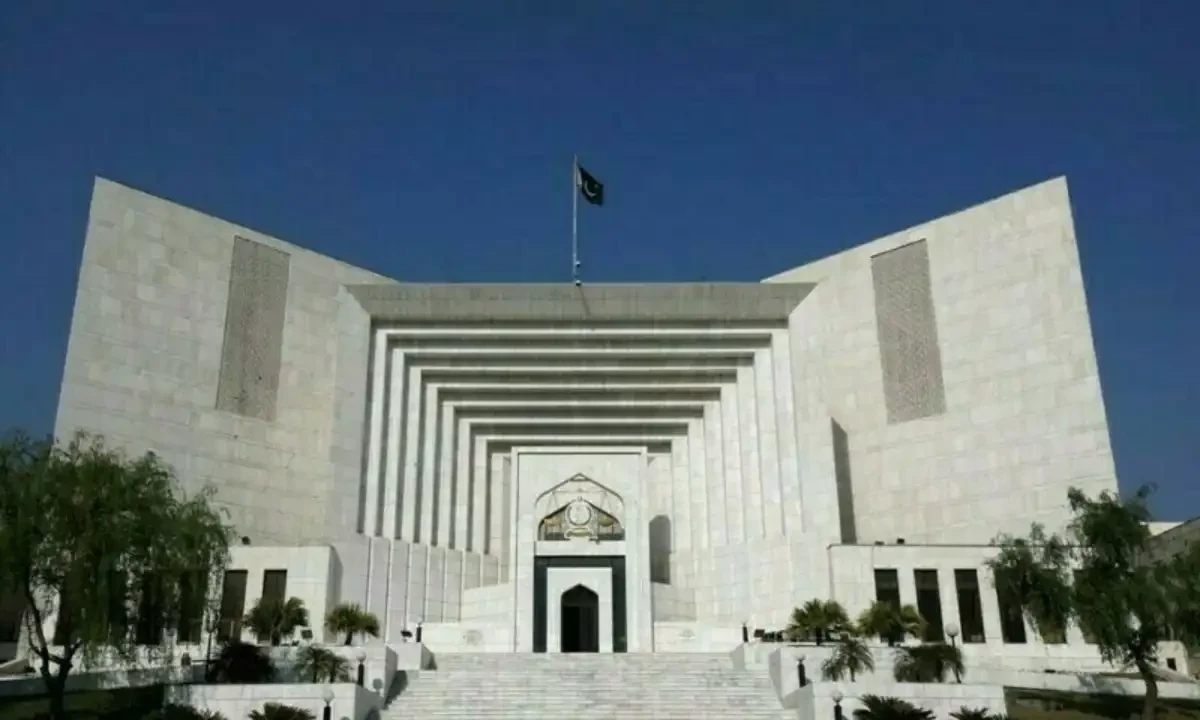

The Supreme Court resumed hearings on Thursday regarding review petitions against the verdict that awarded reserved seats to the Pakistan Tehreek-e-Insaf (PTI), with justices raising concerns over whether the judiciary had exceeded its constitutional role.
An 11-member larger bench, led by Justice Aminuddin Khan, conducted the proceedings in a rare live broadcast session, attracting widespread public and political interest.
Justice Musarrat Hilali sharply criticized the original judgment, arguing that it mistakenly characterized voting as a fundamental right. “Fundamental rights are inherent from birth, but the right to vote is granted by law and is subject to age and qualifications,” she said. “This ruling effectively altered the Constitution.”
Justice Muhammad Ali Mazhar questioned whether the judiciary had the authority to change constitutional provisions under the guise of democratic necessity. “Can judges rewrite the Constitution?” he asked. “PTI has capable legal experts—how did such a significant error go unnoticed?”
Senior lawyer Faisal Siddiqui, responding to the bench, defended the original stance, noting that even the country’s top court is composed of legal experts. “If legal matters were so straightforward, the court wouldn’t be needed,” he said. He also reminded the bench that 11 judges had acknowledged independent candidates as PTI representatives. “Both I and Justice Qazi Faez Isa supported the majority view concerning 39 candidates,” he added.
Justice Jamal Khan Mandokhel also pointed out that Justice Yahya Afridi had previously affirmed PTI’s entitlement to reserved seats, saying, “Justice Afridi clearly stated that PTI deserves these seats.”
Siddiqui expressed his intention to present the minority opinion for consideration. “I disagreed with Justice Amin’s ruling, but it was thought-provoking,” he said. When Justice Aminuddin urged him to stay focused on the main issue, Siddiqui argued for a broader reading of the previous bench’s decision. “This is the first time a 13-member bench’s decision is under review. How can the majority opinion be dismissed from discussion?”
Justice Aminuddin informed Siddiqui that he would have another opportunity to conclude his arguments. Siddiqui requested two more hearings, commenting, “It seems as if I’m the one who filed the review, given how all the questions are directed at me.”
Separately, the lawyer for the Sunni Ittehad Council (SIC) argued that several review petitions did not comply with Supreme Court rules and should be dismissed. When asked about the SIC’s election symbol, the counsel explained that while the symbol is a horse, Sahibzada Hamid Raza had contested as an independent candidate.
Justice Mandokhel remarked that this issue wasn’t central to the current case, but Justice Hilali pressed for clarification. “The SIC has existed since 2013. If the party took part in elections, it should have contested under its own name. Why didn’t Raza do that?” she questioned.
The hearing was adjourned until June 16.
