

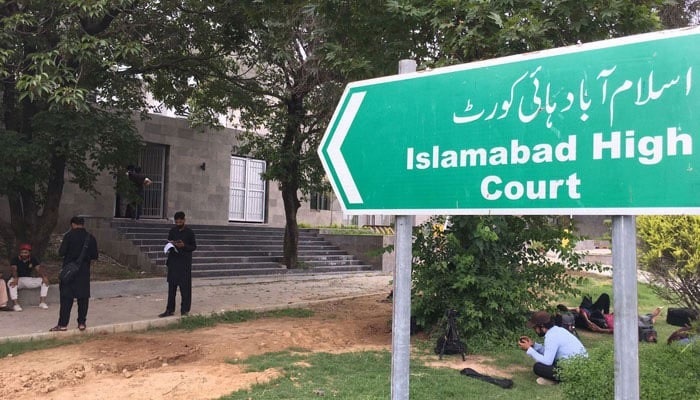

The Islamabad High Court (IHC) has instructed the Deputy Registrar (Judicial) to present the high court rules to determine whether the chief justice holds the authority to withdraw a case from a bench.
A key issue raised during the hearing was whether forming a larger bench and proceeding with judicial hearings without explicitly addressing prior office objections aligns with legal provisions.
Justice Sardar Ejaz Ishaq Khan, presiding over a contempt of court case against the Deputy Registrar (Judicial) for delisting a petition filed by Mashal Yousafzai against the Jail Superintendent, emphasized the necessity of a final ruling on the matter.
He asserted that there is no clear legal basis for transferring a case in such a manner. The judge further observed that if a high court judge had not made this decision, it could have amounted to criminal contempt of court. However, he clarified that he would not issue a contempt notice, stressing that the primary concern was establishing a legal precedent rather than focusing on any political figure.
During the proceedings, Advocate General (AG) Islamabad, Ayaz Shaukat, requested permission to present his argument, stating that he should be allowed to speak just as the court had expressed its views the previous day. He remarked, “If this high court exists, it is because of us. Everyone knows you are not here just for a job or salary.”
He argued that the central issue was whether Yousafzai remained the legal representative of a political leader. He referred to a media statement from the leader’s focal person suggesting that Yousafzai no longer represented him.
However, Justice Khan redirected the focus, stating that the court was not concerned with Yousafzai’s status but rather with the legal validity of transferring a case from one bench to another.
Shaukat contended that due to the controversy surrounding the case, all related matters were consolidated before a larger bench. Justice Khan countered that if the only issue was verifying Yousafzai’s role as legal counsel, a commission had already been appointed to address it.
“This matter could have been resolved in seconds by arranging a meeting. Instead, the court has been drawn into this situation,” he remarked.
He further explained that when lawyers appear before the court claiming to represent clients, the court does not routinely summon those clients for verification. “Hundreds of petitions are filed daily. Do we call each client to confirm their lawyer’s representation?” he questioned.
Justice Khan also underlined the procedural requirements for merging cases or forming a larger bench. He noted that the presiding judge of a case must submit a formal request to the chief justice, who then issues an order.
He inquired whether the parties involved had been heard before the formation of the larger bench under Section 24, which typically governs case transfers from subordinate courts.
He pointed out that the Registrar’s Office had initially objected, stating that the Section 24 application was invalid. Despite agreeing with the objection, the chief justice proceeded with forming a larger bench.
The judge then questioned whether the Advocate General intended to present arguments before the larger bench on the contempt of court petition, as such cases are usually heard by the judge whose order was allegedly violated.
He also clarified that the applicant had not requested the transfer of cases to a larger bench, yet the decision was made.
“This is not about creating unnecessary complications for the High Court. My priority is to ensure that no unresolved issues are left behind for myself or my colleagues. The credibility and integrity of the Islamabad High Court are of utmost importance,” he stated.
The court instructed the Advocate General to maintain a consistent stance before the larger bench, cautioning against adopting conflicting positions in different courtrooms.
The hearing was adjourned until after Eid for further deliberations.
