

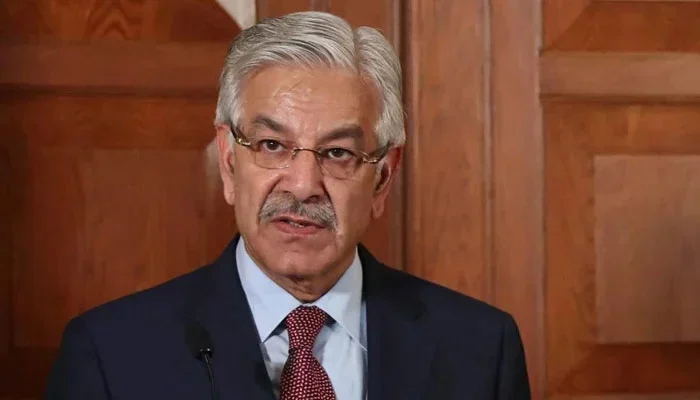

Defence Minister Khawaja Muhammad Asif has accused two major terrorist organisations operating in Pakistan—the Baloch Liberation Army (BLA) and Tehreek-i-Taliban Pakistan (TTP)—of acting as Indian proxies. He asserted that Pakistan will soon provide comprehensive evidence proving India’s role in the recent attack on a school bus in Balochistan’s Khuzdar district, which killed three children and injured dozens.
The bus, en route to the Army Public School in Khuzdar Cantonment, was targeted by a bomb near Zero Point on the Quetta-Karachi highway. The explosion claimed the lives of six individuals, including three students, and left over 40—mostly schoolchildren—wounded. At least 15 injured were girls, with a dozen reported in critical condition.
Prime Minister Shehbaz Sharif and Army Chief Field Marshal Syed Asim Munir visited the victims in Quetta, vowing justice. Meanwhile, security forces have pledged to relentlessly pursue those responsible for the deadly attack.
In a recent interview, Defence Minister Asif stated that the BLA operates as an extension of Indian interests, with its leadership based in New Delhi. He said the government would back its claims with verifiable evidence.
Asif drew comparisons with last month’s Pahalgam incident in Indian-occupied Kashmir, which killed 26 people. India had blamed Pakistan without offering evidence. In contrast, Asif said Pakistan would support its allegations with proof. He stressed that groups like the BLA and TTP have no ideological or nationalist motivations, but are instead funded by India to destabilize Pakistan.
Condemning the targeting of civilians, especially schoolchildren, Asif emphasized that Pakistan would respond forcefully. He added that Islamabad had called for an international investigation into the Pahalgam attack—an offer New Delhi refused. Asif accused India’s leadership of using baseless accusations as a justification for nuclear brinkmanship and stated that while Pakistan does not seek nuclear conflict, it will not remain passive if provoked.
The military’s media wing, Inter-Services Public Relations (ISPR), also issued a statement condemning India’s alleged use of terrorist proxies to target civilians in Pakistan. ISPR called this a “state policy” reflective of India’s disregard for human rights and morality. It warned that those involved in the Khuzdar attack would be hunted down and brought to justice, vowing to expose what it described as the “heinous face of India.”
Earlier this week, ISPR reported that 12 terrorists linked to Indian-backed groups were killed in separate operations in Khyber Pakhtunkhwa and Balochistan. Last month, ISPR Director General Lt Gen Ahmed Sharif Chaudhry stated that India was activating its assets to escalate terrorist activities in Pakistan, presenting the arrest of a terror suspect trained by Indian personnel as further proof.
In a separate development, Foreign Minister Ishaq Dar announced that China, Pakistan, and Afghanistan had agreed during a recent trilateral meeting that none of their territories would be used for cross-border terrorism. Dar emphasized the importance of resolving issues with neighboring countries through dialogue and mutual commitments to counterterrorism.
Dar said he had conveyed to Afghan Taliban leaders that Pakistan would not tolerate terrorism emanating from Afghan soil, just as it would prevent the use of its own territory for such purposes. He noted that the Chinese delegation shared similar concerns, with Beijing reaffirming support for Pakistan’s sovereignty and expressing sympathy for recent casualties linked to regional hostilities.
China also reiterated its stance that the Kashmir dispute should be resolved in accordance with United Nations resolutions, acknowledging the issue as a major driver of regional instability.
Meanwhile, Pakistan’s Foreign Office declared a staff member of the Indian High Commission in Islamabad persona non grata, ordering their departure within 24 hours for activities deemed inconsistent with diplomatic norms. The decision was communicated to the Indian Chargé d’Affaires, with a warning that Indian diplomatic staff must not abuse their privileges.
This action followed a similar move by India a day earlier, where a Pakistani diplomat was also expelled for allegedly engaging in inappropriate activities. The Indian Ministry of External Affairs issued a demarche to Pakistan’s representative, urging that diplomatic protocols be respected by all staff.
