

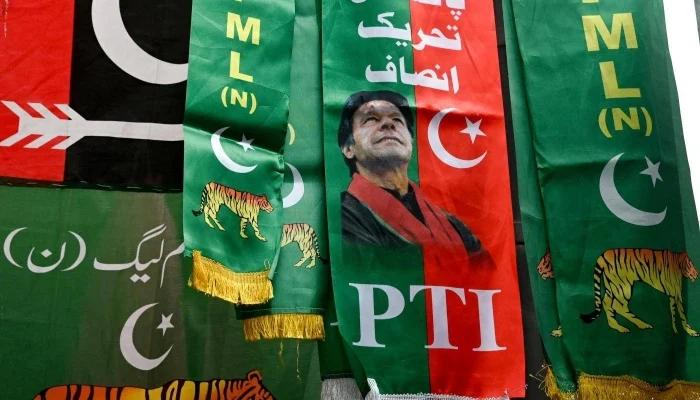

The First-Past-the-Post (FPTP) electoral system has resulted in Pakistan Tehreek-e-Insaf (PTI) and Pakistan Peoples Party Parliamentarians (PPPP) securing significantly more seats than their vote share in Khyber Pakhtunkhwa (KP) and Sindh, respectively, according to a report by the Free and Fair Election Network (Fafen).
Pakistan Muslim League-Nawaz (PML-N) also gained an outsized share of seats in Punjab under the same system, which declares the candidate with the highest votes as the winner, regardless of overall vote distribution.
Conversely, Jamiat Ulema-e-Islam Pakistan — Fazl (JUI-F) received a considerable percentage of votes in KP but did not translate this into a proportional number of seats. The report highlights that JUI-F secured 1,269,230 votes (15%) in KP but won only seven provincial assembly seats (6%). Meanwhile, PTI’s candidates in the province garnered 3,093,306 votes (38%) and secured 85 provincial seats (75%), demonstrating a clear disparity.
A similar trend was observed in Sindh, where PPPP received 5,228,678 votes (46%) but obtained 85 provincial seats (65%). The Muttahida Qaumi Movement-Pakistan (MQM-P) also benefited from the system, securing 28 provincial seats (22%) despite receiving only 905,992 votes (8%).
In Punjab, PTI gained 11,272,578 votes (31%) and won 109 provincial assembly seats (37%), while PML-N secured 11,515,206 votes (32%) and obtained 139 seats (47%).
In Balochistan, JUI-F emerged as the leading party in terms of vote share, securing 400,072 votes (18%) and winning nine provincial assembly seats (18%).
However, several parties, including Tehreek Labbaik Pakistan (TLP), JUI-F, and Jamaat-e-Islami Pakistan (JI), received significant vote shares but remained underrepresented in terms of seats. TLP, the fourth-largest party, secured 2,918,086 votes (5%) for the National Assembly but failed to win a single seat. In the Punjab Assembly, it won just one seat despite securing 3,047,019 votes (5%).
Similarly, JUI-F, the fifth-largest party, won six National Assembly seats with 2,292,355 votes (4%) and 16 provincial assembly seats with 2,286,546 votes (4%). JI, the sixth-largest party, received 1,345,371 votes (2%) for the National Assembly but failed to win any seats. It secured three provincial assembly seats—two in Sindh and one in Balochistan—despite obtaining 1,739,774 votes (3%).
Explaining these disparities, Sahibzada Saud, Team Lead Research and Learning at Fafen, attributed them to two main factors: the electoral system itself and local political dynamics.
“The FPTP system ensures that the candidate with the highest number of votes wins, without accounting for whether other candidates collectively received more votes than the winner. Additionally, local political factors in many constituencies contribute to these discrepancies,” he said.
Under this system, candidates often focus their campaigns on specific voter groups to secure victory rather than appealing to the entire constituency. Consequently, when overall election results are analyzed, the gap between vote share and seat allocation becomes increasingly evident.
