

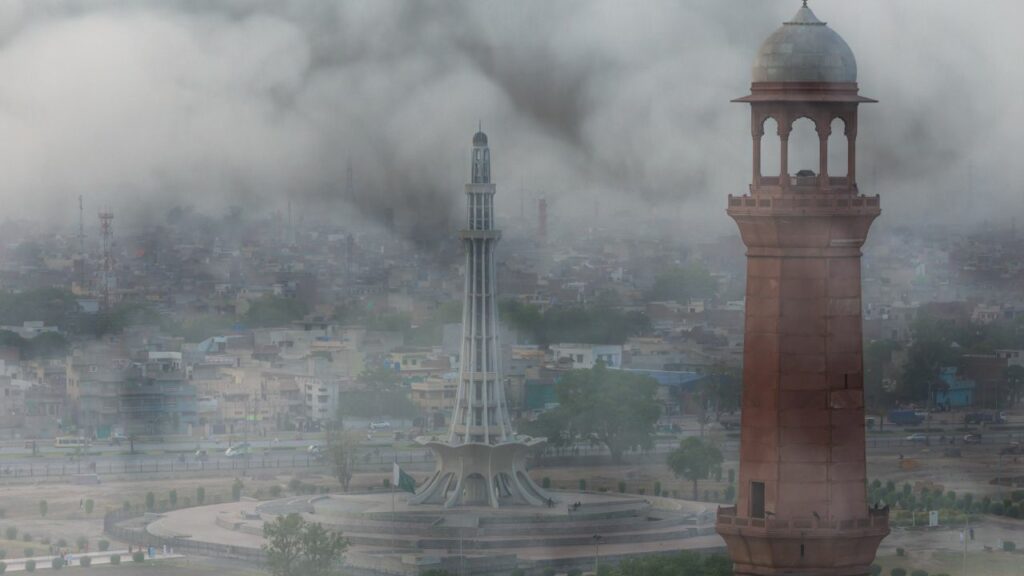

Lahore has once again emerged as one of the world’s most polluted cities. Air quality worsened sharply despite a slight drop in temperatures across Punjab. As a result, the provincial capital topped both national and global pollution charts.
Air Quality Index levels surged to alarming levels on Thursday. The city’s overall AQI reached 368, placing it in the hazardous category. Consequently, health risks increased for residents across multiple areas.
Other Punjab cities also reported dangerous air quality. Faisalabad followed closely with an AQI of 355. Meanwhile, Gujranwala recorded an AQI of 276.
Smog Blankets Lahore’s Major Areas
Dense smog spread across large parts of Lahore throughout the day. AQI readings varied significantly by location. However, most areas remained well above safe limits.
Near the Civil Secretariat, AQI spiked to an extreme 569. Burki Road recorded 296, while Defence reached 262. Similarly, Allama Iqbal Town reported 217.
Askari Block 10 recorded an AQI of 214. Gulberg stood at 210. Model Town reached 200, while Raiwind Road showed 193. Bedian Road reported a relatively lower reading of 163.
Despite variations, overall conditions remained hazardous. Therefore, residents faced prolonged exposure to polluted air.
Cross-Border Winds Worsen Air Quality
Provincial authorities attributed worsening pollution to cross-border smog. Contaminated air from Indian Punjab drifted into Lahore and central Punjab. Cities such as Amritsar, Jalandhar, and Ludhiana were identified as major contributors.
According to officials, local pollution sources remain largely controlled. However, winds from the east and southeast carry polluted air into the region. Consequently, air quality deteriorates rapidly.
Temperature Inversion Traps Polluted Air
Weather patterns also intensified the smog crisis. During night and early morning hours, slow winds cause temperature inversion. This process traps polluted air near the ground.
As a result, AQI levels rise sharply. Officials noted that stronger afternoon winds may offer temporary relief. Wind speeds between 10 and 15 miles per hour can help disperse smog.
Government Response and Public Advisory
Authorities confirmed that monitoring remains ongoing. All relevant departments have been placed on high alert. A 24-hour smog control room continues surveillance using drones and cameras.
Officials stated that all brick kilns now operate on cleaner technology. Strict action continues against polluting industries and vehicles. Violators face fines and closures.
Residents were advised to take precautions. Children, elderly individuals, and those with respiratory conditions should avoid outdoor exposure. Precaution remains essential until air quality improves.
