

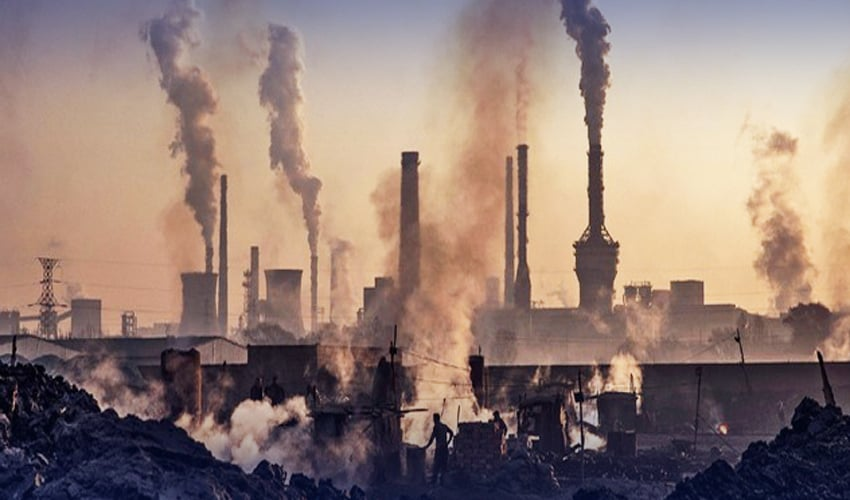

Lahore has maintained its position as the world’s most polluted city for several consecutive days, with its Air Quality Index (AQI) reaching ‘Hazardous’ levels above 320 on Wednesday morning.
According to the Swiss air quality monitoring organization IQAir, Lahore’s air quality was categorized as ‘Hazardous,’ with an AQI of 323 on Wednesday. The concentration of PM2.5 (particulate matter) in the air of Punjab’s capital was recorded at 54.5 times higher than the annual air quality guideline value recommended by the World Health Organization (WHO).
PM2.5 refers to fine particulate matter with a diameter of less than 2.5 micrometers and is used to measure particle levels in both outdoor and indoor environments.
In Lahore, the most polluted areas included The Mall Road area with the highest AQI of 374, followed by the Lahore American School area and Polo Ground in Cantt.
Lahore’s air quality has consistently been unhealthy, not only over the past few months but also during the “fifth season” of smog, which typically lasts from September to at least February.
According to IQAir data, the second most polluted city in the world was New Delhi, India, with an air quality index of 210 (‘Very Unhealthy’). The third most polluted city on Wednesday morning was Chengdu in China, with an air quality index of 179, categorized as ‘Unhealthy.’
Karachi’s Electric Bus Service Faces Crisis: Sudden Suspension Leaves Commuters Stranded
Meanwhile, the Karachi Electric Bus Service, initiated by the Sindh government a year ago, is facing the risk of a complete shutdown. Buses operating on two of its three routes were suddenly suspended, leaving numerous passengers stranded. Only one route still has functional electric buses, and even that route has a limited number of high-tech public transport buses.
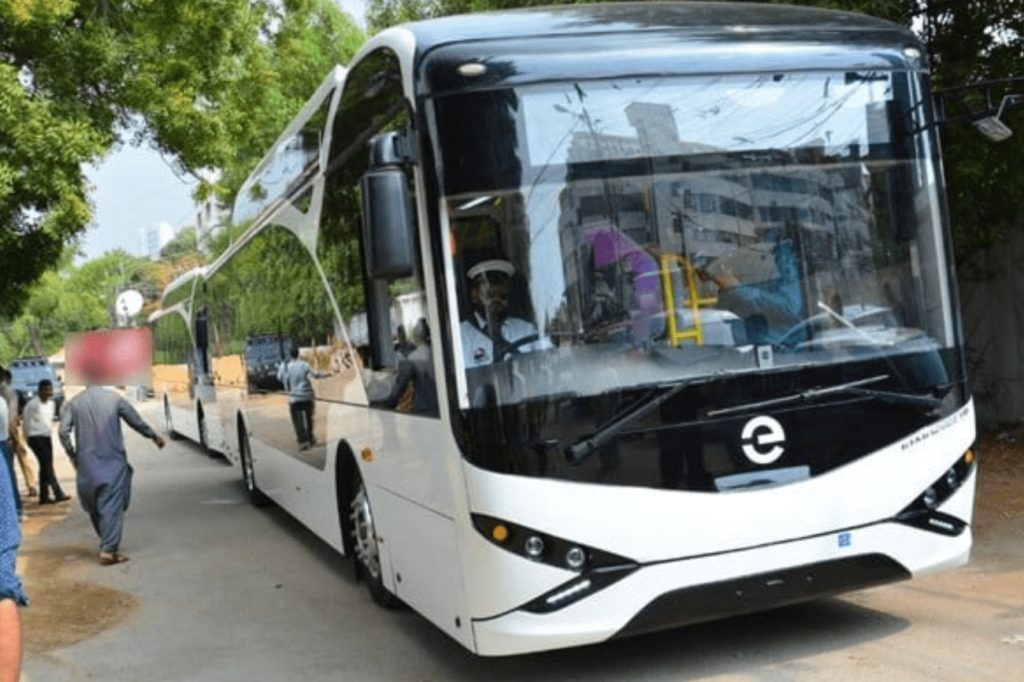
These electric buses were introduced as part of the People Bus Services project by the Sindh government in June 2023. One of the routes runs from Tank Chowk near Jinnah Avenue to Clock Tower, passing through various important locations like the Airport, Sharae Faisal, FTC, Korangi, and Khayaban-e-Ittahad.
The other route starts from Malir Cantt checkpost and travels to M.A. Jinnah Road via Safoora Chowk, Moosamyaat, Kamran Chowrangi, Perfume Chowk, Millennium, Dalmia, and Agha Khan Hospital.
To function, these electric buses require a charging dock to provide them with power. Two power stations were established in Bahria Town and Malir Cantt to serve a total of 40 buses. However, it’s been reported that the charging stations have been unable to charge the buses, leading to the suspension of services on two routes.
