
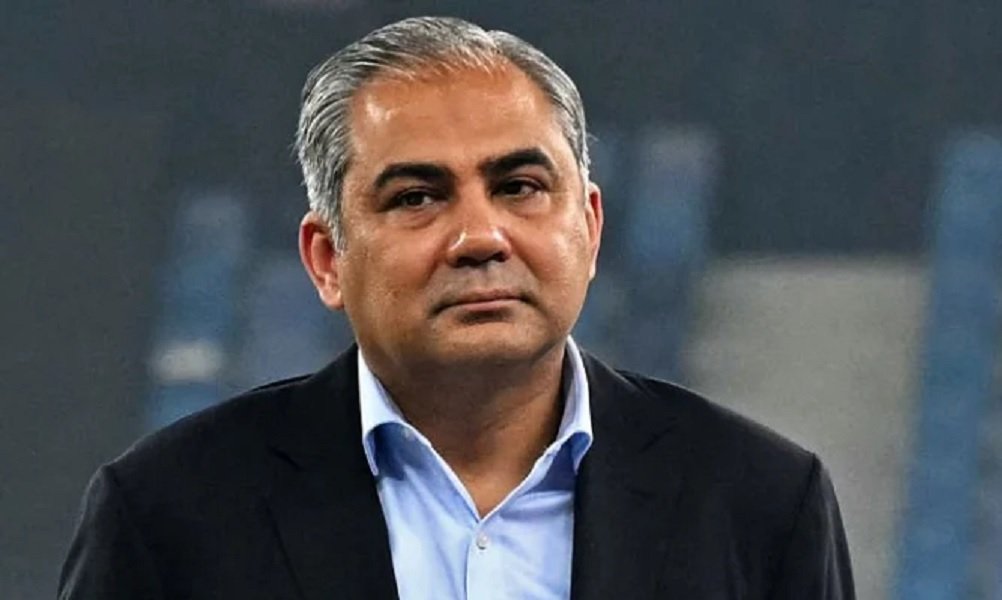

Interior Minister Mohsin Naqvi has claimed that a political party chief is unhappy after missing out on the Khyber Pakhtunkhwa governorship. Although he did not identify the politician, his remarks appeared to point towards Jamiat Ulema-i-Islam-Fazl (JUI-F) chief Maulana Fazlur Rehman.
Speaking to journalists in Lahore on Friday, Naqvi alleged that the politician was disappointed about being excluded from the new political arrangement in KP. His comments came amid mounting tensions over the federal government’s decision to impose governor’s rule in the province.
“The head of a party is extremely upset over being denied a role in the new setup in KP and not getting the governorship,” Naqvi alleged.
The interior minister also questioned the politician’s criticism of the establishment, claiming that he had relied on its support for decades to advance his political career.
“These are the same politicians who remained in politics for decades with the support of the establishment, and this politician even relied on the establishment to arrange air tickets for the members of his party,” he further alleged.
Naqvi argued that politicians who had benefited from the system should not now criticise others without acknowledging their own past actions. However, he stressed that political disagreements should remain focused on arguments rather than personal attacks.
“Political differences are part of politics. But instead of using inappropriate language and making allegations, political leaders should speak on the basis of arguments and facts,” the minister said.
Why Has Governor’s Rule in KP Triggered Political Tensions?
Naqvi’s remarks come days after the federal government imposed governor’s rule and emergency measures in Khyber Pakhtunkhwa. The Centre cited the provincial government’s alleged “deliberate disengagement” from counterterrorism efforts as justification for the move.
However, the decision has drawn strong criticism from opposition leaders, including Fazlur Rehman, Mehmood Khan Achakzai and Raja Nasir Abbas of the Tehreek-i-Tahafuz Ayin-i-Pakistan.
Political tensions between the Centre and opposition parties had already intensified before the announcement. The Pakistan Tehreek-e-Insaf (PTI), which governed KP, had announced a protest march to Islamabad demanding former prime minister Imran Khan’s release.
Meanwhile, negotiations between the government and opposition failed to produce an agreement despite intensive discussions during the preceding week. Fazlur Rehman emerged as a potential mediator, with both sides reportedly holding separate meetings with him.
Following the imposition of governor’s rule, Fazl accused the federal government of abandoning its commitments despite his mediation efforts.
Fazlur Rehman Questions the Centre’s Decision on KP
On Thursday, Fazlur Rehman again criticised the federal government during a rally in Multan. He accused the Centre of depriving provinces of their constitutional rights and questioned its justification for imposing governor’s rule in KP.
The JUI-F chief also revisited his party’s reservations about merging the former Federally Administered Tribal Areas (FATA) into KP under the 25th Constitutional Amendment in 2018.
“We were not against the merger, but we said that it was an issue of the political future of the people of tribal areas,” he said, alleging that the people of those areas were not consulted on the merger.
Fazl also challenged the Centre’s argument that inadequate provincial cooperation against terrorism justified emergency measures. He pointed to the security situation in Balochistan, arguing that the province faced even greater challenges.
He alleged governor’s rule had not been imposed in Balochistan because its chief minister “praises you”.
“In KP, the PTI is in power. […] Where opposition is in power, you topple it. And the resources of former tribal areas, which had become part of the province, you have taken control of them by imposing emergency,” he remarked.
Naqvi Raises Questions Over Tribal Districts’ Resources
Responding to concerns about the former tribal areas, Naqvi questioned why political leaders had remained silent when those districts allegedly failed to receive their rightful share of resources for years.
“When the districts … were not getting their rightful share for years, why were these people silent?” he questioned.
The interior minister argued that political leaders had failed to adequately defend the rights of residents in the former tribal districts. He maintained that their resources and entitlements should remain above partisan political interests.
Furthermore, Naqvi highlighted the serious security challenges facing Khyber Pakhtunkhwa. He urged political leaders to support efforts to restore peace and combat terrorism rather than deepen political divisions.
“Instead of fanning the flames and creating unrest, political leaders should play their role in restoring law and order and eliminating terrorism,” he said.
He added that the province needed stability, cooperation and collective action to address its security problems.
Maryam Nawaz Criticises Fazlur Rehman Over PTI Support
Separately, Punjab Chief Minister Maryam Nawaz criticised Fazlur Rehman in a post on X, questioning his apparent support for the PTI amid allegations linking the party to terrorism.
She said a senior politician like Fazl should not support those who facilitate terrorism. Her remarks appeared to refer to the federal government’s accusations against the PTI.
Maryam also described his stance as unfortunate, arguing that he should instead hold accountable those she blamed for KP’s decline through incompetence, ineptitude and corruption.
Additionally, she criticised Fazl’s remarks concerning Chief of Defence Forces and Chief of Army Staff Field Marshal Asim Munir. Her comments appeared to refer to his speech in Multan, where he discussed the centralisation of power.
Maryam concluded by arguing that the PTI itself was responsible for the end of its government in Khyber Pakhtunkhwa.
The exchange highlights growing friction between the federal government and opposition leaders following the imposition of governor’s rule. With disagreements continuing over provincial authority, security policy and the distribution of resources, political tensions in KP remain a major challenge for both sides.
For the latest updates, visit and follow The Truth International website (www.thetruthinternational.com) and subscribe to the YouTube Channel.

