

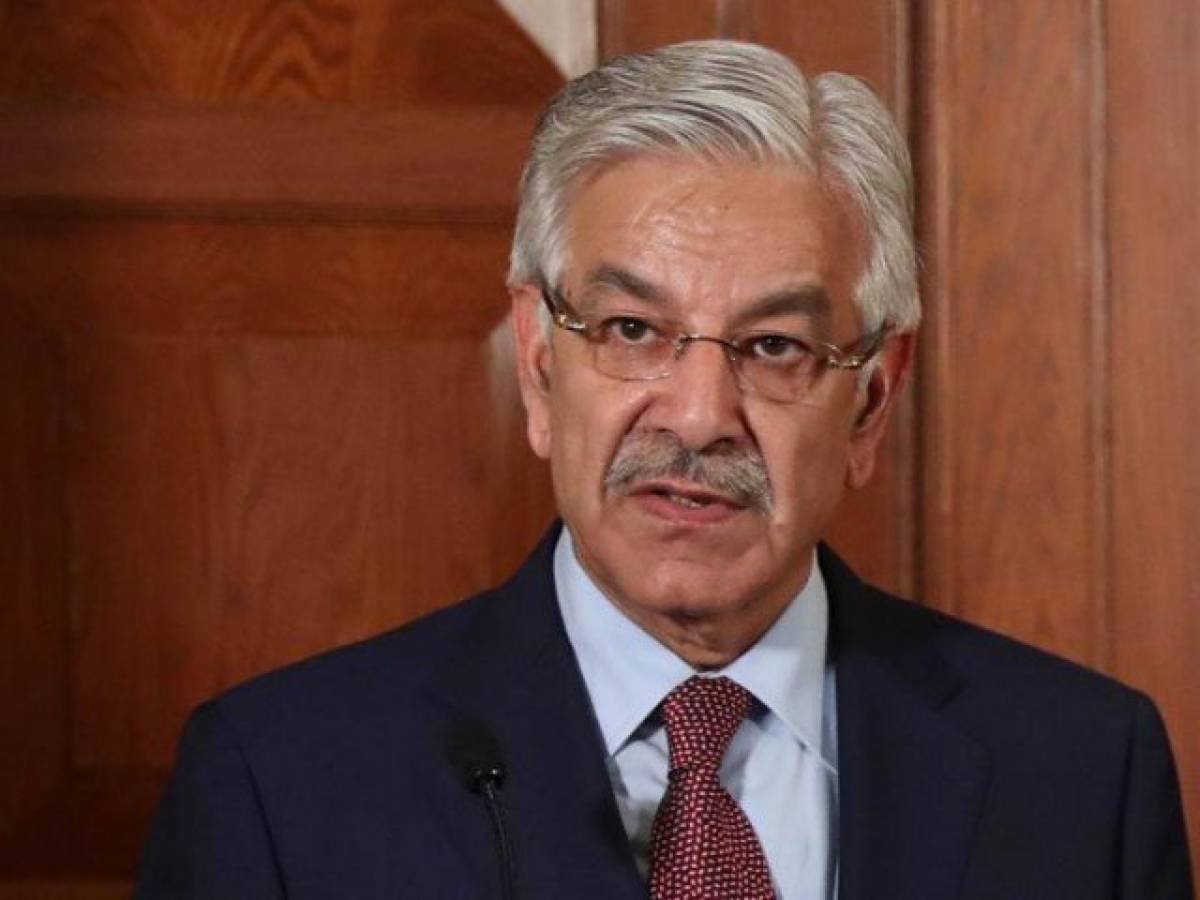

Federal Minister for Defence, Khawaja Asif, has stressed the urgent need to enforce international laws along Pakistan’s borders to stem the flow of terrorist elements, particularly from Afghanistan, amidst a resurgence of terrorist activities gripping the nation.
Taking to the social media platform X, Asif underscored the imperative for fundamental changes in border management in response to the escalating wave of terrorism. He emphasized the unique nature of the Pakistan-Afghanistan border, labeling the neighboring country as a primary “source of terrorism” for Pakistan.
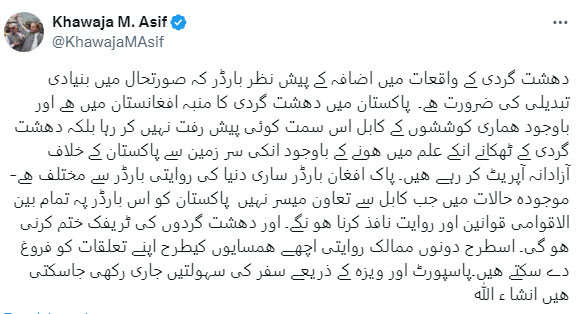
Asif expressed disappointment over the lack of tangible progress by the Afghan government in eliminating terrorist elements exploiting Afghan soil to launch attacks on Pakistan, despite Islamabad’s persistent efforts. He criticized the Afghan authorities for purportedly turning a blind eye to terrorist hideouts within their territory and lamented the lack of cooperation from Kabul.
Following Tuesday’s tragic suicide attack in Shangla’s Besham city, which claimed the lives of five Chinese nationals and a Pakistani citizen, Asif’s remarks resonated with the growing concern over the surge in terrorist incidents across the country.
Pakistan has consistently accused Afghan authorities of harboring terrorist outfits, including the banned Tehreek-e-Taliban Pakistan (TTP), and failing to address cross-border attacks targeting security forces and civilians.
In response to these attacks, Pakistani forces have conducted intelligence-based operations (IBOs) in border regions inside Afghanistan to counter terrorist activities originating from Afghan soil. The military attributes the escalation of terrorism in Pakistan to the continuous support and assistance received by terrorist elements from Afghanistan.
Asif reiterated the government’s stance, affirming that militants exploit Afghan territory to orchestrate terrorist attacks within Pakistan. His statements underscore the gravity of the security situation along the Pakistan-Afghanistan border and the urgent need for collaborative efforts to address cross-border terrorism.
