



ISLAMABAD: Senior Judge of Supreme Court Justice Qazi Faez Isa has written a letter to the Chief Justice of Pakistan (CJP), raising question about the formation of a larger bench in the journalists’ harassment case and terming the formation of the new bench a transgression of the Constitution.
On August 20, a two-judge Supreme Court (SC) bench, consisting of Justice Isa and Justice Jamal Khan Mandokhel, took up an application moved by the Press Association of the Supreme Court, which highlighted frequent incidents of harassment of journalists.
In an order issued the same day, the two-judge bench said that since the application had raised matters of public importance with reference to the enforcement of fundamental rights, it met the criteria for invoking the suo motu jurisdiction of the SC under Article 184(3) of the Constitution.
However, Justice Umar Ata Bandial, who is the acting chief justice at present since Justice Gulzar Ahmed is on leave and out of Pakistan, constituted a larger five-judge bench on Saturday to provide clarity with regard to the invocation of the court’s suo motu jurisdiction.
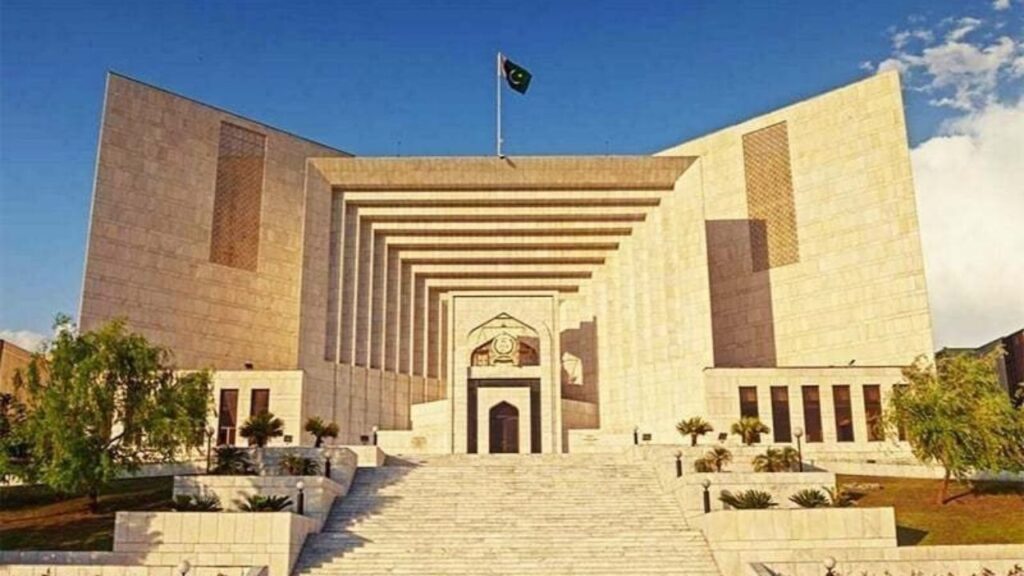
The larger bench comprised Justice Umar Ata Bandial, Justice Ijazul Ahsan, Justice Munib Akhtar, Justice Qazi Muhammad Amin Ahmad, and Justice Muhammad Ali Mazhar.
The new bench then put the Aug 20 order in abeyance on Monday and observed that its implementation may obscure and unsettle the practice of invoking suo motu jurisdiction.
In a letter written to the CJP dated Aug 24, Justice Qazi Faez Isa said the Constitution detailed the different jurisdictions of the SC and they could also be conferred by law.
“No jurisdiction is conferred which permits one bench to monitor the working of another bench, let alone to hold its orders in abeyance,” Justice Isa said in his letter.
He also said the Constitution did not permit “monitoring jurisdiction” and therefore, the five-member bench did not have the jurisdiction to hear the case.

“If they continue hearing the case, they will transgress the Constitution, resultantly, any purported order passed by the purported larger bench would be a constitutional nullity, void and of no legal effect,” said Justice Isa.
He also said that the two-member bench — comprising him and Justice Jamal Khan Mandokhel — was not informed about the formation of the larger bench, and had not decided anything in the case.
Justice Qazi Isa said that once the case was decided, if anyone felt that it was not dealt with in accordance to the Constitution or the law then they had the option to review it.
Justice Isa argued that if one bench started to monitor the activities and orders of another bench then it would lead to “chaos and the collapse of the judicial system”.
“Once the honourable chief justice has constituted the benches then cases should be fixed in routine before such benches without any filtration,” he said.
Regarding the Aug 23 order, Justice Isa said it was subject to “a number of misconceptions”, adding that the Aug 20 order was passed only after it was noted that the matter was of public importance seeking enforcement of fundamental rights. He said that the case was “urgent and time sensitive” and needed immediate attention.
He said, “To shy away from exercising powers vested in this court under Article 184(3) of the Constitution, in a matter of extreme urgency involving the lives of journalists would constitute dereliction of duty”.
He pointed out that suo motu notices had been taken in the past without considering whether the issues came within the purview of Article 184(3) or fulfilled its mandatory requirements.
Pointing out that he had worked in the Prime Minister’s Office prior to becoming a registrar, Justice Isa said the Constitution mandated the separation of the judiciary from the executive and he criticised the induction of government servants as registrars.
