
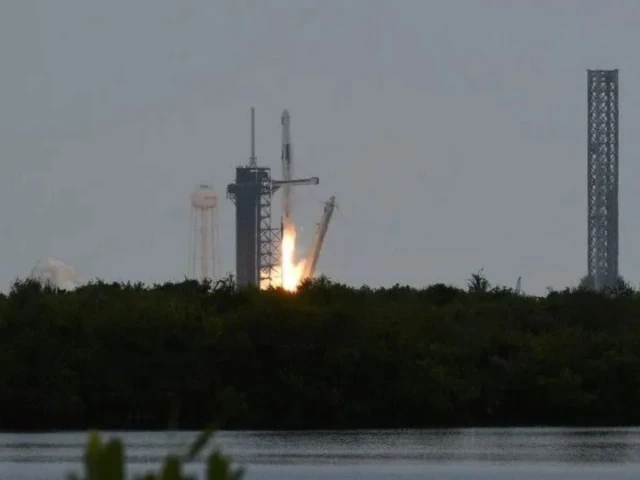

Japan has launched the world’s first mission designed to collect rock and sand samples from a moon of Mars and return them to Earth. The Martian Moons eXploration (MMX) spacecraft lifted off aboard an H3 rocket on October 20, marking a major milestone in planetary exploration.
The Japan Aerospace Exploration Agency (JAXA) leads the mission, which aims to uncover how Mars’ two moons formed and evolved.
MMX Spacecraft Heads Towards Phobos
The 4,480-kilogram spacecraft departed from the Tanegashima Space Center in southwestern Japan. It successfully separated from its rocket and entered its planned orbit, according to JAXA. The probe will travel towards Mars and is expected to arrive in August 2027. Its primary target is Phobos, the larger of the planet’s two moons.
Scientists plan to collect at least 10 grams of material from Phobos during two planned landings. The spacecraft will also study Deimos, Mars’ smaller moon, before beginning its return journey.
JAXA expects the samples to reach Earth in July 2031.
Scientists Seek Clues to the Moons’ Origins
Phobos and Deimos remain among the least understood objects in the Martian system. Scientists have long debated whether the moons formed from material ejected during an ancient collision with Mars or originated as asteroids captured by the planet’s gravity.
Analysing samples could help researchers distinguish between these theories. The material may also reveal details about the early solar system and Mars’ geological history. If Phobos contains material ejected from Mars, the samples could provide additional clues about the Red Planet itself.
International Partners Support the Mission
The MMX programme involves international cooperation, including contributions from NASA, the French space agency CNES, the German Aerospace Center and the European Space Agency.
A French-German rover named Idefix will survey Phobos before the main spacecraft attempts to collect samples. Its observations will help researchers identify suitable landing locations.
The mission will also test technologies for future planetary exploration. Operating in Phobos’ extremely weak gravity presents significant technical challenges, particularly during landing and sample collection.
Samples Expected Back on Earth in 2031
After completing its observations and collection activities, MMX will leave the Martian system in 2030. A return capsule will carry the collected material back to Earth.
The mission is expected to conclude in 2031, when researchers can begin detailed laboratory analysis of the samples. Its findings could reshape scientific understanding of Mars’ moons and support planning for future robotic and crewed missions to the Martian system.
For the latest updates, visit and follow The Truth International website (www.thetruthinternational.com) and subscribe to the YouTube Channel.

