

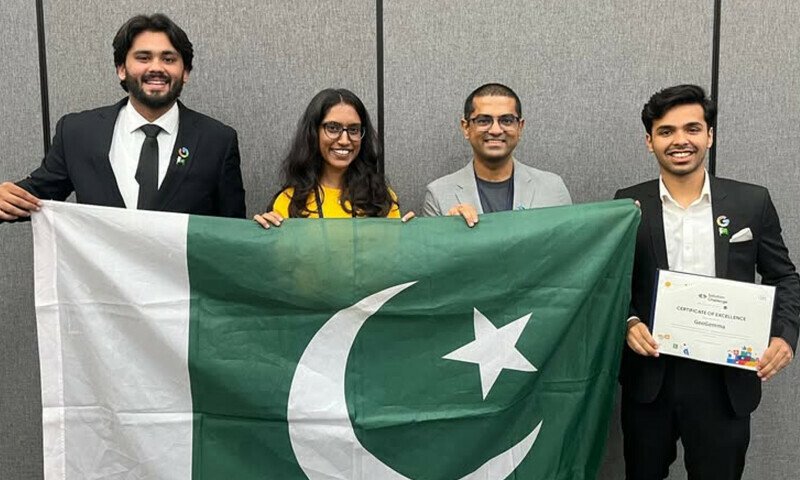

In 2024, Ahmed Iqbal and Hanzila Bin Younus, final-year students at Islamabad’s Institute of Space Technology (IST), faced a choice: submit a routine final-year project to fulfill graduation requirements, or build something groundbreaking.
They chose the latter, creating GeoGemma — an open-source Large Language Model (LLM) integrated with Google Earth Engine that enables users to analyze satellite imagery and spatial data through simple text prompts, eliminating the need for complex coding.
Their innovation has now earned global recognition. Last week, GeoGemma won the Best AI Use Case award at the Asia-Pacific (APAC) Solution Challenge, co-hosted by Google and the Asian Development Bank in Manila.
Iqbal explained, “Google Earth Engine stores over 80 petabytes of satellite imagery from across the globe. You can overlay maps to analyze geographic variables, from temperature on K2 to thermal patterns — but accessing and analyzing this data requires programming skills.”
GeoGemma aims to break that barrier. By integrating LLM capabilities with Google Earth Engine, the tool allows users to generate detailed spatial analyses using simple natural language prompts. This dramatically broadens access to geospatial analysis for professionals in fields such as oil and gas, real estate, logistics, and agriculture.
The project’s journey began in mid-2023 when Iqbal discovered a research grant offered by the Gemma Academic Programme, launched by Google DeepMind — Alphabet’s AI-focused subsidiary. Iqbal, Younus, and their academic supervisor Dr. Sajid Ghaffar formed the GeoAI team and pitched their idea: fusing Google Earth Engine with the open-source Gemma LLM to democratize geospatial intelligence.
In September 2024, their vision received a significant boost when they secured a $10,000 research grant from Google DeepMind.
Since then, GeoGemma has evolved into a powerful tool with real-world applications and international recognition — a remarkable leap from a student project to a globally awarded AI innovation.
