

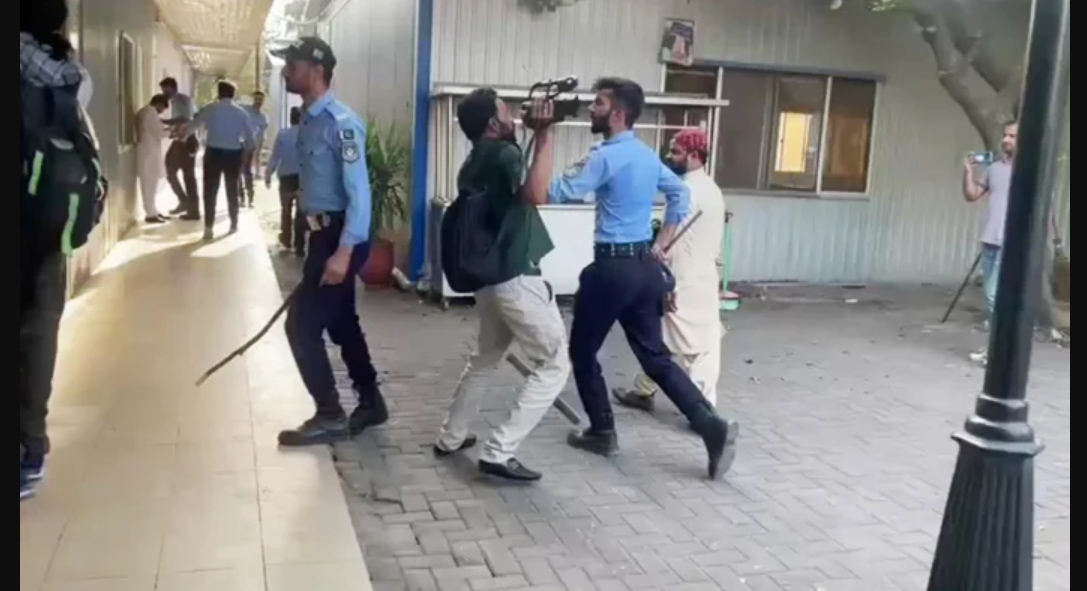

A police raid on the National Press Club in Islamabad has triggered widespread condemnation after journalists were allegedly assaulted and equipment destroyed. Interior Minister Mohsin Naqvi has ordered an inquiry into the incident, which many describe as one of the darkest days for press freedom in Pakistan.
Police Action Inside the Press Club
Eyewitness accounts and videos showed policemen storming the press club, dragging journalists, and attacking them with batons. Several journalists reported broken cameras and mobile phones, while some individuals were detained and later released. The raid took place as members of the Jammu Kashmir Joint Awami Action Committee (JKJAAC) staged a protest at the premises.
According to journalists, the police stormed the cafeteria, breaking doors and damaging property. Journalists were prevented from covering the protest, with several alleging that they were beaten and threatened.
Government Response and Inquiry
Interior Minister Mohsin Naqvi condemned the violence, stating that it could not be tolerated under any circumstances. He demanded a report from the inspector general of police and assured that disciplinary action would be taken against those responsible.
Minister of State for Interior Talal Chaudhry also apologised and called the incident “sudden,” claiming that police were attempting to arrest protesters who had clashed with officers. Information Minister Attaullah Tarar labelled the raid “regrettable” and pledged a comprehensive investigation.
Journalists’ Outcry and National Response
The Pakistan Federal Union of Journalists (PFUJ) strongly condemned the raid. Its president, Afzal Butt, stated that press club officials trying to intervene were beaten and tortured. He announced that a black day would be observed nationwide, with black flags hoisted at press clubs across Pakistan.
Journalists from Rawalpindi, Lahore, Karachi, Peshawar, and Quetta expressed solidarity, warning that if the National Press Club was not safe, then no press club in Pakistan was secure.
Allegations of Media Suppression
Journalist bodies called the raid an attack on freedom of expression and described it as a continuation of government pressure on the media. They criticised recent threatening advertisements targeting journalists as “anti-state” and condemned misuse of cybercrime laws to silence dissent.
Prominent journalists described the incident as reminiscent of repressive eras under past dictatorships. Others called it a direct assault on the “second home” of journalists. Human rights defenders demanded prosecutions of officials, written apologies from ministers, and compensation for damaged property and equipment.
Widespread Condemnation
Human rights organisations, media unions, and political leaders denounced the raid. Activists called the assault shocking and unacceptable, stressing that mere inquiries were not enough. Many argued that the raid was not just an isolated incident but part of a larger pattern of state actions undermining press freedom.
The raid on the National Press Club has become a defining moment in Pakistan’s ongoing debate on media freedom. With journalists demanding accountability, the government faces mounting pressure to take concrete action and ensure such violations are never repeated.
