
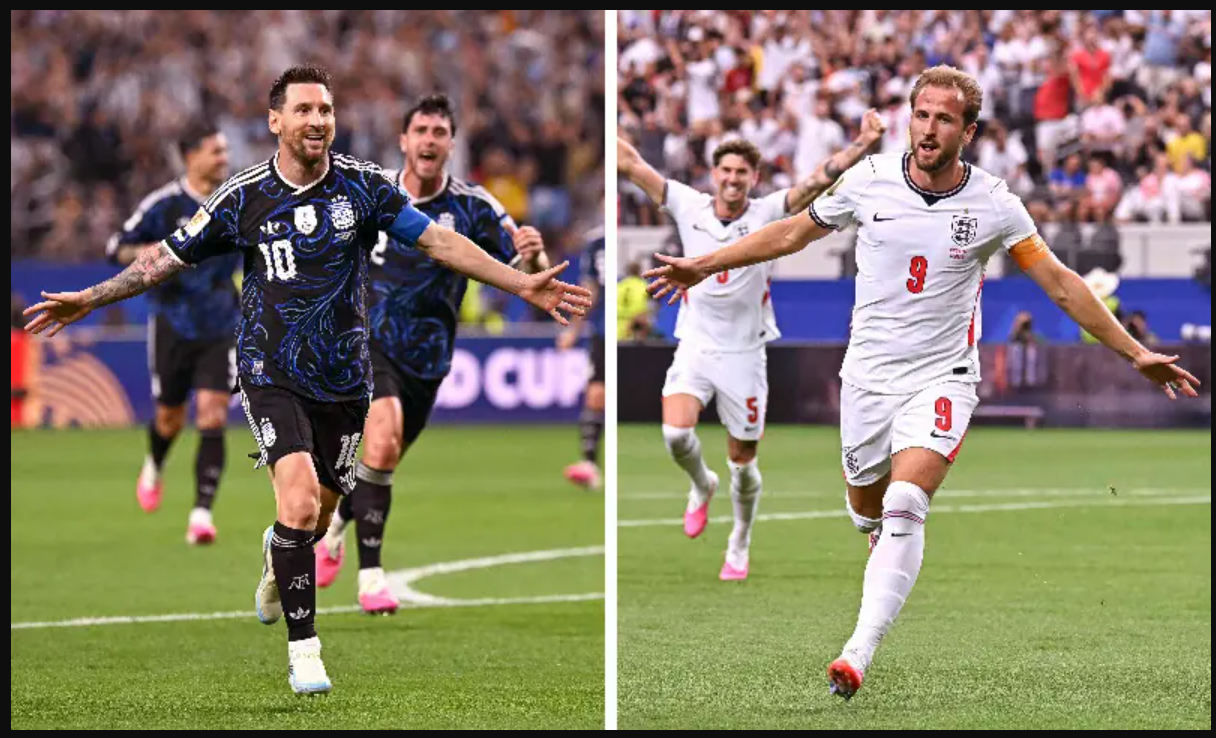

Argentina have reached the FIFA World Cup semi-finals after another impressive campaign led by Lionel Messi. However, alongside their success, online conspiracy theories have intensified ahead of the blockbuster clash with England in Atlanta on Wednesday.
Supporters have praised Argentina’s performances throughout the tournament. Meanwhile, critics have questioned several refereeing decisions and VAR interventions that they believe favoured the defending champions.
At the same time, social media has been flooded with AI-generated images, videos, and memes suggesting that Argentina have received special treatment. Despite the growing online debate, no evidence has been presented to support those claims.
Several controversial moments have nevertheless kept the discussion alive as Argentina prepare for one of their biggest matches of the tournament.
Messi Escapes Red Card Against Algeria
One of the earliest controversies came during Argentina’s group-stage victory over Algeria.
With Argentina leading 1-0, Lionel Messi appeared to rake his studs down the right calf and Achilles tendon of Algeria captain Aissa Mandi during the first half.
Polish referee Szymon Marciniak awarded Algeria a free kick. However, he did not show Messi a card for the challenge.
Messi remained on the pitch and later scored a hat-trick.
The decision quickly divided football analysts.
“It should have been a red card in my opinion,” said former Manchester City defender Nedum Onuoha.
“Messi knew he did something that could have got him in trouble. I personally feel it is a red card.”
Former Bundesliga referee Patrick Ittrich shared the same opinion.
“For me, that is a red card. We have various examples from the Bundesliga where that was punished with a red. By the letter of the law, that is a red. If I had seen it like that on the pitch, I would have shown red.”
Following the match, Algeria’s football federation submitted an official complaint to FIFA over what it described as “refereeing injustice.”
Egypt Questions Key VAR Decisions
Argentina’s dramatic comeback against Egypt in the Round of 16 created another major controversy.
After recovering from a 2-0 deficit, Argentina secured a 3-2 victory to reach the quarter-finals.
However, Egypt strongly disputed several refereeing decisions made during the match.
The biggest debate surrounded a second-half goal scored by Egypt.
The goal was ruled out after the Video Assistant Referee identified a foul against an Argentina player several phases before Mostafa Zico found the net.
The decision immediately sparked criticism from several football experts.
“VAR was looking at something too deeply and looking for something that has happened in the game to try to cancel the Egypt goal,” former FIFA referee Mark Clattenburg said.
Egypt head coach Hossam Hassan also questioned another key decision.
He argued that his team should have received a penalty before Enzo Fernandez scored Argentina’s winning goal.
“There seems to have been pressure on the Argentinian side on the referee that has brought about this outcome,” Hassan said.
“Perhaps they wanted to keep the world champions in the competition?”
“Perhaps they wanted Messi to stay in the running? In football, there are sometimes external factors that go beyond the technical aspects.”
Despite those claims, FIFA referees’ chief Pierluigi Collina dismissed the allegations as “unfounded.”
Another VAR Decision Shapes Quarter-Final
Further debate followed Argentina’s 3-1 extra-time victory over Switzerland in the quarter-finals.
During the second half, referee Joao Pinheiro initially showed Argentina midfielder Leandro Paredes a yellow card following a challenge on Breel Embolo.
However, VAR reviewed the incident using FIFA’s mistaken identity rule.
Officials concluded that Embolo had initiated the contact through simulation.
As a result, the original decision was overturned.
Since Embolo had already received a yellow card, he was shown a second yellow followed by a red card.
Switzerland finished the match with ten players before Argentina eventually secured victory in extra time.
Swiss coach Murat Yakin criticised the outcome after the match.
“We were punished because of a rule that, in my opinion, is completely unacceptable.”
Others defended the decision, arguing that Embolo had committed a clear dive and that the rules had been applied correctly.
Questions Over Argentina’s Route to the Semi-Finals
Another topic generating discussion involves Argentina’s path to the semi-finals.
Some critics argue that the defending champions benefited from facing lower-ranked opponents throughout the tournament.
Argentina advanced from a group containing Algeria, Jordan and Austria.
Later, they defeated Cape Verde, Egypt and Switzerland during the knockout stages.
None of those opponents were ranked higher than 19th in the world before the tournament.
However, the draw resulted from FIFA’s tournament seeding system, which separated the world’s top-ranked teams until the later rounds.
England have also avoided facing a top-10 ranked nation before the semi-finals.
Meanwhile, France faced seventh-ranked Morocco in the quarter-finals.
Spain encountered arguably the toughest route after defeating fifth-ranked Portugal and ninth-ranked Belgium to reach the final four.
As Argentina prepare to face England, discussions surrounding refereeing decisions, VAR interventions and tournament scheduling continue to dominate online debate. Nevertheless, no official findings have supported claims that the defending champions have received preferential treatment during their journey to the World Cup semi-finals.

