
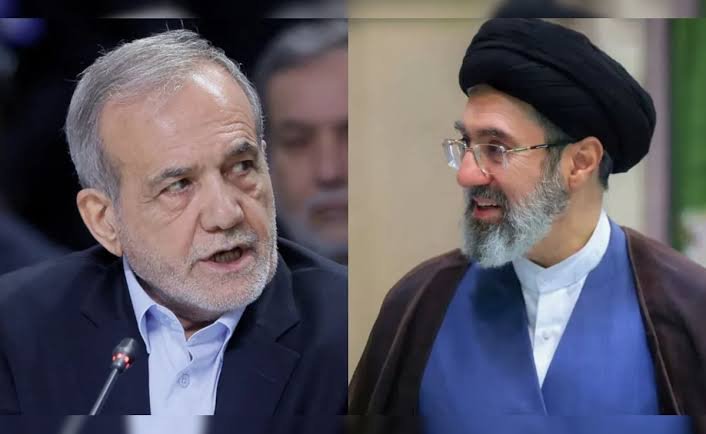

Rare Talks Focus on Military and Economic Challenges
Iranian President Masoud Pezeshkian has held a rare meeting with Supreme Leader Ayatollah Mojtaba Khamenei as Tehran faces mounting military, economic and diplomatic pressures.
Iranian state media confirmed the meeting on Sunday, saying it took place around the beginning of Pezeshkian’s third year as president in late July.
The meeting attracted particular attention because Khamenei has maintained an extremely low public profile since becoming Iran’s supreme leader in March 2026.
According to Khamenei’s office, the two leaders discussed Iran’s domestic problems and the country’s future in detail.
Their talks covered the ongoing military situation, economic pressures and measures aimed at improving living conditions.
They also discussed government spending, securing financial resources and managing Iran’s currency and energy consumption.
Economic relations with foreign countries were another major subject during the meeting.
The discussions come as Iran continues to face the consequences of its conflict with the United States and Israel.
The war began with US-Israeli strikes on February 28.
The attacks killed Iran’s longtime supreme leader Ayatollah Ali Khamenei, who was Mojtaba Khamenei’s father and predecessor.
Mojtaba Khamenei was selected as Iran’s new supreme leader on March 8.
He has since issued written statements but has largely remained outside public view.
Khamenei’s Health and Public Absence Fuel Questions
Questions surrounding the supreme leader’s health have intensified because of his limited visibility.
Reuters reported that Mojtaba Khamenei suffered serious facial and leg injuries in the February 28 attack that killed his father.
Sources familiar with his inner circle previously said health and security concerns were among the reasons for his absence from public appearances.
Pezeshkian has also offered changing descriptions of his access to the supreme leader.
On July 21, the Iranian president said interaction with Khamenei was increasing each day.
However, in early August he described communication with him as “very difficult.”
State media had previously reported another meeting between Pezeshkian and Khamenei in May.
That was described at the time as the first publicly reported meeting between the two since Mojtaba Khamenei assumed Iran’s highest political and religious position.
Iranian media also released an undated video over the weekend that appeared to show Khamenei speaking with several people.
However, the footage did not establish when or where the meeting shown in the video took place.
The uncertainty has kept attention focused on how actively Khamenei is currently involved in Iran’s decision-making process.
Iran Promises More Images as Leadership Faces Critical Decisions
Iranian authorities have indicated that additional footage of the supreme leader could be released.
Basij Organisation deputy Qasem Qoraishi said images and documentation showing Khamenei among the public and meeting armed forces commanders would be published in the future.
His comments appeared aimed at responding to speculation surrounding the supreme leader’s health and prolonged absence from public events.
The rare meeting also comes at a sensitive moment for Iranian foreign policy.
Tehran has been involved in indirect diplomatic efforts concerning the continuing conflict and the future of the Strait of Hormuz.
Iran and Oman have also been negotiating navigation arrangements for the strategic waterway, although Tehran has said a deal with Oman would not automatically result in the strait fully reopening.
At the same time, Iran continues to deal with severe economic pressures caused by war, sanctions, energy challenges and disruptions to international trade.
These pressures help explain why economic management and foreign economic relations featured prominently in the meeting between Pezeshkian and Khamenei.
Despite Pezeshkian holding the presidency, Iran’s supreme leader remains the country’s highest authority and has the final say on major security, military and foreign policy decisions.
Khamenei’s limited public visibility has therefore become politically significant as Iran navigates war, economic pressure and difficult negotiations with foreign powers.
The latest meeting suggests communication between Iran’s president and supreme leader is continuing, even as questions remain over Khamenei’s health, public role and level of direct involvement in government affairs.

