

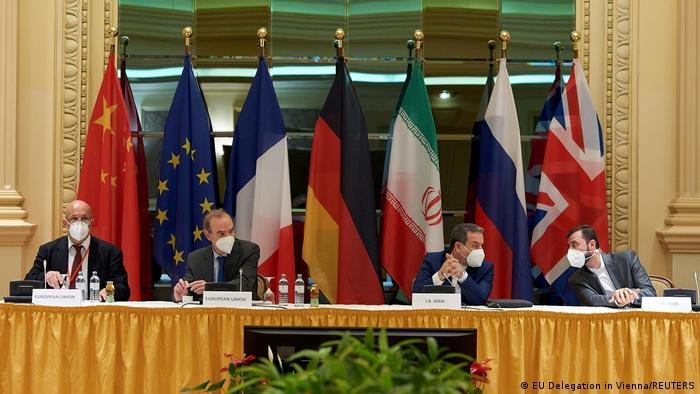

VIENNA/JEDDAH: Iran has demanded that world powers must allow it to sell oil on international markets to replenish its dwindling foreign currency reserves, as talks resumed in Vienna aimed at reviving the 2015 deal to curb Tehran’s nuclear program.
Indirect talks between Iran and the US also resumed, with Tehran focused on one side of the original bargain, lifting sanctions against it, despite scant progress on reining in its atomic activities.
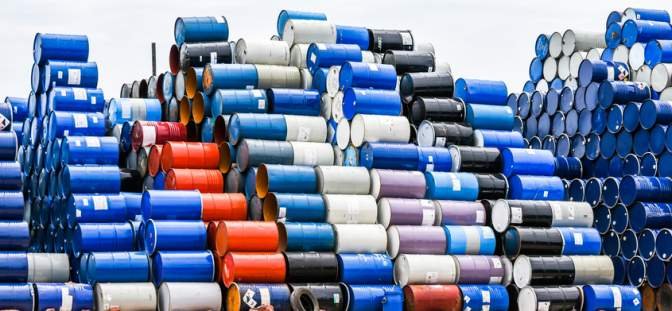
Iranian oil sales have plummeted from about 2.8 million barrels per day to as low as 200,000 since 2018, when the US withdrew from the 2015 deal, the Joint Comprehensive Plan of Action, and Donald Trump reimposed crippling economic sanctions. Any country or company doing business with Iran risks being frozen out of the international finance system.
Since the US pulled out, Iran has increased enrichment of fissile uranium to levels banned by the agreement. The UN’s nuclear watchdog, the International Atomic Energy Agency, has expressed concerns over Iran’s growing stockpile of highly enriched uranium.

Iran’s demand
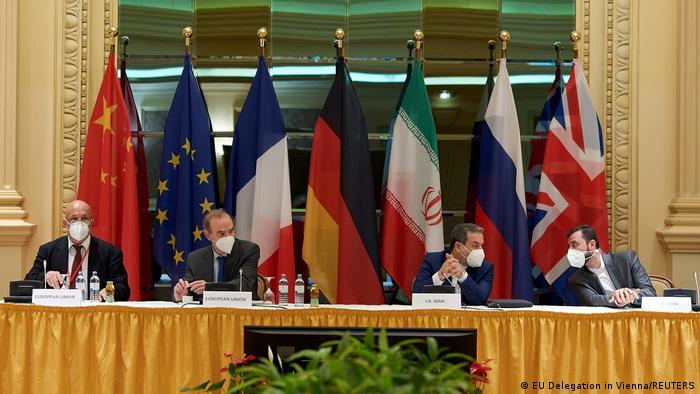
The eighth round of the talks, which began Monday, involves delegations from Iran and the other countries that remain party to the deal — Britain, China, France, Germany and Russia.
Ahead of the resumption, Iran’s Foreign Minister Hossein Amir-Abdollahian said the agenda should be “the issue of guarantees and verification” on the lifting of US sanctions.
“The most important issue for us is to reach a point where, firstly, Iranian oil can be sold easily and without hindrance,” Iranian Foreign Minister Hossein Amirabdollahian said on Monday.
“The money from the oil is to be deposited as foreign currency in Iranian banks, so we can enjoy all the economic benefits stipulated in the JCPOA.
“Today, there is an acceptable joint document on the negotiating table that we call the Dec. 1 and Dec. 15 documents. Our negotiations will start on the basis of this joint document. Guarantees and verification are among the issues on the agenda.”
Iran’s two draft texts, submitted in previous talks, were incorporated in a draft drawn up in June after six rounds of negotiations between the previous Iranian team and major powers.
‘Time running out’
Washington is participating indirectly, with diplomats shuttling back and forth between the Iranian and the US sides.
Iran has reported progress in the talks, but European diplomats have warned they are “rapidly reaching the end of the road.”
US negotiator Rob Malley has said there are only “weeks” left to revive the deal, if Iran continues its current pace of nuclear activities.
EU diplomat Enrique Mora, who is chairing the talks, said all sides were showing “a clear will to work toward the successful end of this negotiation.”
“If we work hard in the days and weeks ahead we should have a positive result…. It’s going to be very difficult, it’s going to be very hard. Difficult political decisions have to be taken both in Tehran and in Washington,” the talks’ coordinator, Mora told a news conference.
He was speaking shortly after a meeting of the remaining parties to the deal — Iran, Russia, China, France, Britain, Germany and the European Union — formally kicked off the round on Monday evening.
“There is a sense of urgency in all delegations that this negotiation has to be finished in a relatively reasonable period of time. Again, I wouldn’t put limits but we are talking about weeks, not about months,” Mora said.
‘No to a nuclear Iran’
Iran’s arch-rival Israel, which staunchly opposes the nuclear deal, had reportedly warned in November that Tehran had taken the technical steps to prepare to enrich uranium to military-grade levels of around 90 percent.
“Stopping Iran’s nuclear program is the primary challenge for Israeli foreign and security policy,” Israel’s Foreign Minister Yair Lapid said on Monday.
“We prefer to act through international cooperation, but if necessary, we will defend ourselves, by ourselves.”
On Saturday, Atomic Energy Organization of Iran director Mohammad Eslami said Tehran has no plans to enrich uranium beyond 60 percent, even if the Vienna talks fail.
Eslami said the enrichment levels were related to the needs of the country, in remarks published by the Russian news agency RIA Novosti.
Mora said he decided to reconvene the talks during many officials’ holidays between Christmas and the New Year so as not to lose time, but he added that talks would stop for three days as of Friday “because the facilities will not be available,” referring to the luxury hotel hosting most meetings. They are expecting to resume Monday next week.
Moscow’s ambassador to the UN in Vienna, Mikhail Ulyanov, said on Twitter that negotiators “held businesslike and result-oriented discussions.”
“In particular they agreed to intensify the drafting process in order to achieve an agreement ASAP,” he said.
