
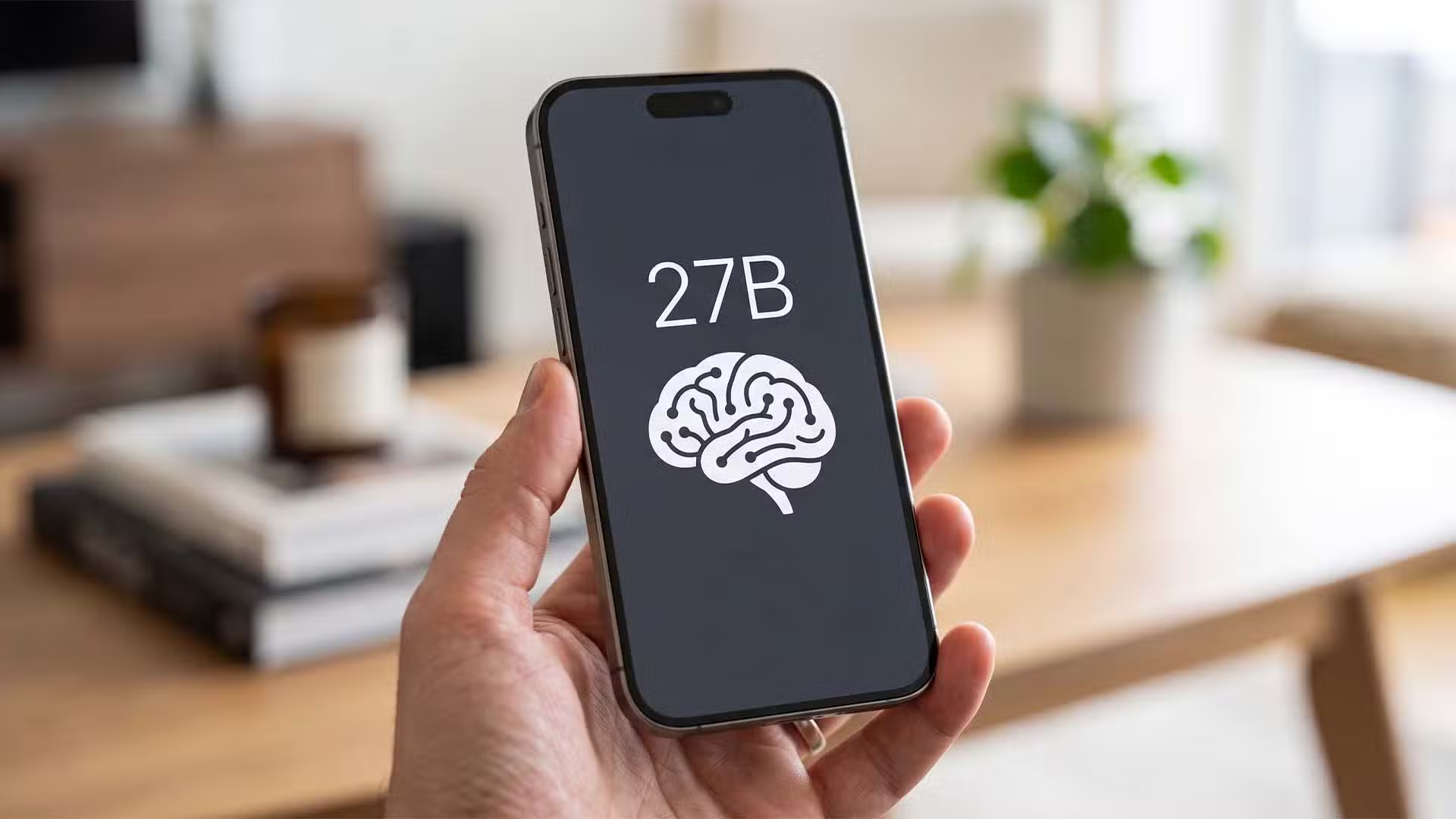

Apple’s iPhone 18 Pro has demonstrated a significant improvement in on-device artificial intelligence performance, running a 27-billion-parameter AI model at roughly twice the speed reported for the iPhone 17 Pro.
Developer Adrien Grondin demonstrated the Bonsai 27B model operating directly on an iPhone 18 Pro, with the test showing faster token generation than on the previous-generation device.
The performance increase comes alongside Apple’s A20 Pro chip, which features a dual-16-core Neural Engine, and faster memory in the iPhone 18 Pro and Pro Max.
A20 Pro and Faster Memory Boost Local AI
Both Pro models feature 12GB of 96-bit LPDDR5X memory and offer 115.2GB/s of unified memory bandwidth, according to the supplied report.
Consequently, the combination provides more bandwidth for AI workloads running locally without relying on an internet connection or cloud-based processing.
The report also said the Neural Engine can exceed the A20 Pro’s seven-core GPU in peak throughput for workloads specifically optimised for the neural processing unit.
However, performance depends heavily on how efficiently developers compress and configure individual AI models.
Memory Remains Key Limitation for Larger Models
The original Bonsai model demonstrated on the iPhone uses 1-bit quantisation, significantly reducing its memory requirements. According to the report, it can operate on devices with as little as 4GB of RAM.
By comparison, the newer Bonsai 2 reportedly cannot run comfortably on the iPhone 18 Pro using 2-bit quantisation because its memory requirements exceed what the device can efficiently accommodate.
Therefore, despite major gains in processing performance, the iPhone 18 Pro’s 12GB memory remains a limiting factor for larger models.
The demonstration nevertheless shows how faster memory and dedicated neural hardware can expand smartphone-based AI capabilities while keeping model processing entirely on the device.

