

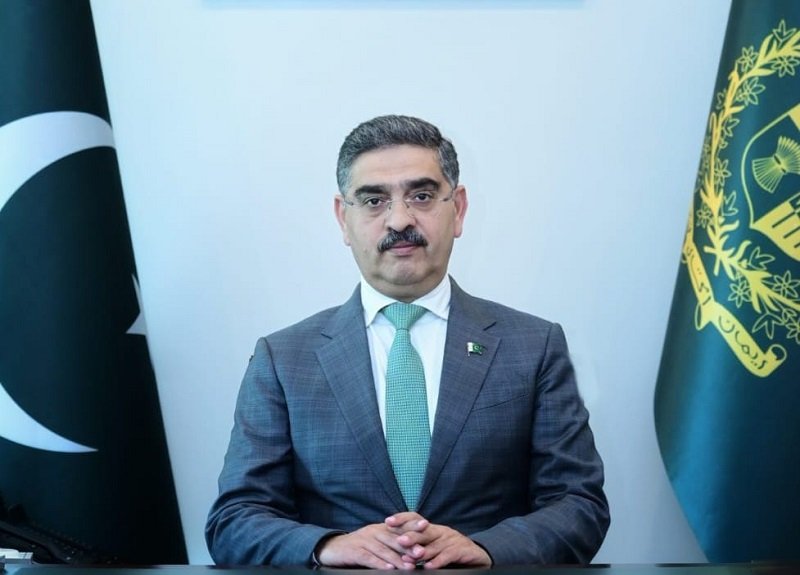

ISLAMABAD: At the 78th session of the United Nations General Assembly (UNGA), Caretaker Prime Minister Anwaar-ul-Haq Kakar delivered a noteworthy address, addressing several vital global issues.
In his debut UNGA address, PM Kakar underscored the UN Security Council’s role in enforcing Kashmir resolutions for peace between Pakistan and India. He criticized India for non-compliance with UN resolutions on Kashmir, including a supervised plebiscite.
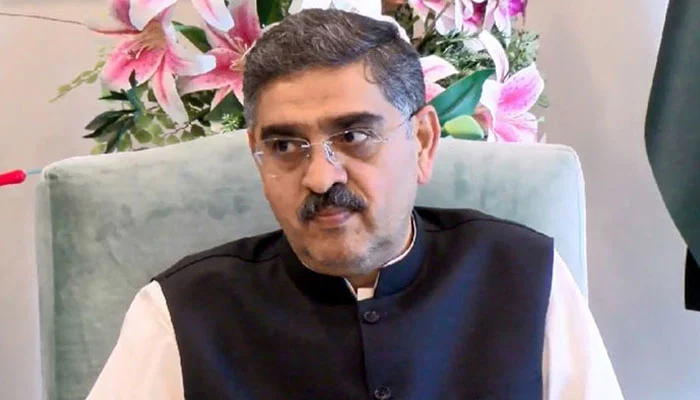
He covered various topics, including cross-border terrorism from Afghanistan, the Palestinian issue, threats from far-right extremist groups like Hindutva-inspired extremists, global economic challenges due to COVID-19, conflict, and climate change, and Pakistan’s efforts on Sustainable Development Goals (SDGs) and economic challenges.
PM Kakar stressed peace for development and peaceful relations with neighbors. He highlighted the dire situation in Kashmir, India’s actions, and human rights abuses. Kakar noted the global presence of extremist groups, emphasizing the threat from RSS terrorists, TTP, and ISIS from Afghanistan.
He also called for stronger support for UNMOGIP and urged India to accept mutual restraint on strategic and conventional weapons. He expressed concern for Afghanistan, advocating for counterterrorism and humanitarian assistance.
Interim PM Kakar’s UNGA Priorities
Regarding Pakistan’s economic recovery, he mentioned the Special Investment Facilitation Council (SIFC) and the second phase of CPEC.
Furthermore, he called for SDG implementation, reallocation of unused SDRs for development, increased concessional lending, and resolving debt issues in 59 debt-distressed countries.
Kakar stressed Pakistan’s climate vulnerability and urged developed nations to fulfill COP28 commitments, provide over $100 billion in annual climate finance, allocate to adaptation, and accelerate carbon emission targets.
He welcomed Saudi-Iranian normalization but expressed concern for the Palestinian issue, reiterating support for a two-state solution.
Moreover, PM Kakar emphasized countering all forms of terrorism, respecting diversity, religious symbols, and sanctity.
Regarding UNSC reform, he advocated for non-permanent category expansion with longer-term seats to maintain Council credibility and legitimacy, rather than adding permanent members.
