

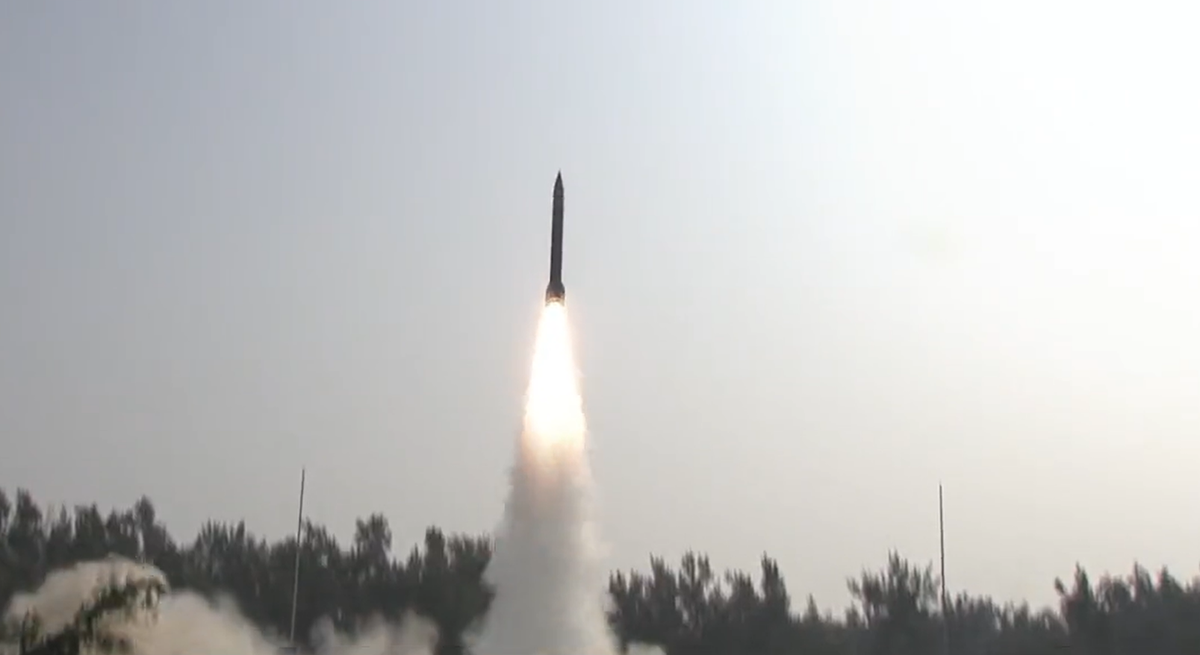

In a development likely to inflame regional security tensions, India has recently conducted multiple tests of its Pralay missile, a short-range surface-to-surface ballistic weapon, from the Dr APJ Abdul Kalam Island located off the coast of Odisha.
Security sources in Pakistan have strongly criticized the move, describing it as a calculated step toward triggering an arms race in South Asia and laying the groundwork for potential military escalation.
According to these sources, the missile tests carried out on July 28 and July 29 were not just routine technical evaluations, but part of a broader and more concerning strategy. They warned that India’s growing missile arsenal and its efforts to establish a separate Integrated Rocket Force (IRF)—independent of its existing Strategic Forces Command—pose a significant threat to the fragile strategic balance in the region.
India’s Defence Research and Development Organisation (DRDO), through a statement by the Press Information Bureau (PIB), confirmed the testing, stating that the trials were part of a “User Evaluation Trial” to assess the missile’s maximum and minimum range capabilities.
The Pralay missile, powered by a solid-fuel propellant, is designed to carry various types of conventional warheads and has a quasi-ballistic trajectory, making it harder to intercept.
In response to the perceived threat, Pakistani security sources pointed to the country’s own tactical ballistic missile system, the Nasr (Hatf-IX), which is reportedly capable of carrying a nuclear warhead. The Nasr system, they noted, has been developed specifically to counter threats like the Pralay and is optimized for battlefield deterrence and survivability in case of a first strike.
These missile tests follow closely on the heels of a recent four-day military confrontation between India and Pakistan, during which Pakistan reportedly launched Operation Bunyan-um-Marsoos, hitting multiple Indian military installations and downing several aircraft. That conflict itself was sparked by a terror attack in Indian Illegally Occupied Jammu and Kashmir’s (IIOJK) Pahalgam region, where 26 Indian tourists were killed.
The timing of India’s missile trials, so soon after these hostilities, has raised alarm in Islamabad. Analysts warn that the move could be interpreted as an act of escalation rather than deterrence, especially considering India’s growing interest in modernizing and expanding its missile capabilities outside traditional strategic command structures.
With both countries possessing nuclear arsenals and a history of military confrontations, these developments add yet another layer of volatility to an already tense region.
Strategic experts have urged both sides to exercise restraint and pursue dialogue rather than continuing down a path that could lead to further instability.
