
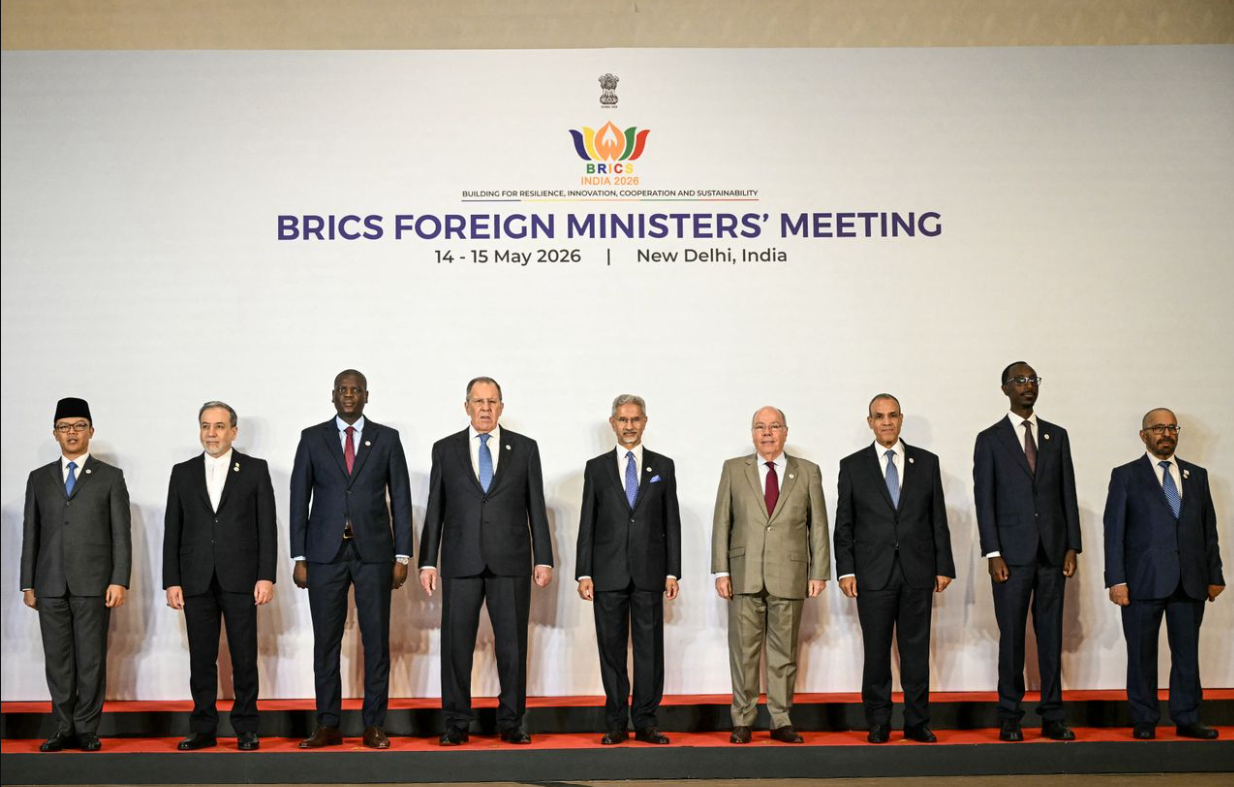

India has avoided directly condemning the United States and Israel during a BRICS foreign ministers’ meeting, even as the ongoing war involving Iran continues to dominate discussions on global energy security and maritime stability.
The meeting in New Delhi brought together senior diplomats from member states, with the conflict in West Asia emerging as one of the central issues.
India Highlights Importance of Maritime Stability
Indian Foreign Minister Subrahmanyam Jaishankar emphasized the importance of safe and uninterrupted maritime trade routes for global economic stability.
Speaking at the BRICS foreign ministers’ meeting, he said that the situation in West Asia required urgent attention, while carefully avoiding direct reference to the United States or Israel.
“The conflict in West Asia merits particular attention,” he said, adding that uninterrupted maritime flows through key waterways, including the Strait of Hormuz, are essential for global economic well-being.
He further stated that safe and unimpeded maritime routes, including those through the Strait of Hormuz and the Red Sea, remain critical for international trade and energy supply chains.
Iran Warns Against Military Solutions
Iran’s Foreign Minister Abbas Araghchi also addressed the BRICS meeting, delivering a strong message on the ongoing conflict.
He stated that there is no military solution to the crisis and that Tehran will not surrender under pressure or threats.
Araghchi said Iran has faced repeated “brutal and illegal aggression” over the past year and insisted that Tehran remains the affected party in the conflict.
“In this shameful situation, we are not the aggressors, but rather the wronged and violated party,” he said, calling on BRICS members to respond to what he described as violations of international norms.
Energy Markets Under Pressure from Strait of Hormuz Disruption
The conflict has severely disrupted global energy markets, particularly due to reduced shipping through the Strait of Hormuz.
The waterway, one of the world’s most important oil transit routes, has seen a sharp decline in tanker movement, creating supply concerns across global markets.
As a result, energy prices have surged, raising fears of inflation and broader economic slowdown across both developing and developed economies.
India Balances Diplomatic Positions
India has taken a cautious diplomatic position throughout the conflict, maintaining relations with both Iran and Israel while avoiding direct criticism of either side.
Officials have highlighted India’s strategic interest in regional stability, especially due to its dependence on energy imports passing through the Strait of Hormuz.
New Delhi has also stressed the importance of dialogue and diplomatic engagement over confrontation, particularly in multilateral platforms such as BRICS.
BRICS Struggles to Reach Consensus
The BRICS group, which includes Brazil, Russia, India, China, and several newer members, has faced challenges in forming a unified position on the conflict.
Differences among member states have made it difficult to agree on a joint statement, especially given the opposing alignments of some countries involved in the West Asia crisis.
India currently holds the BRICS chair for 2026, adding further responsibility to manage internal divisions within the bloc.
Calls for Dialogue and Multilateral Cooperation
During the meeting, Jaishankar also criticized the growing use of unilateral sanctions and coercive economic measures, arguing that such actions undermine international law.
He stated that “such measures disproportionately affect developing countries,” and emphasized that pressure cannot replace diplomacy.
He added that BRICS should play a stabilizing role and support constructive engagement rather than escalation.
Outlook for BRICS and Regional Stability
The ongoing conflict has exposed divisions within BRICS while highlighting the group’s limited ability to address high-intensity geopolitical crises.
At the same time, the economic impact of disrupted energy flows continues to pressure global markets, making maritime security a central concern.
For now, India’s balancing approach reflects its broader strategy of maintaining strategic autonomy while protecting economic and energy interests in an increasingly unstable global environment.

