

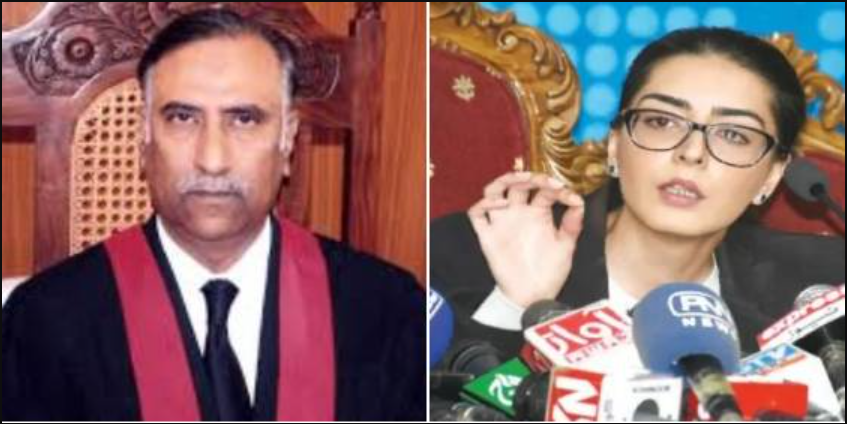

Islamabad High Court (IHC) Chief Justice Sardar Muhammad Sarfraz Dogar has clarified his recent remarks made during an exchange with prominent lawyer and human rights advocate Imaan Zainab Mazari-Hazir. He stated that his words were “presented out of context” and misunderstood, which led to controversy.
The exchange took place during the hearing of a plea seeking the removal of rights activist Mahrang Baloch’s name from the Exit Control List (ECL). During proceedings, Justice Dogar had warned Mazari of contempt of court for allegedly calling him a “dictator.”
The matter resurfaced when another case was heard the following day. Justice Dogar explained that Mazari was “just like a daughter” to him and insisted that he had only been trying to make her understand his perspective. He further said that his words were misrepresented, which fueled unnecessary controversy.
Justice Dogar Explains His Remarks
Justice Dogar maintained that Mazari was free to disagree with his rulings but should avoid personal criticism. Reports also claimed that he told Mazari’s husband, lawyer Hadi Ali Chatha, to “make her understand” or else he might “get hold of her someday.”
However, the Chief Justice denied using such language. He clarified that what he had actually said was that if contempt of court proceedings were initiated, her career could be affected. He emphasized that he had only asked her husband to take her away to avoid escalation.
Reiterating his stance, Justice Dogar said he was explaining matters to her as he would to a child. He expressed frustration that she continued to insist on fundamental rights, asking whether the court itself did not also have fundamental rights.
Imaan Mazari Responds
Imaan Mazari, who is widely recognized for her outspoken views, responded strongly on social media. She stated that in the courtroom she is not an activist but a lawyer representing her client, and that professional respect must be upheld.
She argued that the case of Mahrang Baloch should not suffer due to personal differences between a judge and a lawyer. Following Justice Dogar’s clarification, Mazari again criticized him, calling his remarks sexist and accusing him of harassment inside the courtroom. She stated clearly that she was neither his daughter nor a child but a professional lawyer.
Mazari also thanked the Lahore High Court Bar Association (LHCBA) for condemning the exchange. Sharing their statement, she said Justice Dogar was “not fit to be a judge.”
Condemnations From Legal Community
The LHCBA issued a strong statement condemning Justice Dogar’s behavior. The body stressed that lawyers are officers of the court and their dignity must be respected just like that of judges. The statement also termed his conduct “dictatorial” and a violation of judicial ethics. It urged the Supreme Judicial Council to remove Justice Dogar from his post.
In addition, several female lawyers signed a joint condemnation. Their statement described the remarks as sexist, threatening, and unbecoming of a judge. They stressed that contempt laws should protect the administration of justice, not serve as tools for intimidating lawyers.
Growing Debate Over Judicial Conduct
The incident has sparked a wider debate about judicial conduct, respect for lawyers, and gender sensitivity in Pakistan’s courts. Critics argue that such exchanges undermine confidence in judicial proceedings and perpetuate patriarchal attitudes.
Supporters of Mazari insist that professional boundaries must be respected regardless of personal disagreements. The controversy highlights the urgent need for reforms that safeguard both judicial independence and the dignity of legal practitioners.
